

UGC examples range from customer reviews and unboxing clips to paid creator videos that brands run as ads. The 10 most useful UGC video formats are problem and solution, honest review, unboxing, demo, before and after, day in the life, three reasons, comparison, street interview and routine. Below, each one is shown as an annotated storyboard, followed by famous brand UGC campaigns and how to find live UGC ads to study.
This guide is for creators building a portfolio and for brands writing briefs. The storyboards are illustrations we made for made-up products, not other people's videos, so you can see the structure clearly. For real examples, we link to the brands' own pages and show you where to find live ads.
What counts as UGC?
UGC is user-generated content: photos, videos and reviews made by people outside the brand. Some is organic, posted by customers on their own. Some is creator-made, filmed by paid UGC creators in the same natural style and used in ads and on product pages. Our guide to what UGC is and what a UGC creator does explains the difference. Most of this page is about creator-made UGC videos, because that's what most people mean when they ask for UGC examples for ads.
The anatomy of a UGC video ad
Almost every format below shares the same spine: a hook, the product early, some proof and a clear next step.
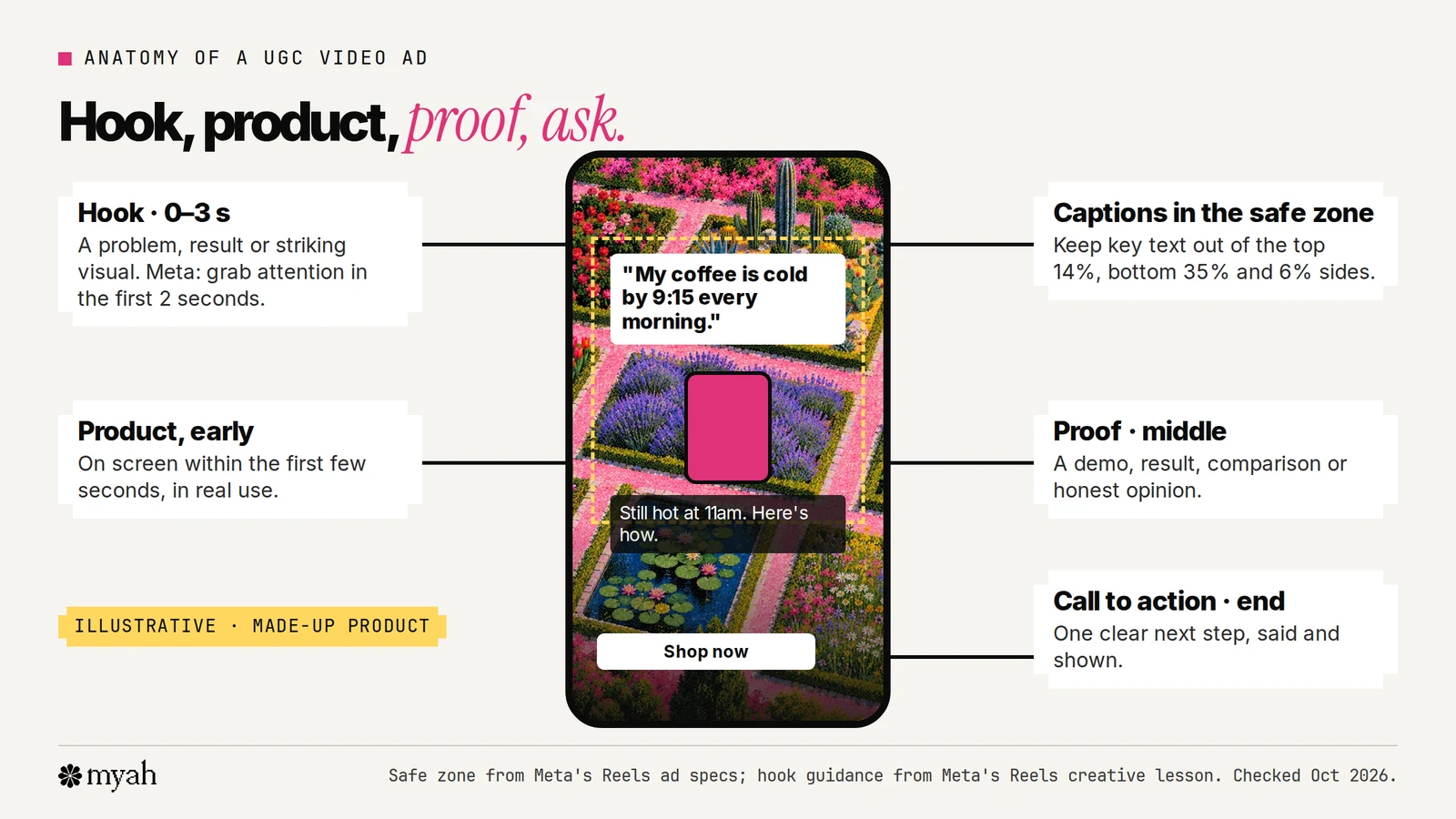
- Hook (first 1 to 3 seconds): a problem, a result or a striking visual that earns the next few seconds. Meta's own guidance for Reels is to grab attention in the first 2 seconds with a bold visual or unexpected moment. Measure it with hook rate.
- Product early: the viewer should know what's being shown within the first few seconds.
- Proof: a demo, a result, a comparison or an honest opinion.
- Call to action: what to do next, said plainly.
- Captions inside the safe zone: Meta suggests leaving the top 14%, bottom 35% and 6% on each side clear of key text. Our Reels safe zone template marks it for you.
10 UGC video examples, by format
Each example below has what it looks like, why it works, a timing structure for a 30-second video, an example hook line and when to use it. For full fill-in scripts, see our UGC script template.
1. Problem and solution
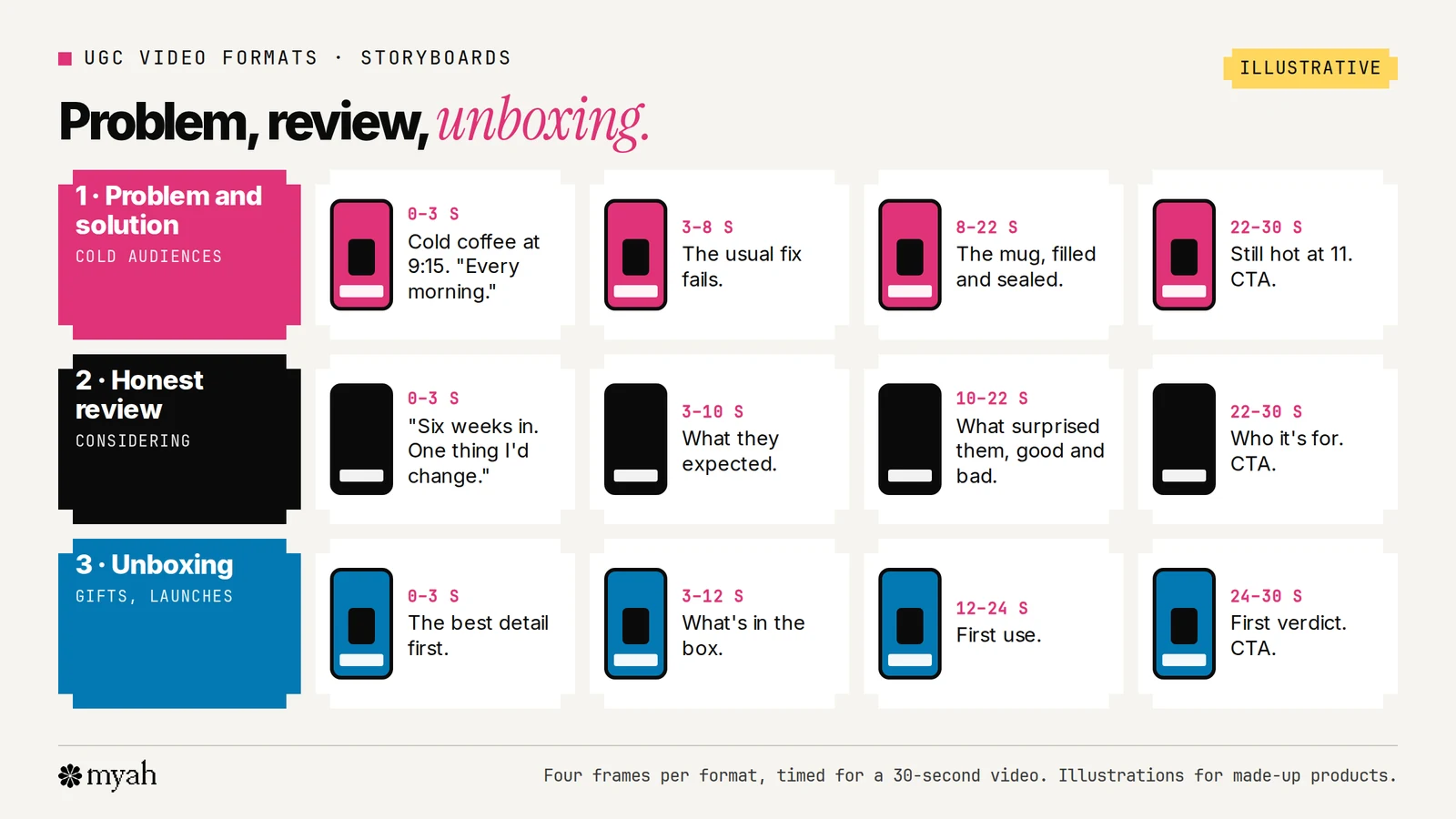
- What it looks like: the creator shows an everyday annoyance, why the usual fix fails, then the product fixing it.
- Why it works: viewers who have the problem recognise it in the first seconds, so the hook selects the right audience.
- Structure: 0–3 s problem · 3–8 s failed fix · 8–22 s product doing the job · 22–27 s result · 27–30 s CTA.
- Example hook: "My coffee is cold by 9:15 every single morning." (a made-up travel mug)
- Use it for: cold audiences who don't know the brand yet.
2. Honest review (testimonial style)
- What it looks like: the creator talks to camera about what they expected, what surprised them and who the product is for, including a downside.
- Why it works: a balanced opinion reads as a recommendation from a person rather than an ad.
- Structure: 0–3 s verdict or time used · 3–10 s what they expected · 10–22 s what surprised them · 22–27 s who it's for · 27–30 s CTA.
- Example hook: "I've used this for six weeks. Here's the one thing I'd change." (a made-up running shoe)
- Use it for: people who are considering the product and need trust.
- Watch out: the creator has to have actually used it for that long. In the US, the FTC's rule on reviews and testimonials bans testimonials that misrepresent someone's experience.
3. Unboxing and first impressions
- What it looks like: the box arrives, the creator opens it, reacts to the details and tries the product for the first time.
- Why it works: it answers "what do I actually get?" and shows packaging and quality before purchase.
- Structure: 0–3 s the box or the best detail · 3–12 s what's inside · 12–24 s first use · 24–30 s first verdict and CTA.
- Example hook: "Okay, nobody told me it comes with this." (a made-up skincare set)
- Use it for: giftable products, premium packaging and product launches.
4. Demo or tutorial
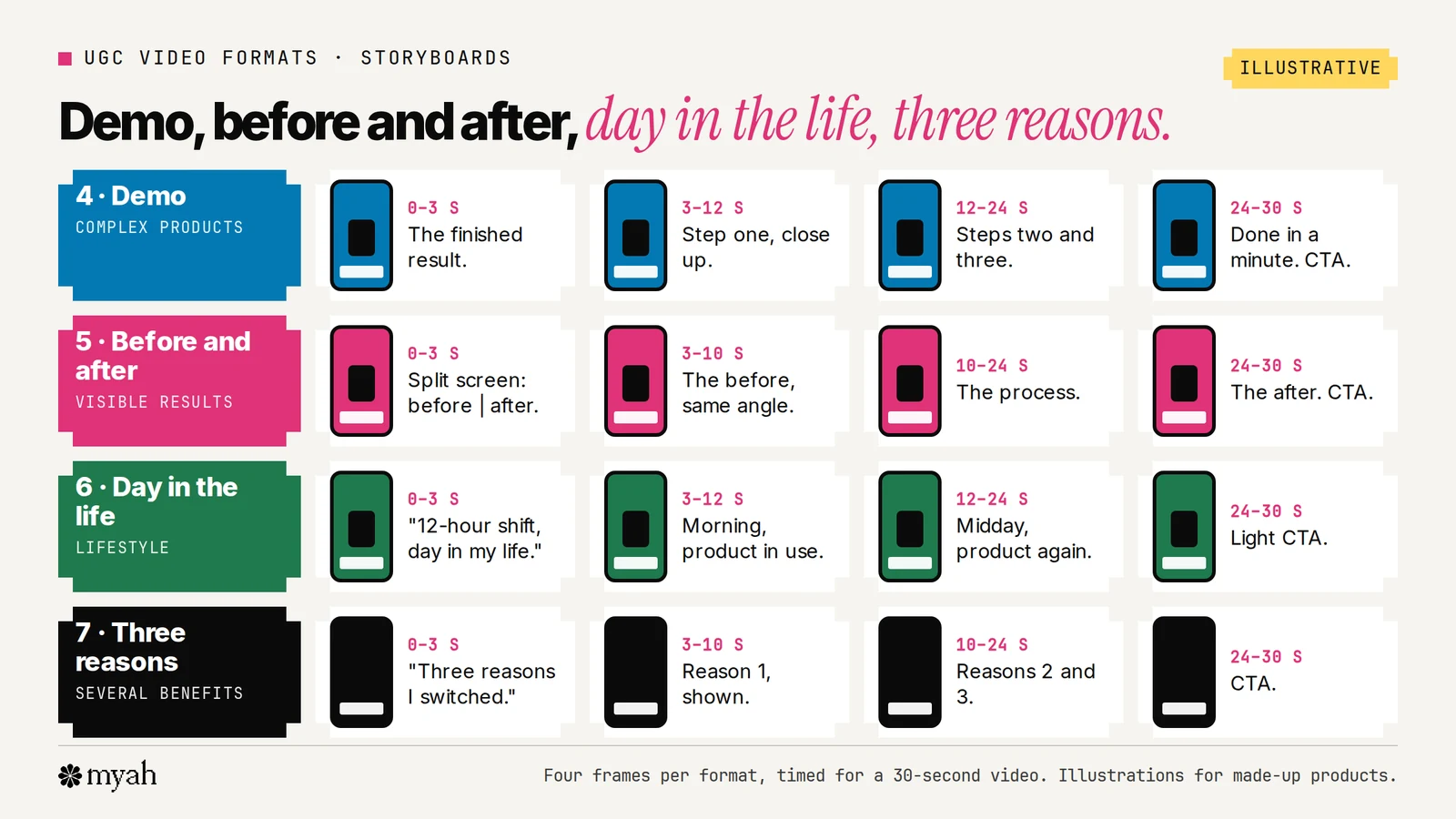
- What it looks like: the creator shows exactly how the product works, step by step, close up.
- Why it works: it removes doubt about whether the product is easy to use, and the hands-on shots double as product page content.
- Structure: 0–3 s the end result or the hardest step · 3–24 s steps one by one · 24–30 s result and CTA.
- Example hook: "Here's how to set this up in under a minute." (a made-up smart plug)
- Use it for: products that look complicated, and for product pages.
5. Before and after
- What it looks like: a matched before shot, the process and a matched after shot, same angle and light.
- Why it works: the result is visible rather than claimed.
- Structure: 0–3 s the after (or a split screen) · 3–10 s the before · 10–24 s the process · 24–30 s the after and CTA.
- Example hook: "Same couch. Ten minutes apart." (a made-up upholstery cleaner)
- Use it for: cleaning, home, car and organisation products.
- Watch out: Meta's health and wellness ad policy restricts weight-loss and cosmetic ads, including statements of inferiority about someone's appearance. Check the rules before you film body or skin results.
6. Day in the life
- What it looks like: quick clips of the creator's day, with the product appearing naturally where it's used.
- Why it works: it feels like organic content, and shows the product in context instead of selling it.
- Structure: 0–3 s an intriguing moment · 3–25 s the day, with the product in two or three scenes · 25–30 s a light CTA.
- Example hook: "Day in my life as a nurse on a 12-hour shift." (a made-up compression sock)
- Use it for: lifestyle products and audiences who scroll past obvious ads.
7. Three reasons why
- What it looks like: "Three reasons I switched to…" with each reason shown, counted on screen.
- Why it works: a numbered list sets an expectation, so people stay to hear all three.
- Structure: 0–3 s the claim and "three reasons" · 3–10 s reason one · 10–17 s reason two · 17–24 s reason three · 24–30 s CTA.
- Example hook: "Three reasons this replaced my whole bathroom shelf." (a made-up multi-use balm)
- Use it for: products with several distinct benefits.
8. Comparison (this vs that)
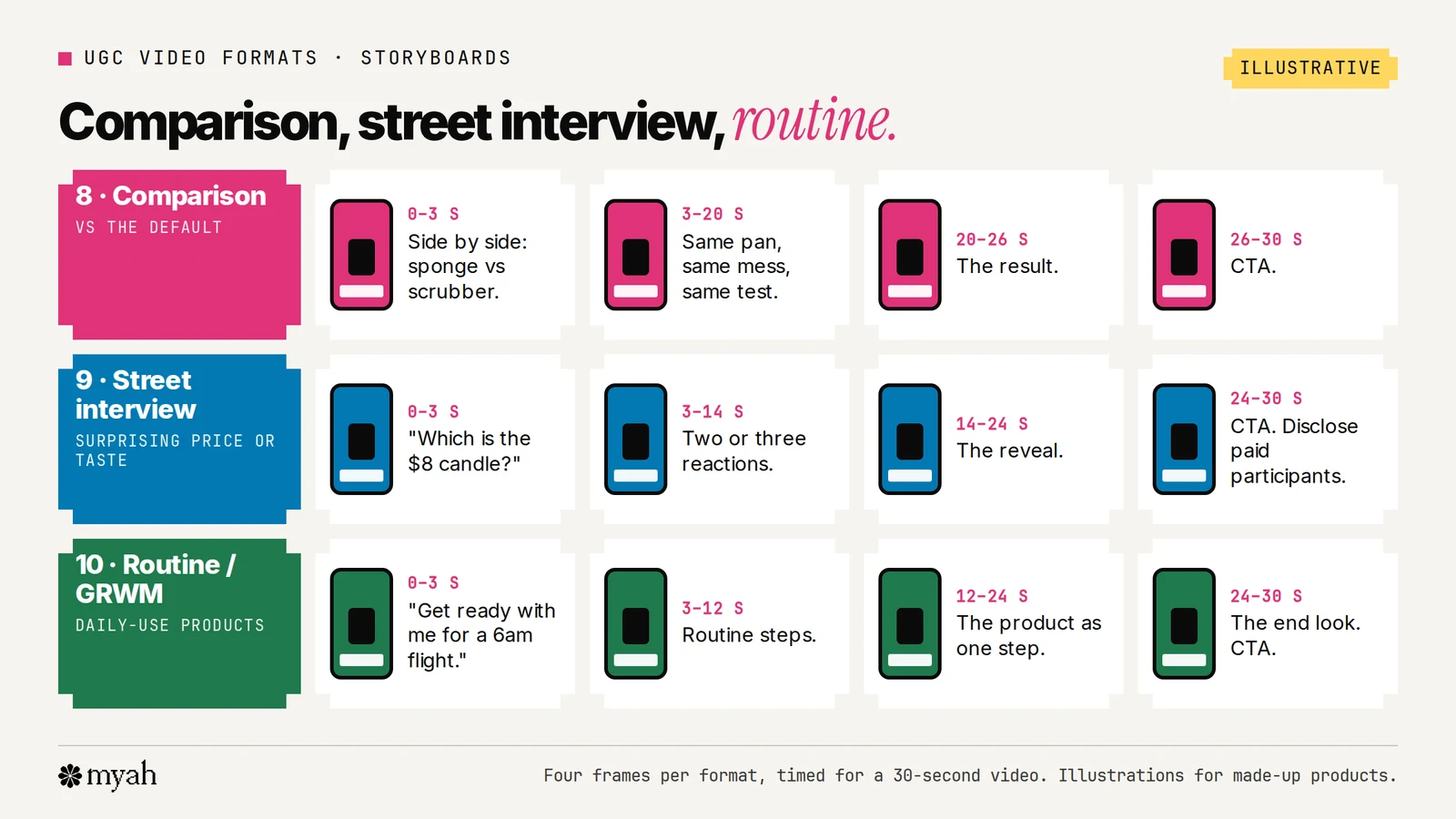
- What it looks like: the product side by side with the usual alternative, tested the same way.
- Why it works: it answers "why not just use what I already have?"
- Structure: 0–3 s the side-by-side · 3–20 s the same test on both · 20–26 s the result · 26–30 s CTA.
- Example hook: "Regular sponge vs this. Same pan, same mess." (a made-up silicone scrubber)
- Use it for: people comparing options, and categories with a familiar default.
- Watch out: don't name or mock a competitor without proof, and make the test fair. Every claim in the video needs to be one the brand can back up.
9. Street interview style
- What it looks like: a creator with a microphone asks people a question, then hands them the product to try.
- Why it works: reactions from several people feel like social proof, and the question format is a natural hook.
- Structure: 0–3 s the question · 3–20 s two or three reactions · 20–27 s the reveal · 27–30 s CTA.
- Example hook: "Can you tell which one is the $8 candle?" (a made-up candle brand)
- Use it for: products with a surprising price, taste or result.
- Watch out: if the "strangers" are paid creators or friends, don't present them as random customers. The FTC's Endorsement Guides say unexpected connections should be disclosed.
10. Routine or "get ready with me"
- What it looks like: the creator walks through a routine, such as morning skincare or a workout, with the product as one step.
- Why it works: routines are content people already watch, and the product appears as part of real use.
- Structure: 0–3 s the end look or a relatable line · 3–24 s the routine, with the product in one or two steps · 24–30 s CTA.
- Example hook: "Get ready with me for a 6am flight." (a made-up tinted SPF)
- Use it for: beauty, personal care and wellness products used daily.
Which UGC format for which job
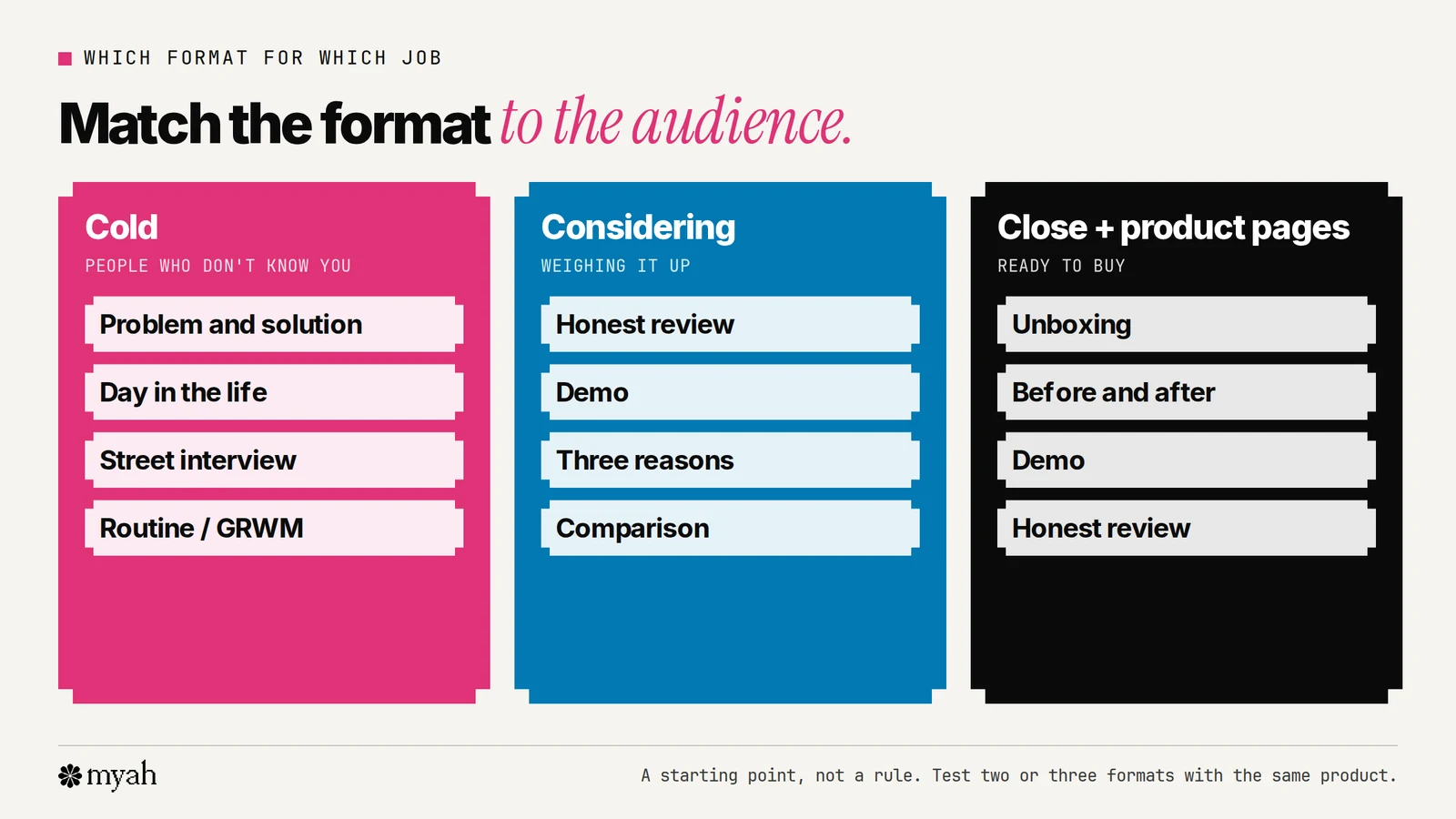
| Job | Formats to try first |
|---|---|
| Reach people who don't know the brand | Problem and solution, day in the life, street interview, routine |
| Help people who are considering it | Honest review, demo, three reasons, comparison |
| Close the sale, or use on product pages | Unboxing, before and after, demo, review |
If you're a brand, brief two or three formats at once with the same product, so you're testing ideas rather than one video. Our guide to hiring UGC creators for Meta ads shows a first test batch. If you're a creator, a portfolio with three different formats shows range. See how to build a UGC portfolio with no client experience.
Famous UGC campaign examples
Some of the best-known UGC comes from customers, invited by a brand. Three examples, from the brands' own pages:
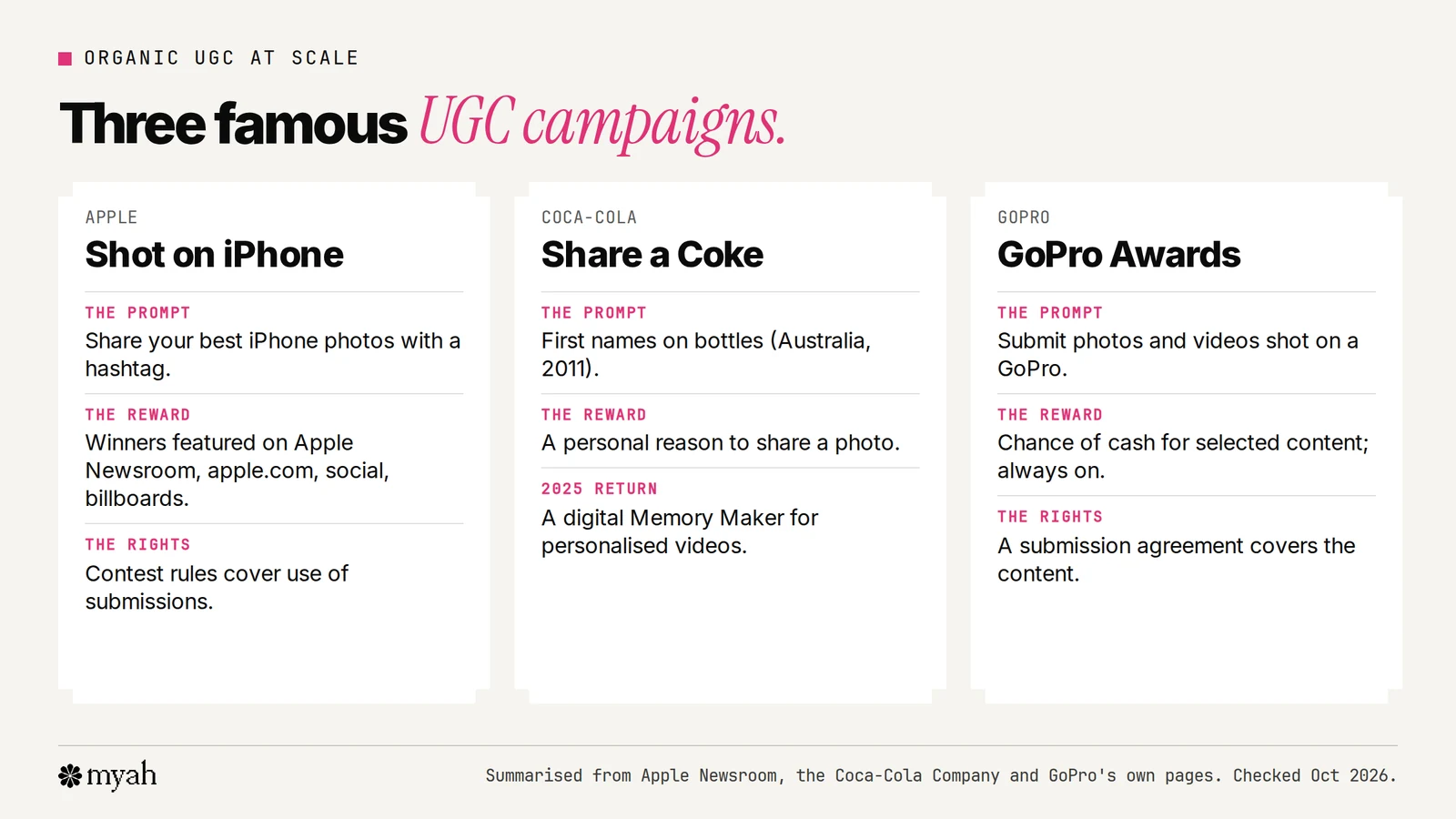
- Apple: Shot on iPhone. Apple runs Shot on iPhone challenges where customers share photos with a hashtag. In the 2022 macro challenge, ten winning photos were featured on Apple Newsroom, apple.com and Apple's social accounts, and could appear on billboards and in Apple Stores.
- Coca-Cola: Share a Coke. Coca-Cola says the campaign launched in Australia in 2011, replacing the logo with popular first names, and returned in 2025 with a digital "Memory Maker" for fans to create personalised videos to share.
- GoPro: GoPro Awards. GoPro Awards invites customers to submit photos and videos shot on a GoPro for the chance to be rewarded, with no limit on how many times you can submit. GoPro's press release describes cash payouts for selected content.
What they have in common: a clear prompt, a reason to take part and permission. Apple's contest rules and GoPro's submission agreement both cover the rights to use what people submit, which is the step brands often skip when they repost customers' content.
How to find real UGC ad examples
The best examples to study are live ads in your own category. Two free, official tools show them:
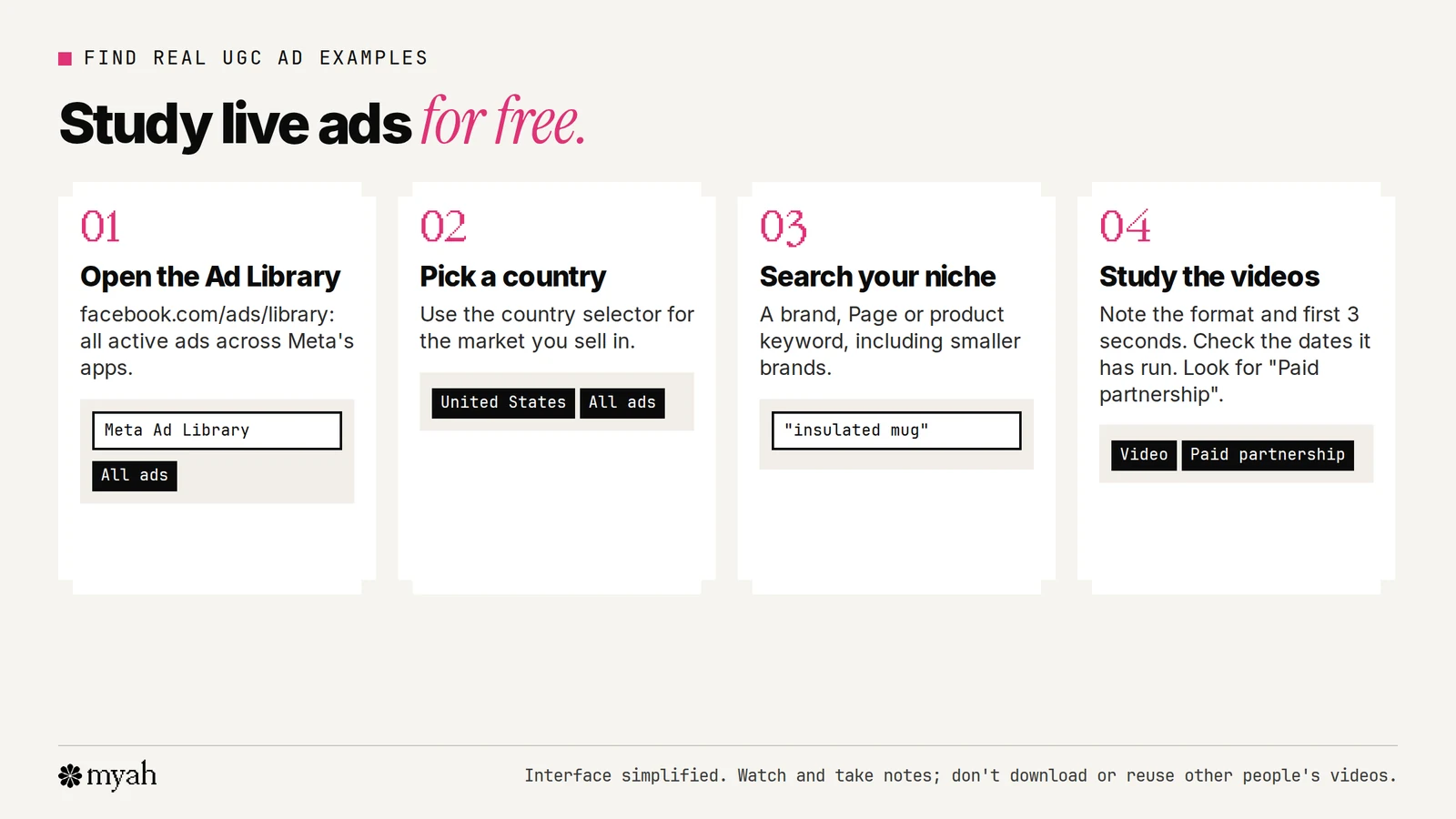
- Meta Ad Library. Meta says the Ad Library contains all active ads shown across its apps, plus active branded content with a paid partnership label. Anyone can search by brand, Page or keyword, choose a country and see the ad creative and the dates it has been running.
- TikTok Creative Center. The Top Ads section shows high-performing auction ads you can filter by region and objective. TikTok notes it only includes ads that advertisers have authorised to appear there.
A few tips:
- Search brands in your niche, including smaller ones, not just the biggest names.
- Note the format and the first three seconds of each ad, using the 10 formats above as labels.
- Look at how long ads have been running. Many marketers treat a long-running ad as a sign it's working, though only the advertiser knows for sure.
- Don't copy or re-upload someone else's video. Use what you learn to brief or film your own.
Using UGC examples well
For brands: put two or three reference examples in every brief, with what you like about each ("this hook", "this lighting"), so the creator knows what "good" means to you. Our UGC brief template has a section for them.
For creators: make your own spec videos in three or four of these formats with products you own, label them as self-directed samples, and lead your portfolio with your strongest hook. Our guides on filming and editing UGC and becoming a UGC creator cover the rest.
Common questions
What are some examples of UGC?
Customer reviews with photos or video, unboxing clips, tutorials, social posts that tag a brand, and paid creator videos that brands run as ads, such as problem-and-solution, honest review and before-and-after videos.
What is a UGC video?
A short video in the natural, phone-shot style of customer content, made either by a customer on their own or by a paid UGC creator for a brand to use in ads, on product pages or on social.
What makes a good UGC ad?
A hook in the first few seconds, the product shown early, real proof such as a demo or result, captions inside the safe zone and a clear call to action, all in a style that feels like a person rather than a brand.
How long should a UGC video be?
Short. Our script template plans for 30 seconds with a 15-second cut. Meta allows Reels ads of up to 15 minutes, but the hook still has to work in the first few seconds.
Can I use another brand's UGC ad as an example?
Yes, as a reference in a brief or for study, by linking to it. Don't download it, re-upload it or copy it shot for shot.
What is organic UGC?
Content customers create and post on their own, without being paid or briefed, like a review or a tagged photo. Brands need permission before reusing it.
Sources
- Meta: Reels ad creative lesson, Instagram Reels ad specs and safe zones, health and wellness ad policy, about the Ad Library
- TikTok: Creative Center Top Ads
- FTC: 16 CFR 465.2, Endorsement Guides: what people are asking
- Brand campaigns: Apple Shot on iPhone contest rules (2019), GoPro Awards terms, Apple Shot on iPhone macro challenge, Coca-Cola Share a Coke, GoPro Awards, GoPro POV Awards press release
Myah is a marketplace where brands post UGC campaigns with a brief, examples and top-performing formats, and creators apply with their portfolios. We're in early access. Join creator early access or see how Myah works for brands. Early access does not guarantee campaigns, availability or earnings.