

A UGC script template is a fill-in plan for a short creator video: what you say and show in the first 2 seconds, how you keep people watching, and what you ask them to do at the end. Most UGC ad scripts follow the same spine, hook, problem or context, product, proof, call to action, in about 30 seconds.
This guide gives you that spine with second-by-second timings, eight frameworks built on it, a storyboard and an example script for each, and a free fill-in PDF. It also covers the lines that can get a script rejected when a brand runs it as a Meta ad, which most templates leave out.
The spine every UGC script shares
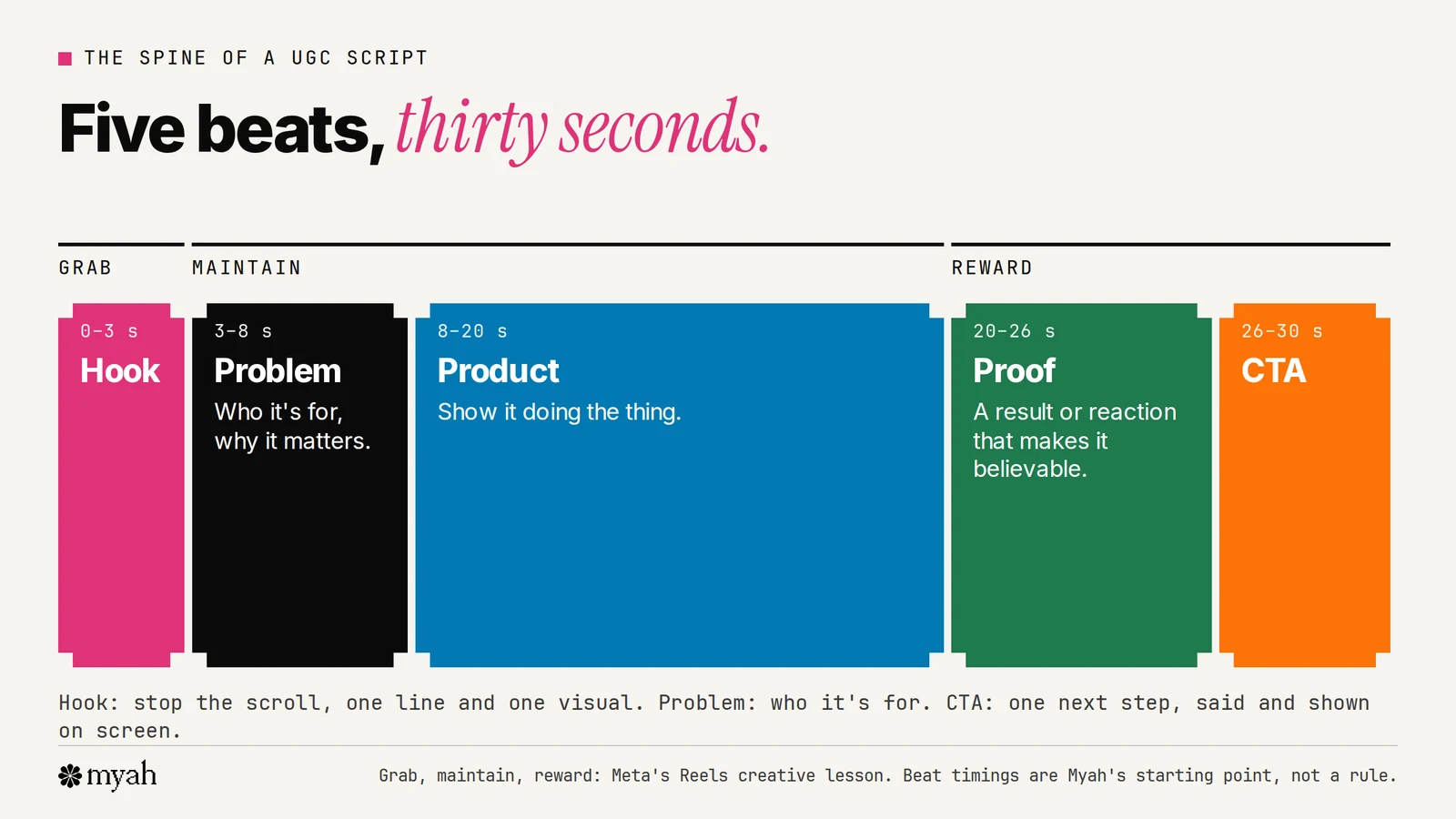
Meta's own lesson on Reels creative sums it up as grab, maintain and reward attention. It suggests a hook in the first few seconds, using text, visuals, audio or a mix, and grabbing attention in the first 2 seconds "with a bold visual or unexpected moment", such as a question, a surprising fact or a quick before-and-after. After that, you show off the product in a compelling way.
Mapped onto a 30-second UGC video, that looks like this:
| Beat | Time | What it does |
|---|---|---|
| Hook | 0–3 s | Stops the scroll. One line or one visual, ideally both. |
| Problem or context | 3–8 s | Says who this is for and why it matters. |
| Product | 8–20 s | Shows the product doing the thing. Show, don't describe. |
| Proof | 20–26 s | A result, a reaction, a detail or a demonstration that makes it believable. |
| Call to action | 26–30 s | One clear next step, said out loud and shown on screen. |
Two practical rules make the spine work as an ad:
- Write for sound on and sound off. Meta says Reels ads play with sound on unless the viewer has turned sound off, so the spoken line matters. But add on-screen text for the hook and the key claim too, so the video still works muted.
- Keep text in the safe zone. On-screen lines near the bottom of the frame are covered by the caption and call-to-action button. Our Reels safe zone template shows exactly where.
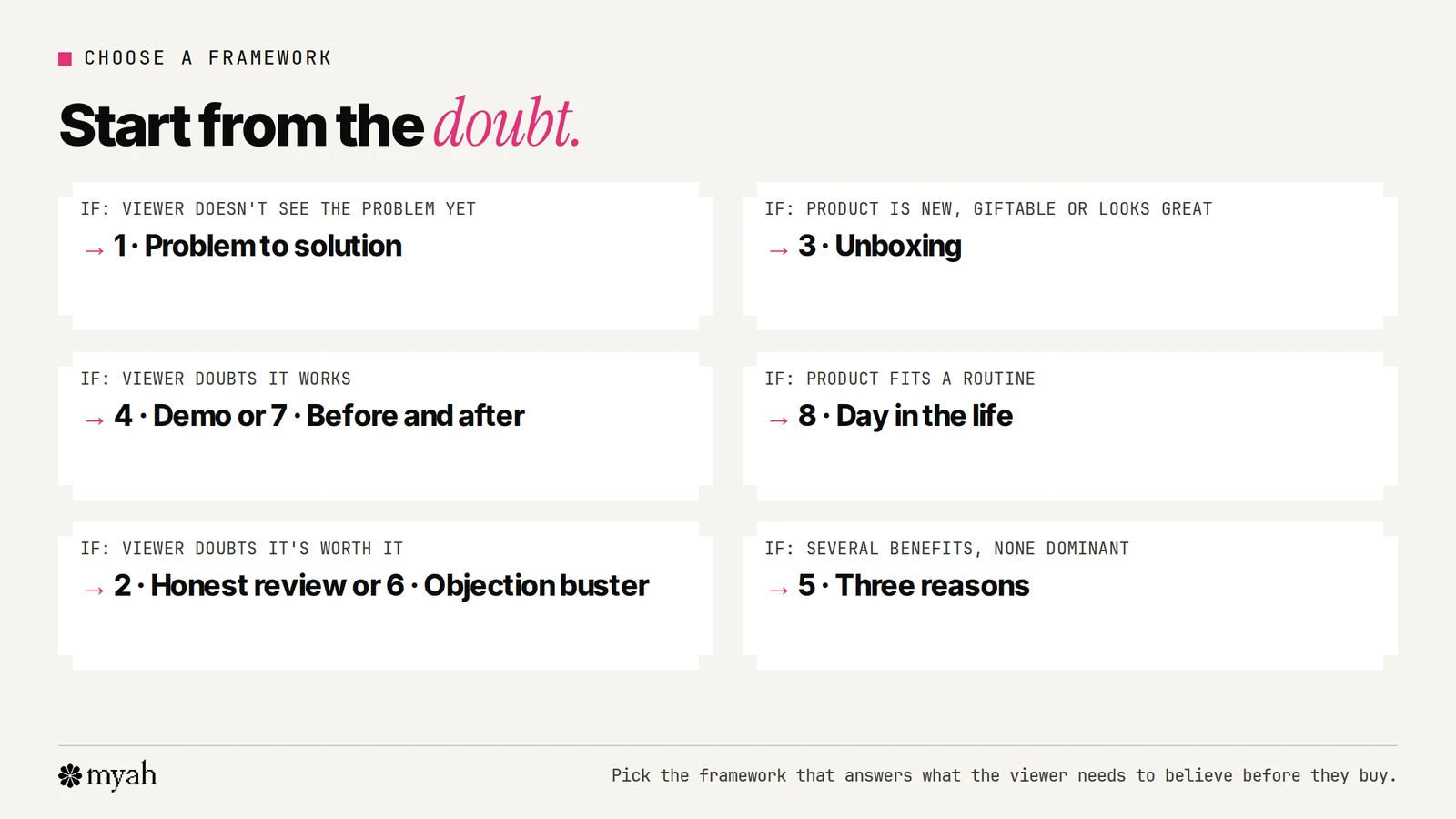
How to pick a framework
Start from what the viewer needs to believe before they buy, then choose the framework that proves it fastest.
The 8 UGC script frameworks
Each framework below has a fill-in template, a storyboard and a short example script. The examples are for made-up products, and the timings assume a 30-second video. For a 15-second cut, keep the hook and call to action and shorten the middle.
1. Problem to solution
Use it when the product fixes an everyday annoyance people recognize instantly.
Template: [Hook: show or say the problem] → [Why the usual fix fails] → [Product doing the fix] → [The result, shown] → [CTA]
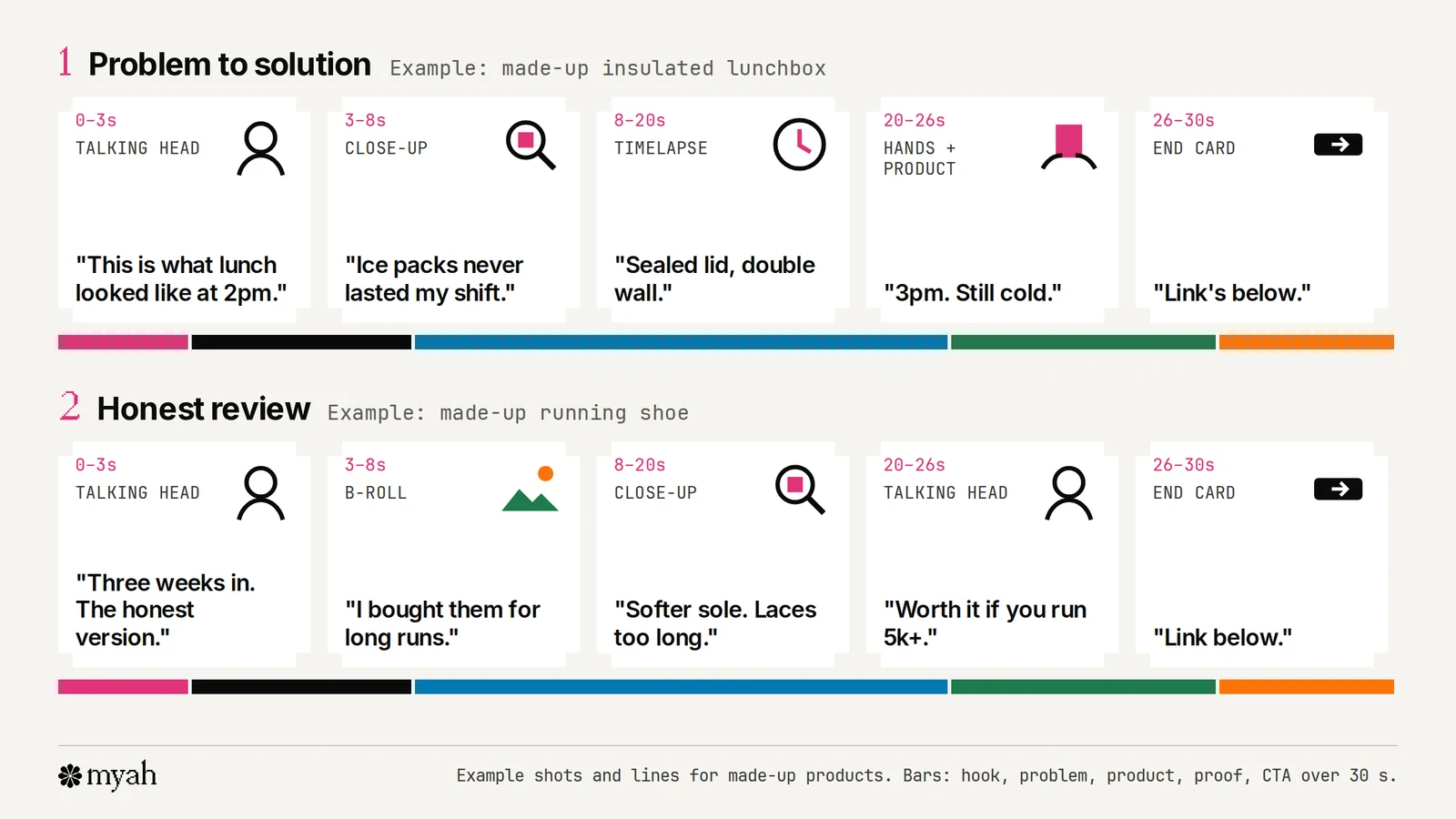
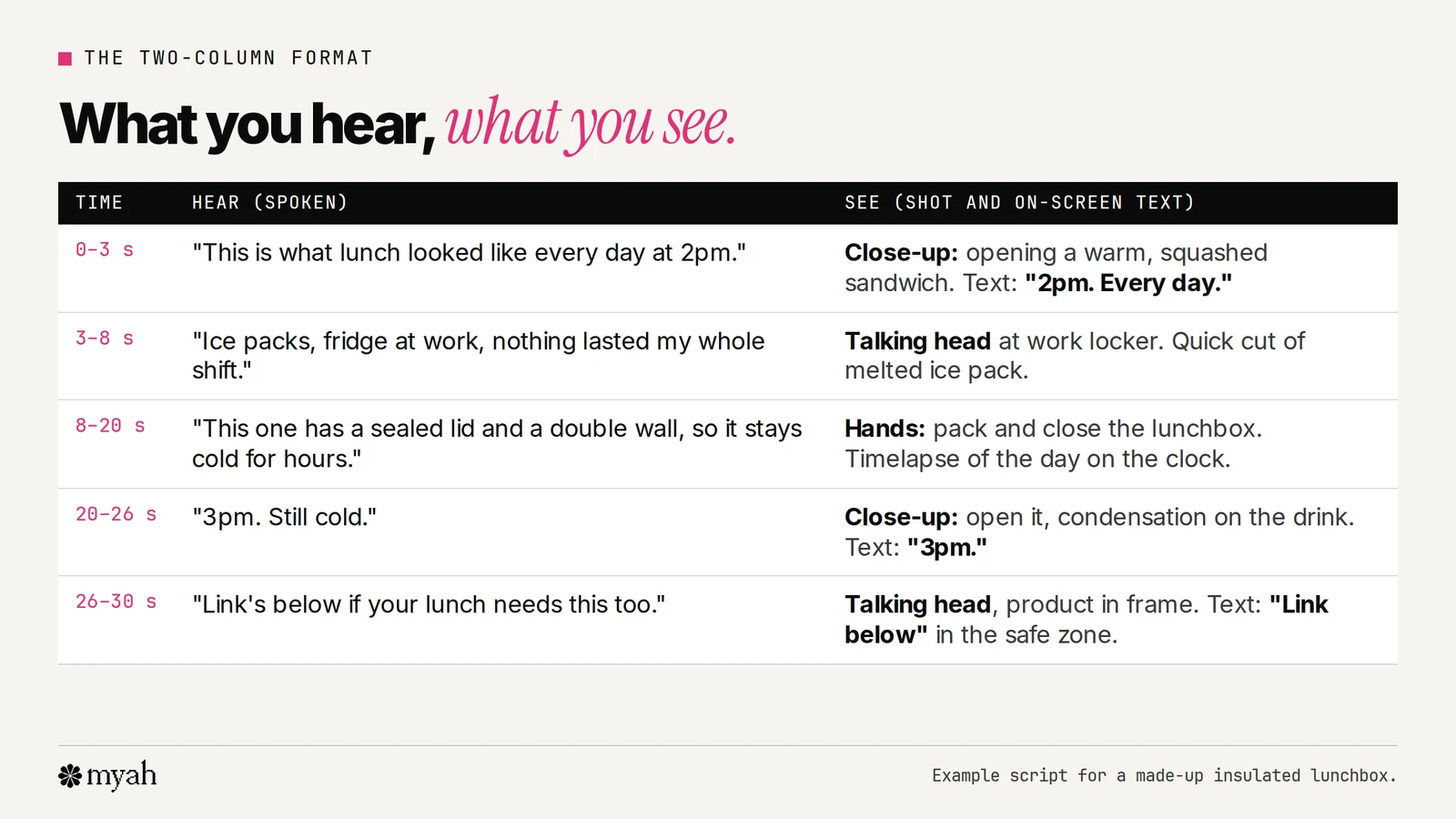
Example (a made-up insulated lunchbox):
0–3 s: (Opens a sad, warm sandwich.) "This is what lunch looked like every day at 2pm."
3–8 s: "Ice packs, fridge at work, nothing lasted my whole shift."
8–20 s: (Packs the lunchbox, closes it, timelapse of the day.) "This one has a sealed lid and a double wall, so it stays cold for hours."
20–26 s: (Opens it at 3pm, shows the cold drink.) "3pm. Still cold."
26–30 s: "Link's below if your lunch needs this too."
2. Honest review
Use it when trust is the barrier, and you've genuinely used the product for a while.
Template: [Hook: verdict or time used] → [What you expected] → [What surprised you, good and bad] → [Who it's for] → [CTA]
Example (a made-up running shoe):
0–3 s: "I've run in these for three weeks. Here's the honest version."
3–8 s: "I bought them for long runs. I didn't expect them to help my knees."
8–20 s: (Close-ups of the sole, a run clip.) "They're softer than my last pair, but the laces are too long."
20–26 s: "If you run more than 5k, they're worth it."
26–30 s: "I've left the link below."
A review has to be true. The FTC's guidance for influencers is blunt: you can't talk about your experience with a product you haven't tried, and if you're paid to talk about a product and thought it was terrible, you can't say it's terrific.
3. Unboxing and first impressions
Use it when the packaging, the first use or the "what's inside" moment is part of the appeal.
Template: [Hook: the box, a reaction] → [What's inside, one by one] → [First use] → [First impression, honestly] → [CTA]
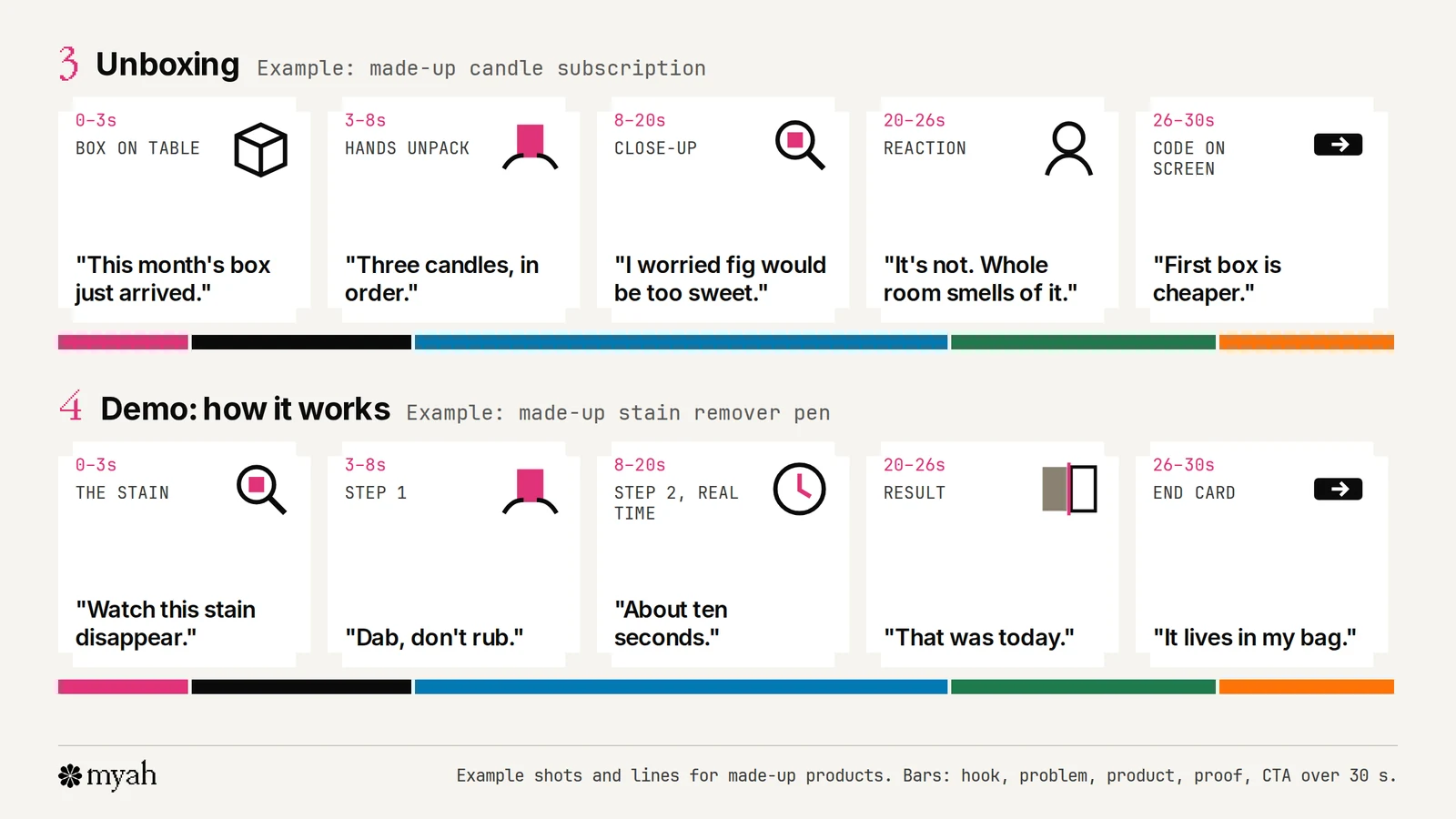
Example (a made-up candle subscription):
0–3 s: (Box on the table, hands opening it.) "This month's box just arrived."
3–8 s: "Three candles, and they tell you which one to light first."
8–20 s: (Lights one, close-up of the flame and label.) "This one's fig. I was worried it would be too sweet."
20–26 s: "It's not. The whole room smells like it after ten minutes."
26–30 s: "First box is cheaper with the code on screen."
4. Demo: how it works
Use it when seeing the product work is the whole argument.
Template: [Hook: the end result first] → [Step 1] → [Step 2] → [Step 3, the result] → [CTA]
Example (a made-up stain remover pen):
0–3 s: (Coffee spill on a white shirt.) "Watch this coffee stain disappear."
3–8 s: "Step one: dab, don't rub."
8–20 s: (Uses the pen, close-up, real time.) "Step two: about ten seconds of this."
20–26 s: (Wipes, shows the shirt.) "And that's it. That was today."
26–30 s: "It lives in my bag now. Link below."
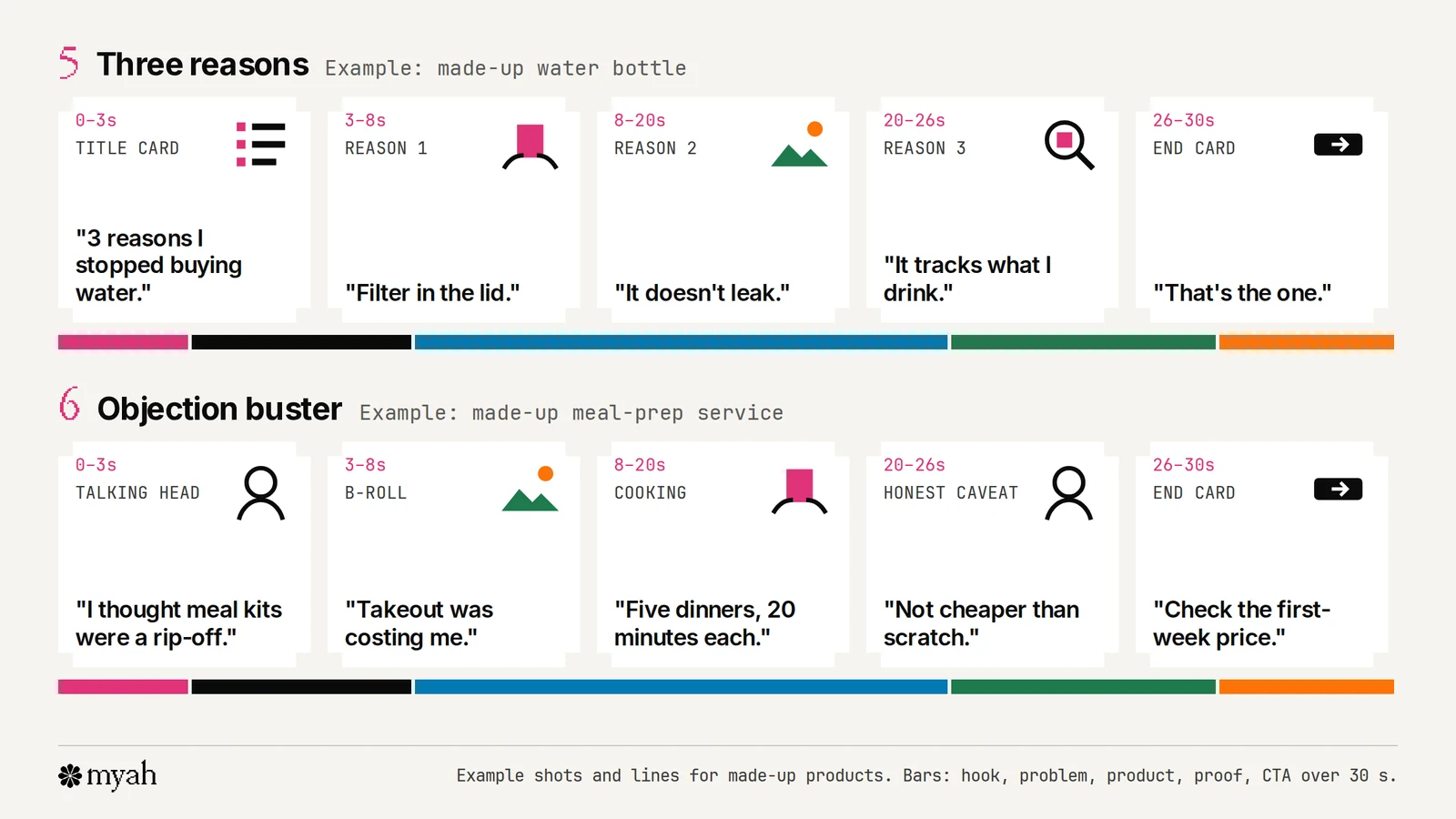
5. Three reasons
Use it when the product has several benefits and no single one carries it.
Template: [Hook: "3 reasons I…"] → [Reason 1, shown] → [Reason 2, shown] → [Reason 3, the strongest] → [CTA]
Example (a made-up reusable water bottle):
0–3 s: "Three reasons I stopped buying bottled water."
3–8 s: (Fills it from the tap.) "One: the filter's in the lid, so tap water tastes fine."
8–20 s: (Drops it in a bag, shakes it.) "Two: it doesn't leak. I've tested that more than I'd like."
20–26 s: (Shows the counter on the lid.) "Three: it tracks how much I drink, which I needed."
26–30 s: "That's the one. Link below."
6. Objection buster
Use it when you know the doubt people have, such as price, a gimmick or "does it really work?"
Template: [Hook: say the objection] → [Why you thought so too] → [What changed your mind, shown] → [The honest caveat] → [CTA]
Example (a made-up meal-prep service):
0–3 s: "I thought meal kits were a rip-off. Here's the math."
3–8 s: "I was spending more on takeout than I want to admit."
8–20 s: (Shows a week of meals, cooking one.) "Five dinners, twenty minutes each, and I throw away less food."
20–26 s: "It's not cheaper than cooking from scratch. It's cheaper than what I was actually doing."
26–30 s: "Check the first-week price at the link."
7. Before and after
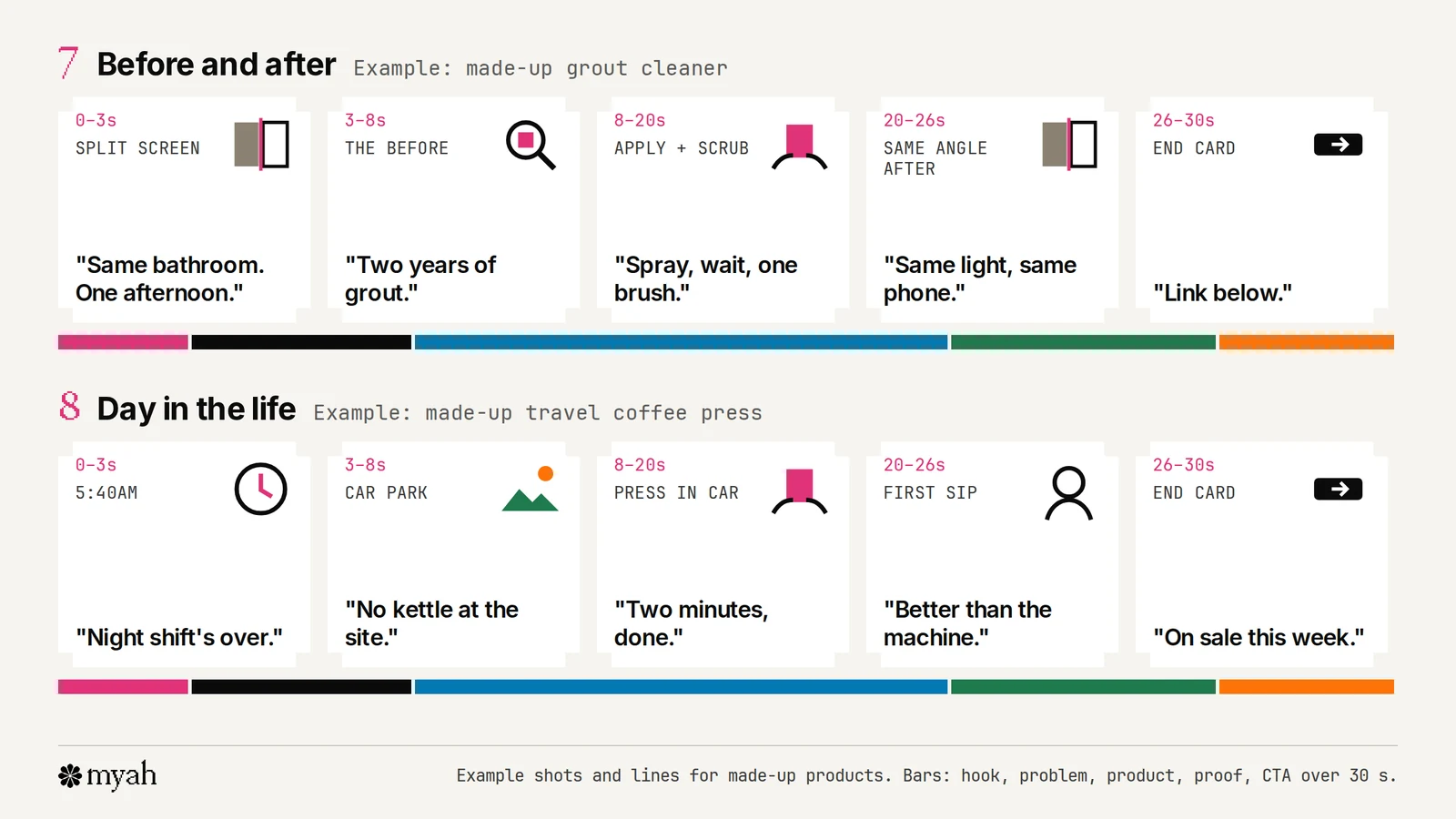
Use it when the change is visible, real and typical, and the product category allows it in ads.
Template: [Hook: the after, or a split screen] → [The before] → [What you did, with the product] → [The after, same light and angle] → [CTA]
Example (a made-up grout cleaner):
0–3 s: (Split screen, dirty grout and clean grout.) "Same bathroom. One afternoon."
3–8 s: "This is what the grout looked like after two years."
8–20 s: (Applies, scrubs, real time.) "Spray, wait five minutes, one brush."
20–26 s: (Same angle, same light.) "No filter, same light, same phone."
26–30 s: "The link's below if your grout looks like my before."
Be careful with this one in health and beauty. Meta's Health and Wellness ad policy bans weight loss and cosmetic ads that contain statements attacking someone's appearance, body or hygiene. In a health or weight loss context, it also bans clickbait such as promising a specific result in a set time without disclaimers or qualifiers. Before-and-afters for home, cleaning and similar products are a safer fit. Whatever the product, shoot both halves the same way and never edit the result.
8. Day in the life
Use it when the product fits naturally into a routine, and the routine itself is relatable.
Template: [Hook: the time or the moment] → [Routine beat 1] → [Product in the routine] → [Routine beat 3] → [CTA]
Example (a made-up travel coffee press):
0–3 s: "5:40am. Night shift's over, day shift's starting."
3–8 s: (Car park, cold air.) "No kettle at the site, so this comes with me."
8–20 s: (Presses coffee in the car, close-up.) "Hot water from the flask, two minutes, done."
20–26 s: (First sip, sunrise.) "Better than the vending machine. By a lot."
26–30 s: "It's on sale this week. Link below."
How to write the script: the two-column format
A common way to write a UGC script is in two columns: what you hear and what you see, with a time for each row. It makes the filming list obvious and stops you from describing something you could just show.
A few writing rules help every framework:
- Write the way you talk. Read it aloud with a timer before you film. If you run out of breath, the line is too long.
- One idea per line. If a line has "and" in the middle, it's probably two lines.
- Put numbers on screen. A time, a price or a step count is easier to read than to hear.
- Write two or three hooks. Brands may test several openings on the same video, and a new first line is the cheapest change to make. Our guide to hook rate on Meta explains how they're compared.
- Agree the details in the brief first. Claims, must-say lines, the call to action and where the video will run belong in the UGC brief, before anyone writes the script.
Script lines that can get a Meta ad rejected
A script that works on your own account can still be rejected when a brand runs it as an ad. Three rules catch most UGC scripts.
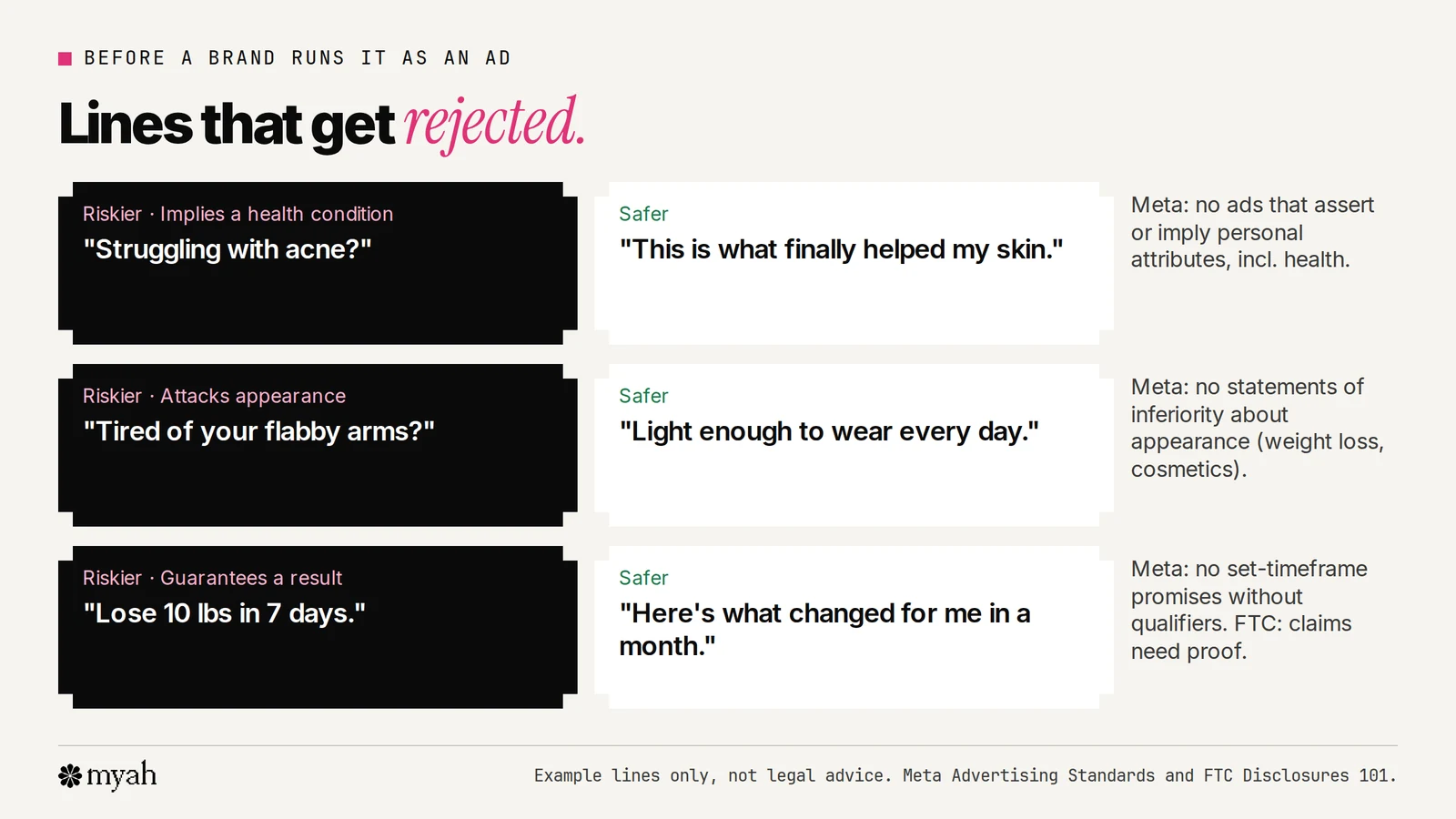
- Don't tell the viewer what they are. Meta doesn't allow ads that assert or imply personal attributes, including physical or mental health, age, financial status and more. Its own examples of rejected ads include "Are you disabled? We can help!" and "Have you been diagnosed with cancer?". So "Struggling with acne?" is riskier than "This is what finally helped my skin." "You" is fine, as long as it isn't attached to a personal attribute.
- Don't attack how people look. For weight loss and cosmetic products, Meta bans statements of inferiority about physical appearance, meaning negative terms or questions that attack someone's appearance, body parts or hygiene.
- Only say what's true for you, and what the brand can back up. The FTC says you can't make up claims about a product that would need proof the advertiser doesn't have, such as scientific proof it treats a health condition. Use the brand's approved claims, and describe your own results as your own.
If the video is posted on your account as sponsored content, disclose it too. Our guide to Meta partnership ads covers how the paid partnership label works.
Free UGC script template (PDF)
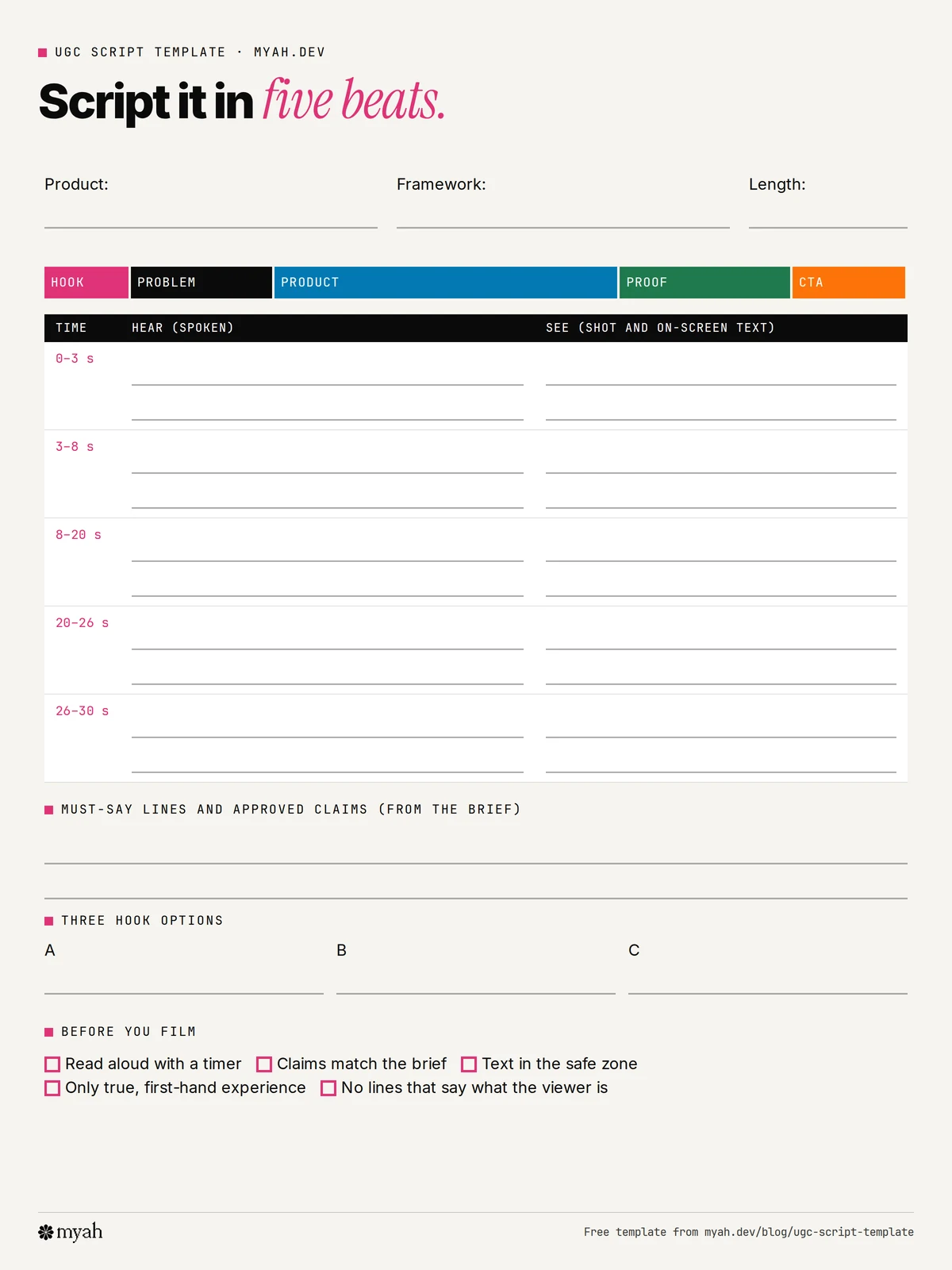
The one-page template has the five-beat timing bar, a two-column script grid with time stamps, a box for must-say lines and approved claims, space for three alternative hooks and a pre-film checklist. Download the PDF, print it or fill it in on screen.
Common questions
What is a UGC script?
A UGC script is a short plan for a creator-style video: the hook, the main points, the shots and the call to action, usually with timings. Unlike a TV script, it's meant to sound natural, so many creators script the beats and key lines rather than every word.
How long should a UGC script be?
There's no fixed length, and the brief should say. A 30-second script is a good default, with a longer cut for demos or reviews if needed. Write the 30-second version first, then cut it to 15 by keeping the hook and call to action and shortening the middle. Time it by reading it aloud.
What is the best UGC script format?
Two columns, what you hear and what you see, with a time stamp for each row. It doubles as your shot list.
Do brands give you the script, or do you write it?
Both happen. Some brands send a full script, many send a brief with key messages and leave the wording to the creator, and some ask the creator to pitch the script first. Agree which it is before you start.
How many hooks should a UGC script have?
Write at least two or three. A brand can test several openings on the same video to see which stops the most people.
Can I use a before-and-after in a UGC ad?
Often yes, if the change is real, typical and shot the same way both times. Weight loss and cosmetic products have extra rules under Meta's Health and Wellness policy, so check the current policy for the product.
Where to go next
- UGC brief template for Meta ads: agree the claims and deliverables before you write.
- Hook rate on Meta: how brands measure whether your first 3 seconds work.
- Instagram Reels safe zone template: keep your on-screen lines readable.
- How to build a UGC portfolio with no client experience: use these frameworks to make sample videos.
Myah is building a performance-UGC marketplace for brands and creators. Brands run approved videos as ads in their own Meta Ads Manager. Join creator early access or join brand early access for updates from Myah. Early access does not guarantee campaigns, availability or earnings.