

Interest in AI creators has grown quickly. In Google search, "ai influencer" went from near zero in 2023 to roughly twice the interest in "ugc creator" in 2026. Advertisers are using generative AI for video in large numbers. Consumers say they want AI content labelled and, in one 2026 survey, many say they are growing more cautious. Platforms and lawmakers have started to set rules.
This is a research summary, not an argument for or against AI-generated creators. It collects what we could verify from primary sources as of 8 October 2026 and says clearly where the evidence is thin.
The short version
- Search interest rose sharply. In our Google Trends data, "ai influencer" averaged 2.9 (on a 0 to 100 scale) in 2024 and 36.2 in 2026 so far. It peaked in the spring and was lower in the third quarter.
- Advertisers are using generative AI for video. IAB says nearly two in three digital video buyers now use it for creative, up from about half in 2025. Meta says more than 9 million small businesses use at least one of its AI ad creative tools.
- Consumers are cautious, not hostile. In a Gartner survey of 1,006 US consumers, 65% said brands produce too much AI-generated content and 35% said they rely on influencers less because of AI. But 43% said they rely more on real people. Gartner's own line: "The answer is not to avoid AI."
- Experiments find a trade-off. A 2026 meta-analysis of 210 experiments found virtual influencers are more novel and as engaging as human influencers, but less credible and less effective on attitudes and purchase intent.
- The rules are tightening. Meta, TikTok and YouTube all have AI labelling rules. New York has required synthetic-performer disclosure in ads since June 2026, California's law starts in January 2027 and the EU's AI Act transparency rules applied from 2 August 2026.
What we mean by "AI creator"
There is no standard definition. For this article:
- AI-generated presenter. Software produces a realistic person, voice or both in an ad-style video. Tools such as Arcads, HeyGen and Higgsfield market this.
- Virtual influencer. A persona, often with its own social account, that isn't a real person.
- AI-assisted human creator. A real person who uses AI tools for scripts, edits, captions or translation.
These get lumped together in headlines but are treated differently by consumers, platforms and the law. Most of the rules below apply to realistic synthetic people, not to a human who used AI to write a caption.
Search interest: what Google Trends shows
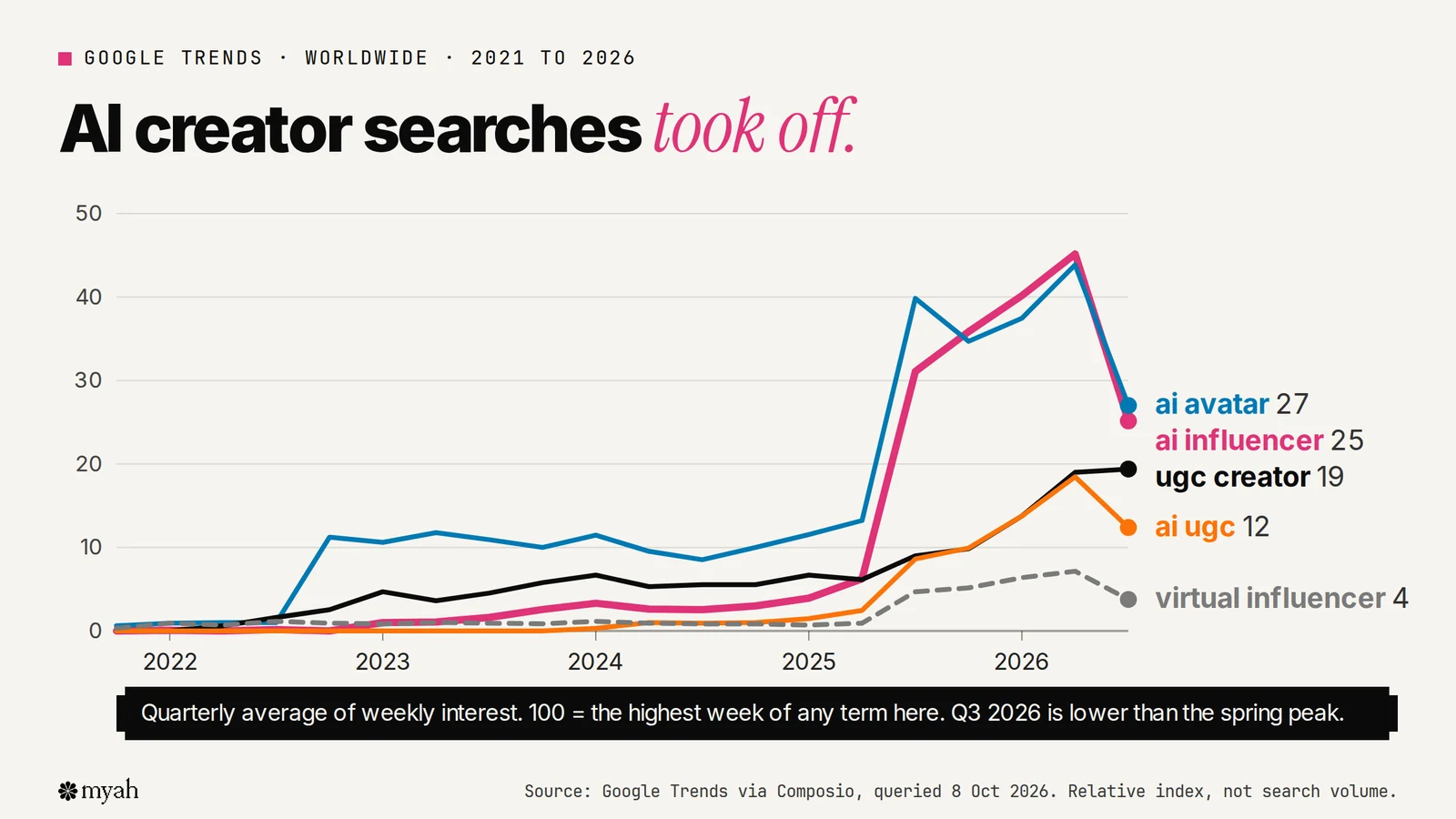
We pulled five years of weekly Google Trends data on 8 October 2026. Yearly averages on the 0 to 100 index (100 is the highest week of any term in the comparison; 2026 is year to date):
| Term | 2024 | 2025 | 2026 |
|---|---|---|---|
| ai influencer | 2.9 | 19.3 | 36.2 |
| ai avatar | 9.9 | 24.8 | 35.5 |
| ugc creator | 5.8 | 7.9 | 17.3 |
| ai ugc | 0.8 | 5.6 | 14.6 |
| virtual influencer | 0.9 | 2.9 | 5.7 |
Three things stand out:
- The ratio flipped. In 2024, "ai influencer" had about half the interest of "ugc creator" (0.5×). In 2026 it has about twice as much (2.1×).
- The spring peak has passed. "ai influencer" averaged 45 in the second quarter of 2026 and 25 in the third. "ugc creator" held at about 19. Search interest can fall for many reasons, so don't read this as a trend reversal yet.
- Tool names grew too. In a separate comparison, searches for Higgsfield and HeyGen rose steeply, while Arcads and Creatify stayed low.
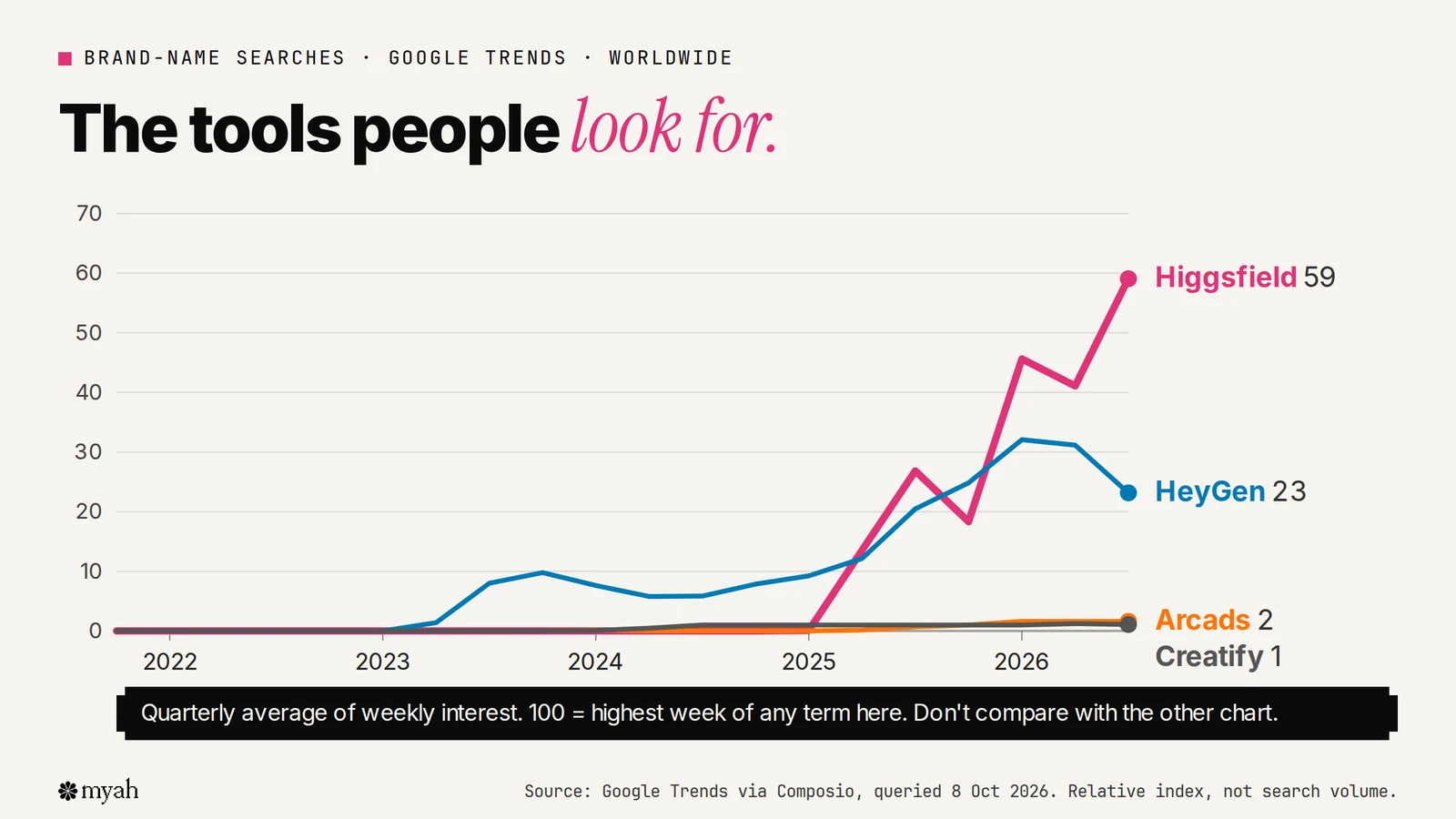
In a separate comparison, "higgsfield" averaged 14.7 in 2025 and 49.6 in 2026, and "heygen" went from 4.9 in 2023 to 28.5 in 2026. "arcads" and "creatify" stayed under 2.
Limits. Google Trends is a relative index scaled within each comparison, not a count of searches, and it measures curiosity, not adoption. "ai avatar" includes uses unrelated to advertising. "ai ugc" is partly mixed up with searches about India's University Grants Commission ("UGC NET"), so we treat it cautiously. Each comparison group is scaled separately, so the same term can have different values in different groups. The full weekly data is below.
Download the weekly data (CSV)
Who is using it
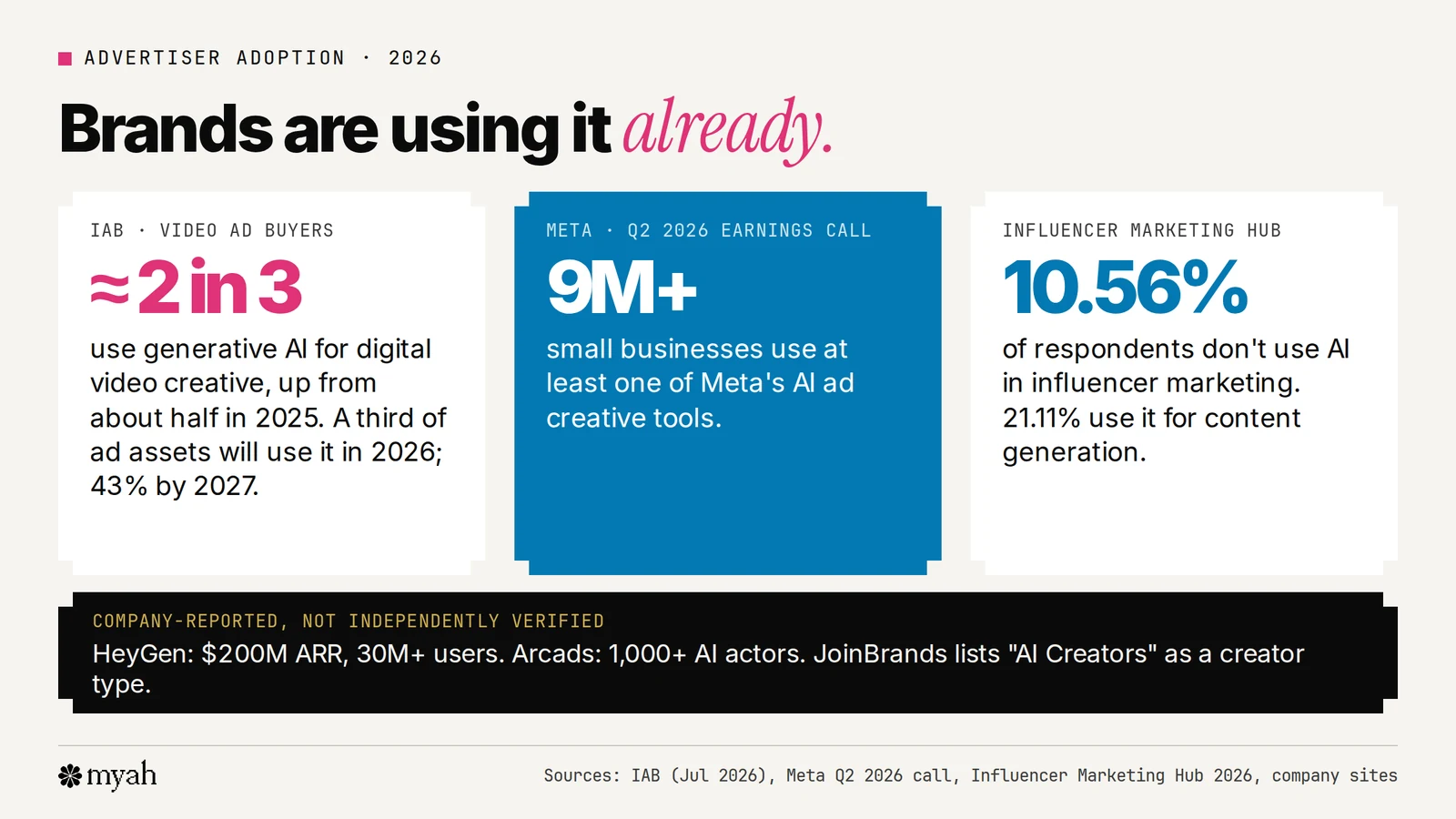
- IAB. In its 2026 Digital Video Ad Spend & Strategy report, IAB says nearly two in three buyers now use generative AI for digital video creative, up from half in 2025. One third of their ad assets will use it this year, up from one quarter in 2025, and IAB projects 43% by 2027.
- Meta. On its Q2 2026 earnings call, Meta said more than 9 million small businesses now use at least one of its AI ad creative tools.
- Influencer marketing. Influencer Marketing Hub's 2026 benchmark report says 36.67% of respondents use AI mainly for creator discovery and 21.11% for content generation. 10.56% don't use AI in influencer marketing. We didn't see the respondent profile in the summary we reviewed.
- Company claims. HeyGen says it reached $200 million in annual recurring revenue and more than 30 million users. Arcads advertises a library of 1,000+ AI actors. JoinBrands lists "AI Creators" as a creator category on its creator page. These are the companies' own statements.
None of this measures how many AI-presenter ads are running, or how well they perform. Generative AI in ad production covers a lot, such as resizing, translation and image edits, not only synthetic people.
What consumers say
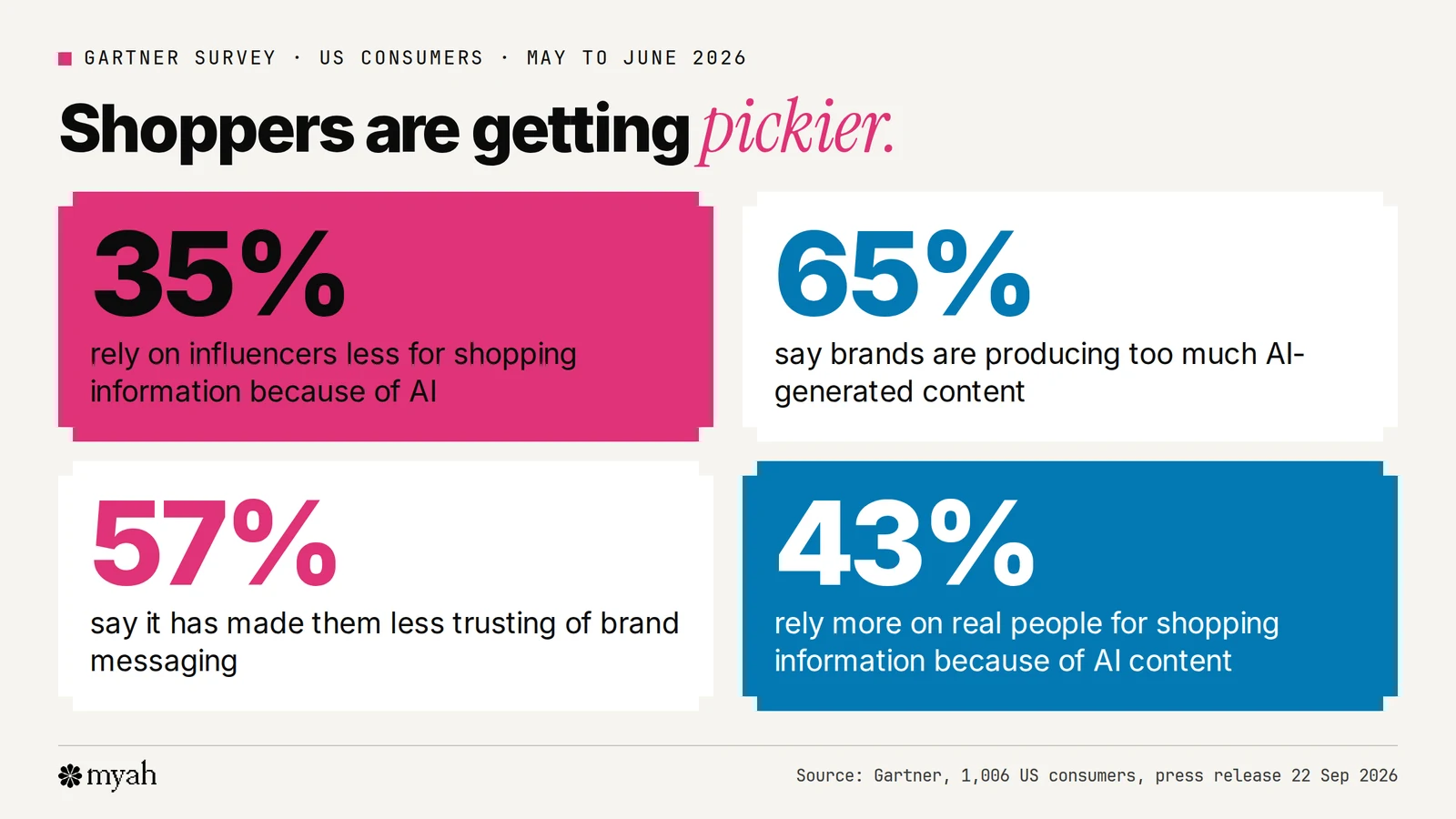
Gartner's survey of 1,006 US consumers, run between May and June 2026, found:
- 35% now rely on influencers less for shopping information because of AI.
- 65% believe brands are producing too much AI-generated content in their marketing.
- 57% say this content has made them less trusting of brand messaging overall.
- 43% say they now rely more on real people for shopping information and recommendations because of AI-generated content.
Gartner's analyst frames this as selectivity, not rejection: "Consumers are not rejecting AI outright." Note these are self-reported attitudes from one survey, and the summary we reviewed doesn't give the question wording.
What experiments say
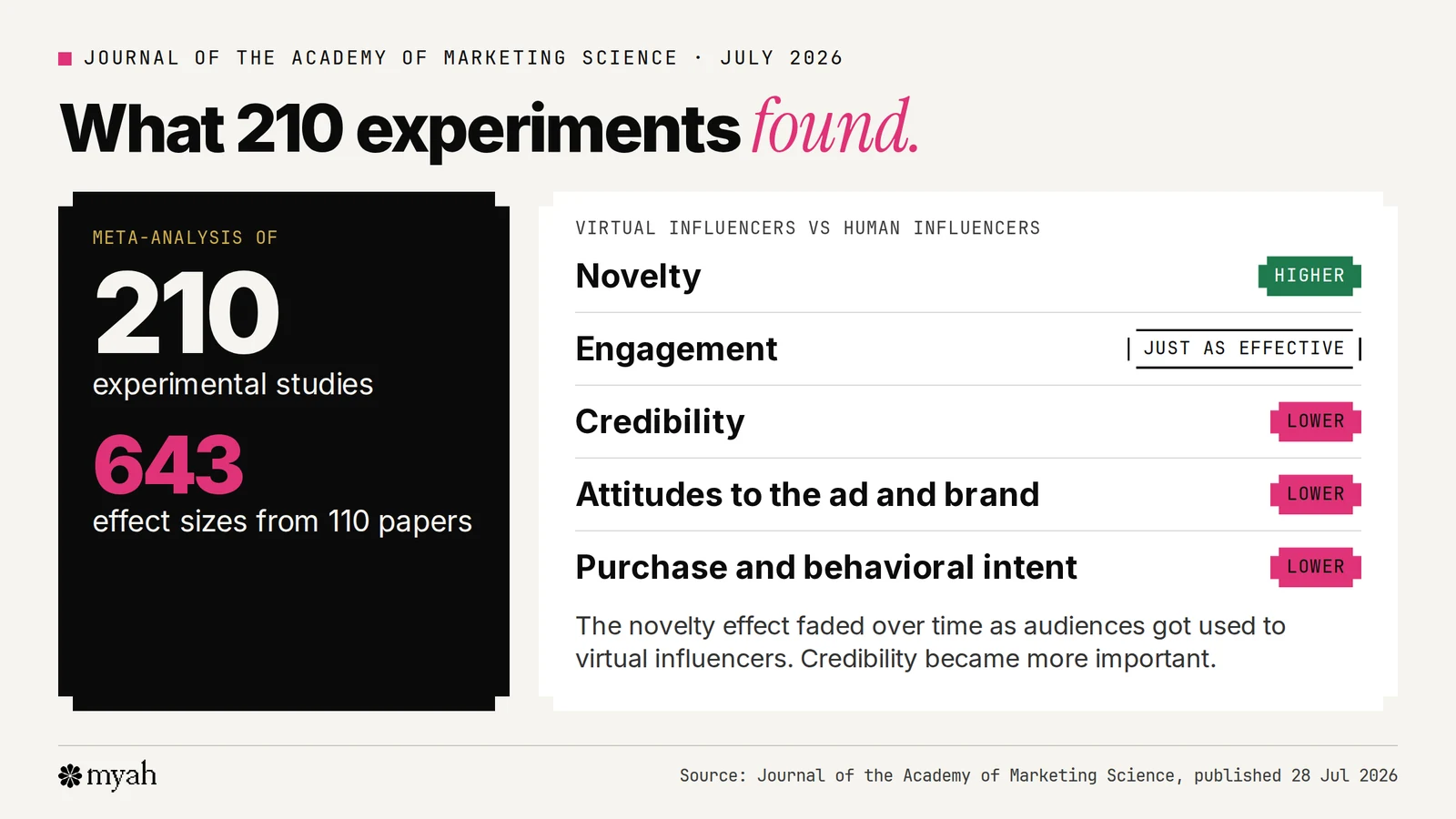
The largest evidence review we found is a meta-analysis in the Journal of the Academy of Marketing Science (published 28 July 2026), covering 210 experimental studies from 110 papers and 643 effect sizes. Its conclusions:
- Virtual influencers are more novel and just as effective as human influencers at driving engagement.
- They are less effective at shaping credibility, attitudes and behavioural intentions.
- The novelty effect faded over time as people got used to virtual influencers, while credibility mattered more.
- How human-like the virtual influencer looks, and how well it fits the product, changed the results.
The studies compare virtual influencers with human influencers in experiments. They aren't measurements of real ad campaigns, and they're about virtual influencers rather than specifically AI-presented, UGC-style ads.
On disclosure, results are mixed. One 2026 experiment on Instagram travel advertising found that disclosing the AI-generated origin of influencers' ad posts lowered brand credibility, attitude and purchase intention. Another 2026 study of AI-generated product images found the effect of disclosure depended on the product context. So the evidence doesn't support a simple rule such as "labelling always hurts" or "labelling always helps."
What the platforms require
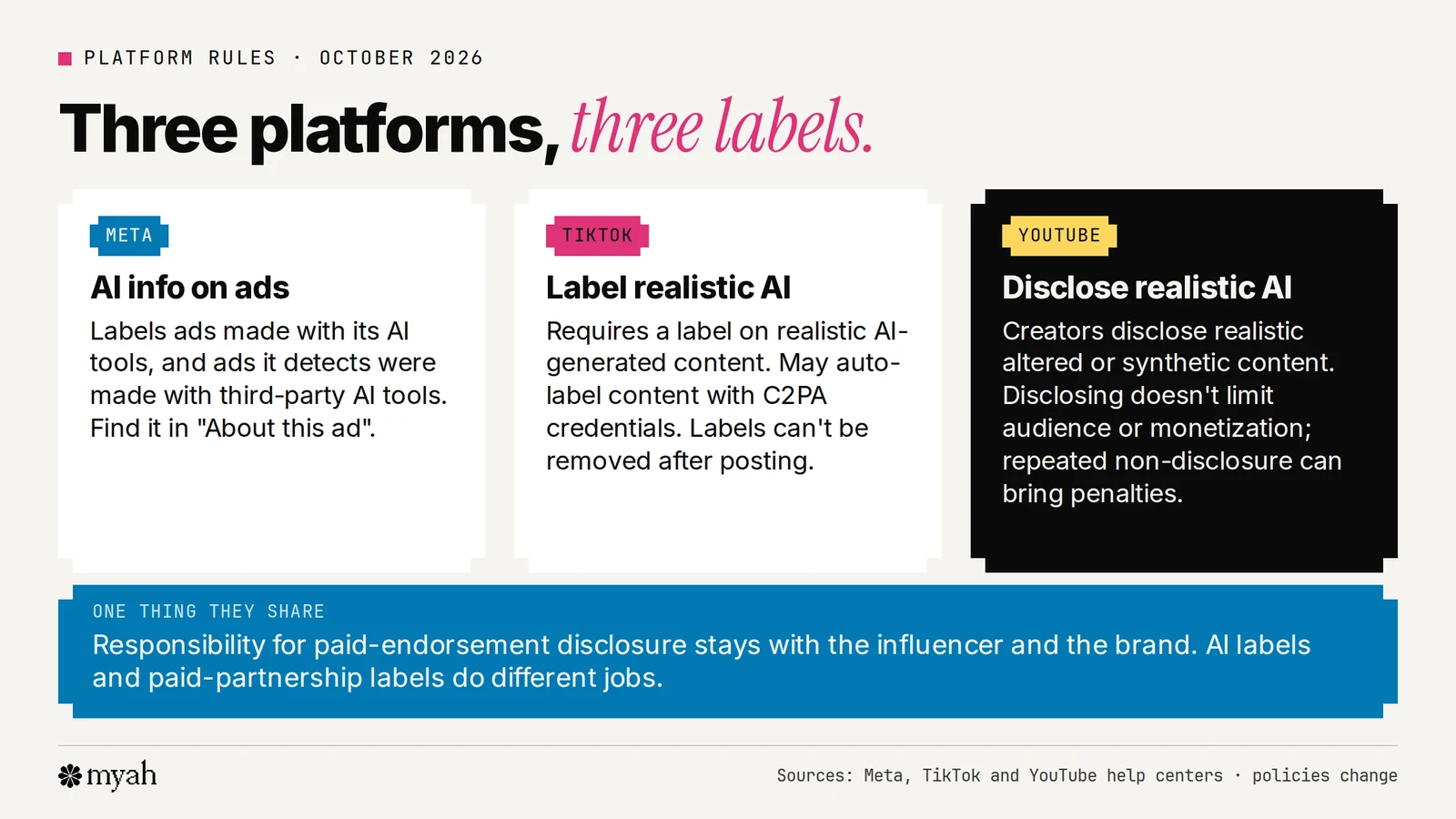
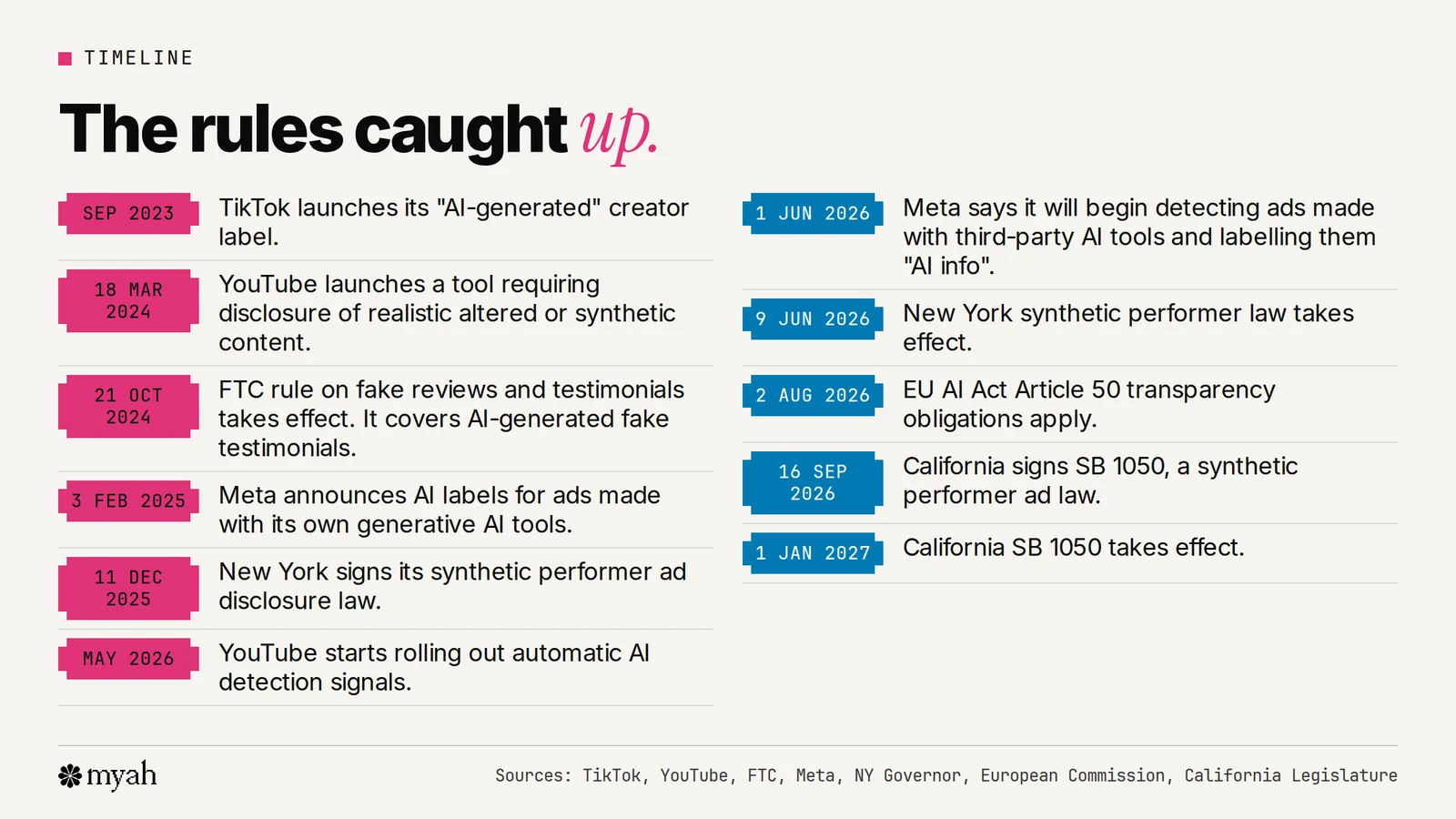
Meta. Meta labels ads created or significantly edited with its own generative AI tools with an "AI info" label, found in the three-dot menu under "About this ad." Its 1 June 2026 update says it will also begin detecting ads made with third-party AI tools through industry-standard signals. Meta says you will see a message before publishing when an AI info label will appear on your ad. Organic content is handled separately: Meta may require an AI label where photorealistic video or realistic-sounding audio was digitally created or altered, including with AI.
TikTok. TikTok requires creators to label realistic AI-generated content. It may also apply an automatic label to content with C2PA Content Credentials. TikTok says adding the label won't affect a video's distribution, and you can't remove it after posting.
YouTube. YouTube has required creators to disclose realistic altered or synthetic content since 18 March 2024. Its help page says disclosing won't limit a video's audience or its eligibility to earn money, and that creators who consistently don't disclose can face a manual label or penalties, up to removal or suspension from the YouTube Partner Program. In May 2026 it began rolling out automatic AI detection.
One point holds across all three: an AI label is a different thing from a paid-partnership disclosure. On paid endorsements, the FTC says that even when a platform offers a disclosure tool, ultimate responsibility for a clear and conspicuous disclosure rests with the influencer and the brand, not the platform.
What the law says so far
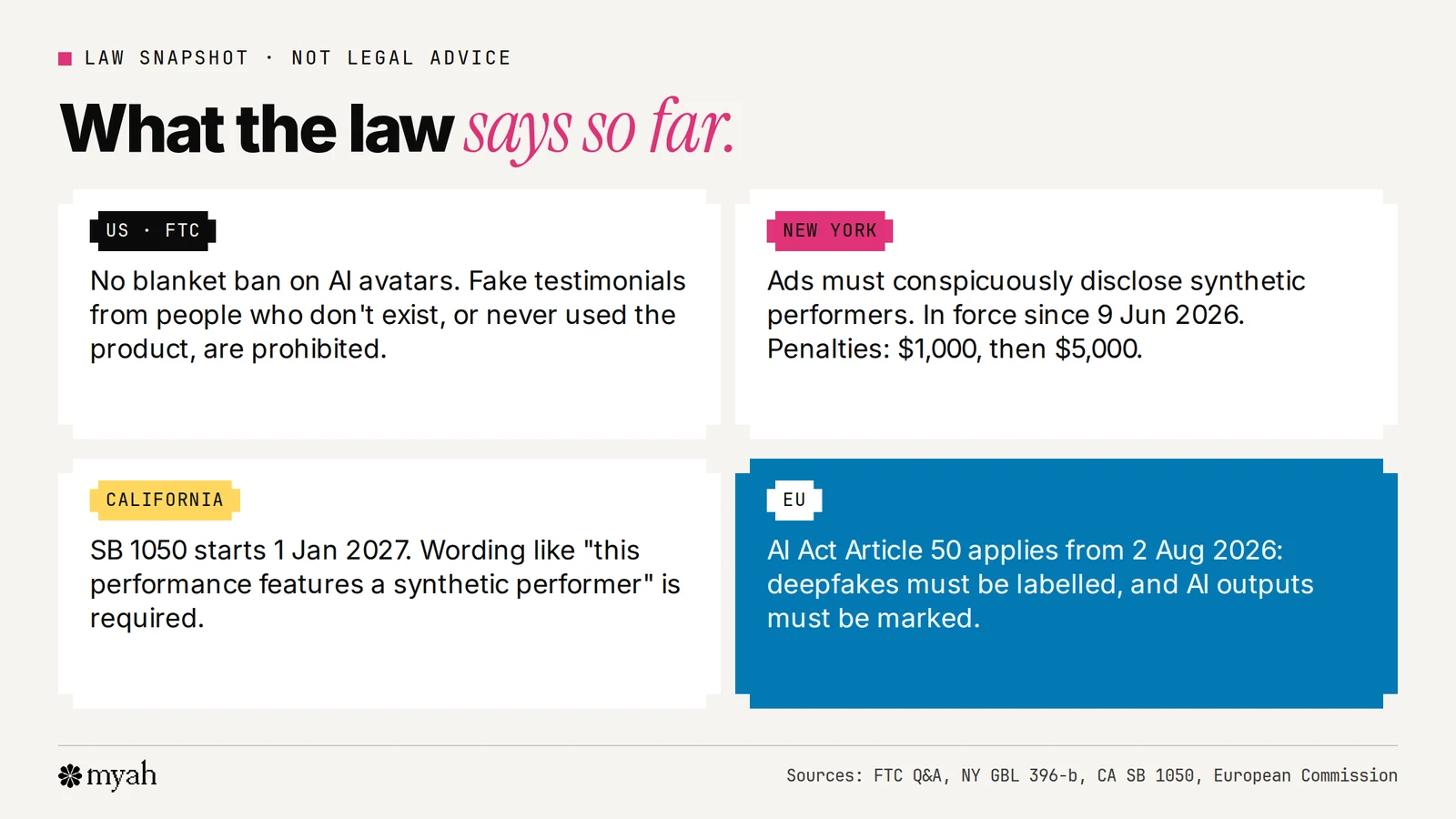
United States, federal. The FTC's rule on consumer reviews and testimonials took effect on 21 October 2024. It prohibits fake testimonials that misrepresent that they are by someone who does not exist, such as AI-generated fake reviews, and the rule lets the FTC seek civil penalties against knowing violators. Its Q&A says the rule has no blanket prohibition on AI-generated avatars in marketing, and that influencers who post testimonials can be liable if they lie about having used a product.
New York. A law amending General Business Law § 396-b, signed on 11 December 2025 and in effect from 9 June 2026, requires a conspicuous disclosure when an ad includes an AI-generated "synthetic performer." As summarised by law firms, it applies where the business has actual knowledge, and civil penalties are $1,000 for a first violation and $5,000 for later ones.
California. Governor Newsom signed SB 1050 on 16 September 2026; it takes effect on 1 January 2027. It makes it unlawful to publish an ad that prominently includes a synthetic performer without a clear and conspicuous disclosure, using wording substantially similar to "this performance features a synthetic performer" or "no human performer is depicted." It includes exemptions, for example for generative AI used solely for translation.
European Union. The European Commission says Article 50 of the AI Act applies from 2 August 2026. Deployers must clearly label deepfakes and, in some cases, AI-generated text on public-interest matters. Providers must mark AI-generated content in a machine-readable way. A grace period until 2 December 2026 applies only to the marking duty for systems already on the market before 2 August. The Commission also published a voluntary code of practice in June 2026. Whether a particular ad counts as a "deepfake" depends on the Act's definition, so that's a question for a lawyer.
Timeline
What we don't know
- How much AI-presenter advertising is running. No source we found counts it.
- How it performs. Experiments compare influencers, not live campaigns. Platform data on AI-presenter ad results wasn't public in what we reviewed.
- Whether attitudes will last. The Gartner results are one survey. Experimental results show novelty fading, so today's reactions may not hold.
- How the laws will be enforced. The New York and California laws are new, and the EU's rules apply to providers and deployers in different ways.
- Whether the spring dip in searches is real. One quarter isn't a trend.
Questions to ask, whichever way you lean
These aren't advice for or against using AI creators. They're questions that come out of the rules above. This is general information, not legal advice.
Brands
- Does any person, voice or testimonial in the ad depict someone who doesn't exist? If so, which platform and legal disclosure rules apply where the ad runs?
- Who is responsible for disclosure, you, the agency or the creator? Put it in the brief.
- Do you keep a record of which tools made which assets?
- Have you tested it against a human-made version in your own account, instead of assuming either result?
Creators
- Does the brief or contract allow, require or forbid AI editing, voice or likeness use?
- Who owns the footage, and can it be used to train or generate other content? Get it in writing.
- Are you disclosing AI use on each platform as required?
- If the deal covers paid-ad use of your likeness, is the length and scope clear?
How we'll keep this updated
This is a research page, not a one-off post. We'll refresh the search data, check platform rules against the current help pages and add new studies. If you spot something out of date, tell us. For related guides, see how partnership ads work and how hook rate is measured.
Method and sources
- Search data. Google Trends data retrieved through Composio's search-trends tool, queried 8 October 2026. Worldwide, last five years, weekly. Quarterly figures are averages of weekly values. Two comparison groups: (1) ai ugc, ai influencer, ai avatar, ugc creator, virtual influencer; (2) ai ugc, arcads, higgsfield, creatify, heygen. Each is scaled so that its highest value is 100.
- Primary sources. Gartner press release (22 Sep 2026), Journal of the Academy of Marketing Science (28 Jul 2026), IAB (2026), Meta Q2 2026 earnings transcript, Meta Business Help Center, TikTok Help Center, YouTube Help and Blog, FTC, New York Governor's Office, California Legislature, European Commission.
- Secondary sources used only for context. Law-firm summaries of the New York and California laws, Influencer Marketing Hub, company websites.
- Not used. Compliance blogs and vendor summaries whose claims we couldn't trace to a primary source.
Common questions
What is an AI influencer?
There's no standard definition. It usually means a virtual persona with its own social presence. A related term, "AI UGC," usually means ad-style video where AI generates the presenter or voice.
Are AI influencers legal in ads?
In the US, the FTC says its testimonials rule has no blanket ban on AI-generated avatars, but fake testimonials from people who don't exist or never used the product are prohibited. New York already requires disclosure of synthetic performers in ads, and California will from 2027. In the EU, labelling duties apply from 2 August 2026. Check the rules where your ads run.
Do platforms require AI labels?
Meta labels AI-made ads and may detect third-party AI tools. TikTok requires a label on realistic AI content. YouTube requires disclosure of realistic altered or synthetic content. Details differ by platform and change over time.
Do consumers trust AI creators less?
On average, experiments find virtual influencers are less credible than human ones, and in a Gartner survey 57% of consumers said AI-generated content made them trust brand messaging less. But 43% said they rely more on real people for shopping advice, and the evidence on disclosure is mixed.
How popular is AI UGC?
Search interest is rising, and IAB reports that nearly two in three video buyers use generative AI for creative. But no source we found measures how many AI-presenter ads run or how they perform.
Myah is building a performance-UGC marketplace for brands and creators. Join brand early access or join creator early access for updates from Myah. Early access does not guarantee campaigns, availability or earnings.