

You can become a UGC creator without followers, because many brands pay for the video rather than the audience. But "no followers needed" is only true for some deals. It holds when the brand posts your video from its own account. It does not always hold when a brief filters creators by audience, or when your video runs from your own Instagram or Facebook handle.
This guide shows where followers matter, how to build proof of your work from scratch and what to sort out before your first invoice.
For this guide, UGC means creator-made product content commissioned for a brand's marketing, often used in ads. That is different from an influencer deal, where a brand mostly buys access to your followers.
Do you need followers to do UGC?
Often not. JoinBrands, a UGC marketplace, says UGC creators don't need a large following, because brands pay "for the content itself, not the reach." Billo says its creator Premium tier unlocks after 14 videos, "with no following required." Both are vendors describing their own marketplaces, so treat them as how those platforms work, not a rule for the whole market.
The honest version is a three-lane picture.
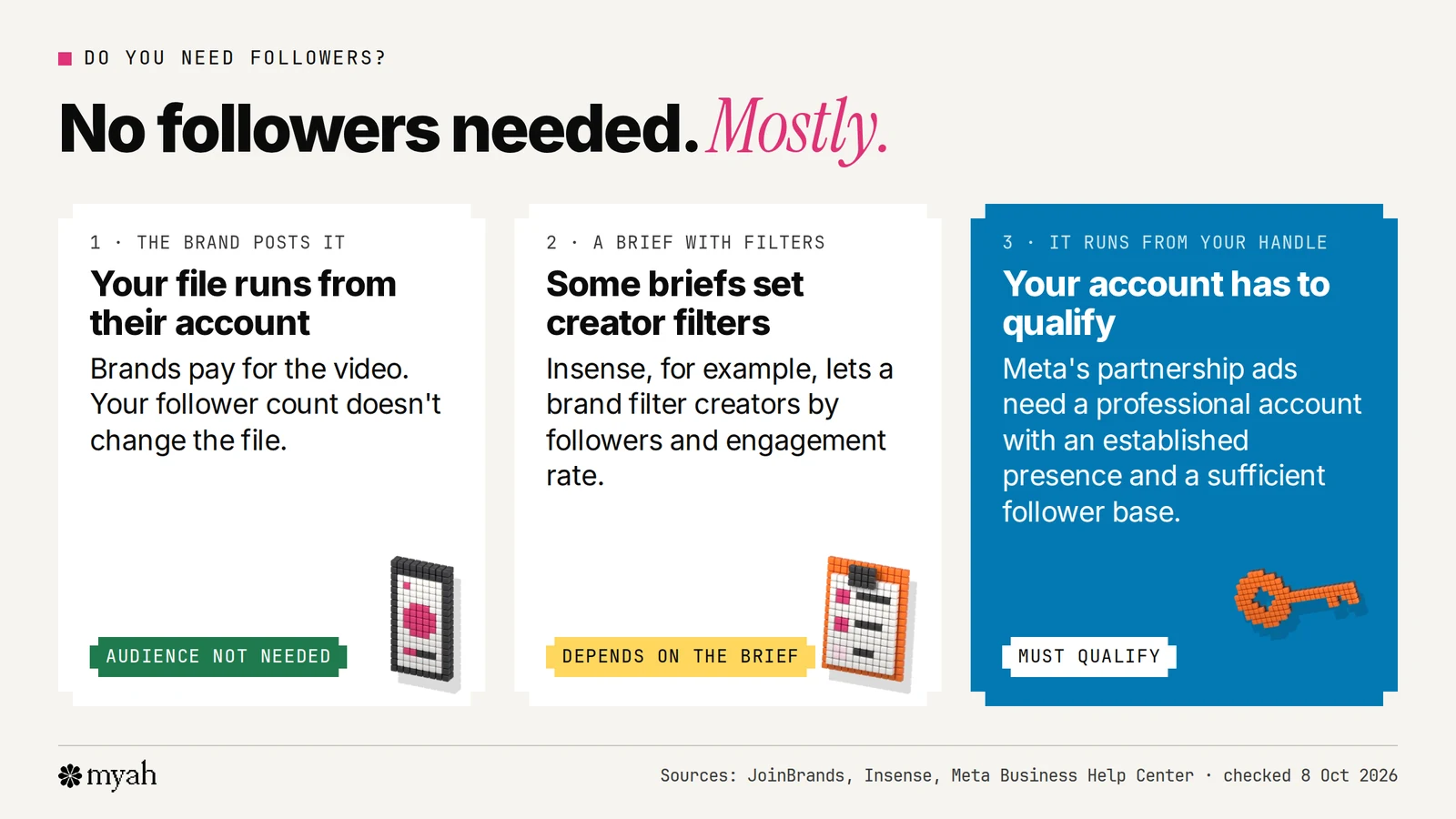
Lane 1: the brand posts it
You film, edit and deliver a file. The brand uploads it to its own ad account or channels. In this lane the buyer cares about the footage, the delivery and whether it's usable. Your follower count doesn't change any of that.
Lane 2: a brief with filters
Marketplaces let a brand describe who it wants. Insense's UGC page lists followers and engagement rate among the creator requirements a brand can set, next to location, category and age. Some briefs will filter you out. Many won't. Read each brief before you assume either way.
Lane 3: it runs from your handle
Some brands want to run your video as a partnership ad, which shows your account's name in the ad. That needs permission from you and an eligible account. Meta requires a professional Instagram account or a Facebook Page or profile in professional mode, public content and "an authentic, established presence" that includes "a sufficient follower base". Meta publishes no minimum number.
So if a brand asks to run ads from your handle and you have a brand-new account, say so early. You can still deliver files for the brand to post itself.
What brands are actually buying
When there's no audience to buy, the video has to carry the deal. For a brand running it as an ad, a usable video usually has:
- An opening that earns the next few seconds. If you want the numbers behind that, read our guide to hook rate on Meta.
- A clear demonstration. The viewer can see what the product does.
- Clean audio and framing. Spoken lines are easy to hear and the product isn't hidden.
- Honest claims. You only describe what you actually tried.
- Files and delivery that match the brief. Right format, right length, on time.
None of that depends on a follower count. All of it can be practised with a phone.
From phone to first paid video
This is a practice plan, not a promise of work or income. Nobody can tell you how long your first paid deal will take.
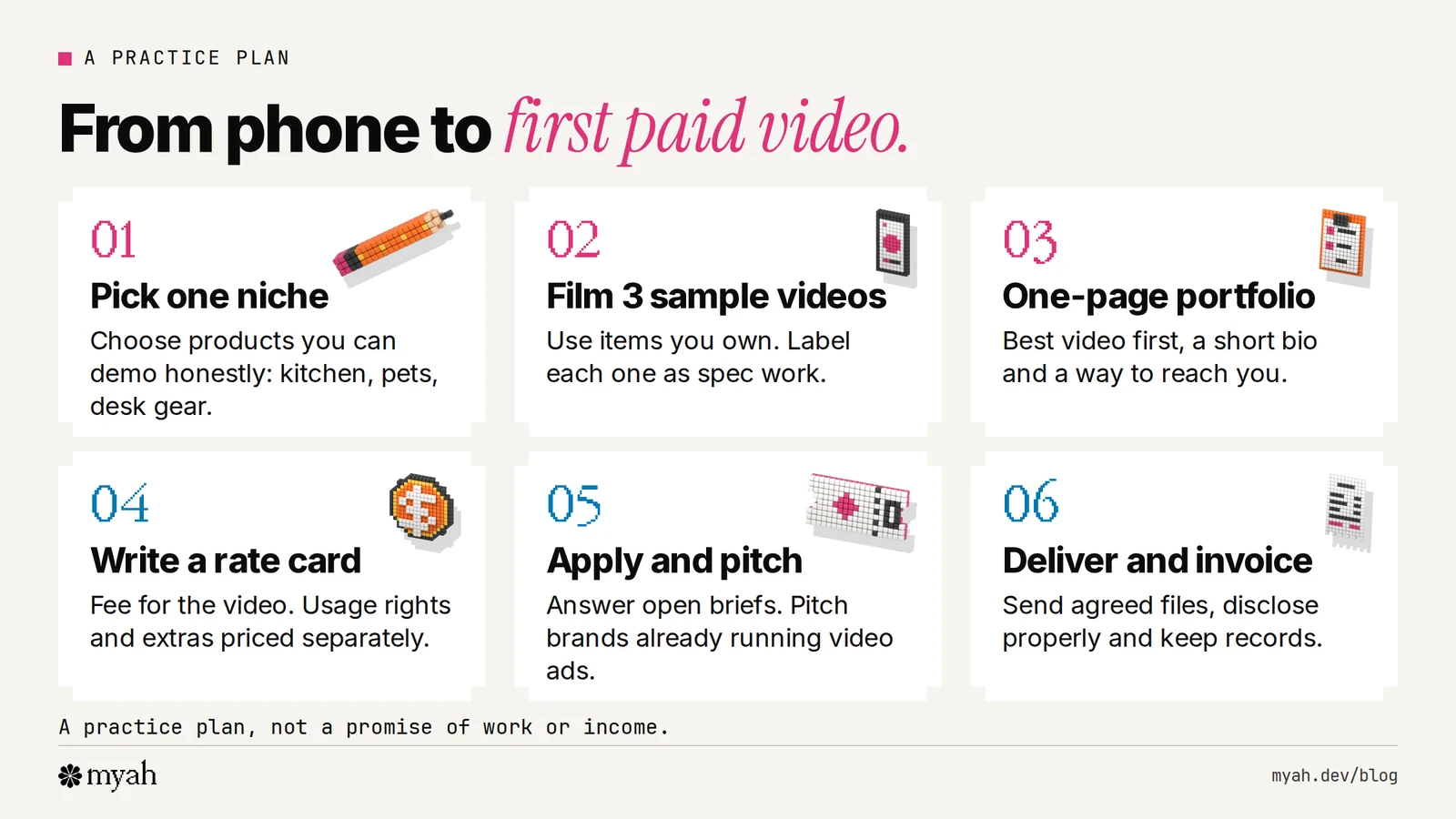
1. Pick one niche you can demonstrate honestly
Choose products you can show working: kitchen items, pet gear, desk accessories, simple skincare you already use. A narrow niche makes your samples look consistent and makes it easier for a brand to picture you making theirs.
Be careful with categories that invite claims you can't back up, such as health, money or body changes. The FTC's endorsement guidance says endorsers shouldn't talk about their experience with a product they haven't tried, or make claims that would need proof they don't have.
2. Film three sample videos
Make short, vertical, ad-style videos with products you already own. Aim for clear sound, steady framing and an obvious point. Label each one as self-directed spec work so no one mistakes it for a paid campaign. Our UGC portfolio guide walks through five practice assignments and how to label them.
Meta's own advice for Reels ads is to shoot 9:16 vertical video, use audio and keep key elements inside the safe zones. Practising that now means less rework later.
3. Build a one-page portfolio
Brands skim. One page, no login, your best video first, a two-line bio that names your niche and the formats you make, and a way to reach you that works on a phone. Don't invent clients or results.
4. Write a rate card
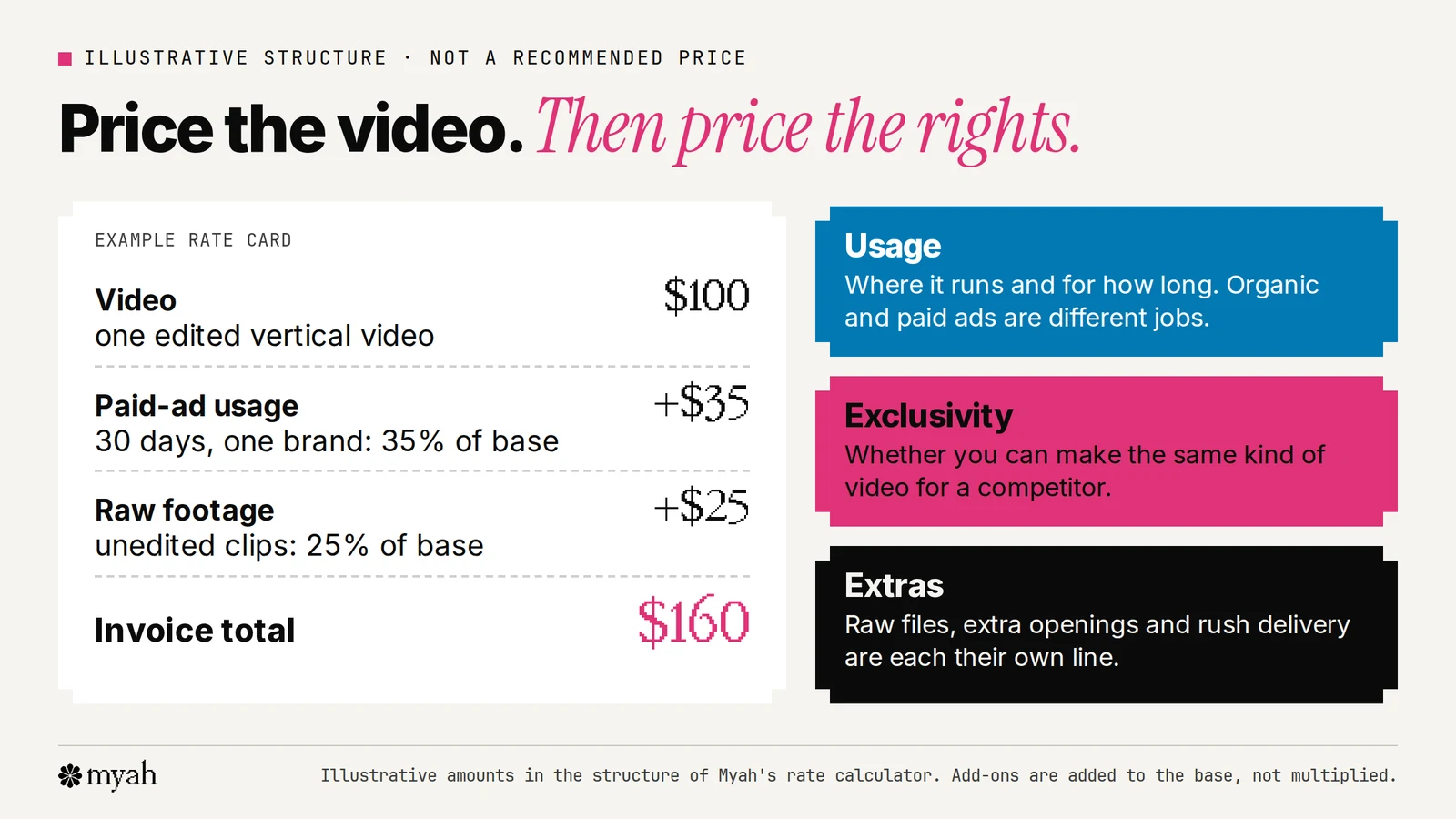
Price the video first. Then price the rights separately.
What should the first number be? Two marketplaces publish data with sample sizes. Both are vendors, and neither is a survey of all creators:
- Pitchlo, a job board, analysed 593 per-video briefs listed between December 2025 and September 2026. The median advertised rate was $100, half fell between $50 and $200 and the top tenth cleared about $300. Niche barely moved the median. Pitchlo is clear that these are advertised budgets, not settled invoices.
- UGC Roster's Q3 2026 report puts the median creator-listed rate at $195 (368 packages), the median brand budget at $200 (71 campaigns) and the median signed contract at $140. That last figure rests on just 32 contracts, so treat it as a hint, not a benchmark. UGC Roster notes that listed rates are asks, not clearing prices.
Our free UGC rate calculator turns data like this into a starting range. For a new creator (0 to 5 brand videos) it uses a base of $50 to $150 for one short, edited video with organic use on the brand's channels, then adds a share of that base for each extra term. It adds, for example, 35% for 30 days of paid-ad use and 25% for raw footage. Those add-on percentages are published industry conventions, not transaction medians, and we treat them as estimates. Many rate figures also repeat across guides without a traceable source, so a number appearing on many sites isn't independent evidence.
Your own number should reflect the work, the length of use and who controls distribution. Our usage-rights guide covers the questions to ask.
If a brand offers a free product instead of a fee, treat it as a deal and decide on purpose. Agree what you'll make, what they can do with it and for how long.
5. Apply and pitch
There are three common routes:
- Marketplaces. On platforms such as Billo and JoinBrands, brands post briefs and creators apply. Insense lets brands set creator requirements. Each platform has its own rules, fees and payout terms.
- Direct pitches. Look at brands that are already running video ads. Meta's Ad Library shows ads currently running on Facebook and Instagram, which tells you who is buying video.
- Your own network. Small brands you already use are often the easiest first conversation.
A short pitch is enough: who you are, what you would make, a link to one relevant sample, and a rate or a request for the brief. Match the pitch to the brand's product, not a template you've sent to fifty people.
6. Deliver, disclose and invoice
Send the files in the format you agreed, with captions if requested. Keep a copy of the brief, the message where the terms were agreed, your invoice and the payment.
Before you hit send
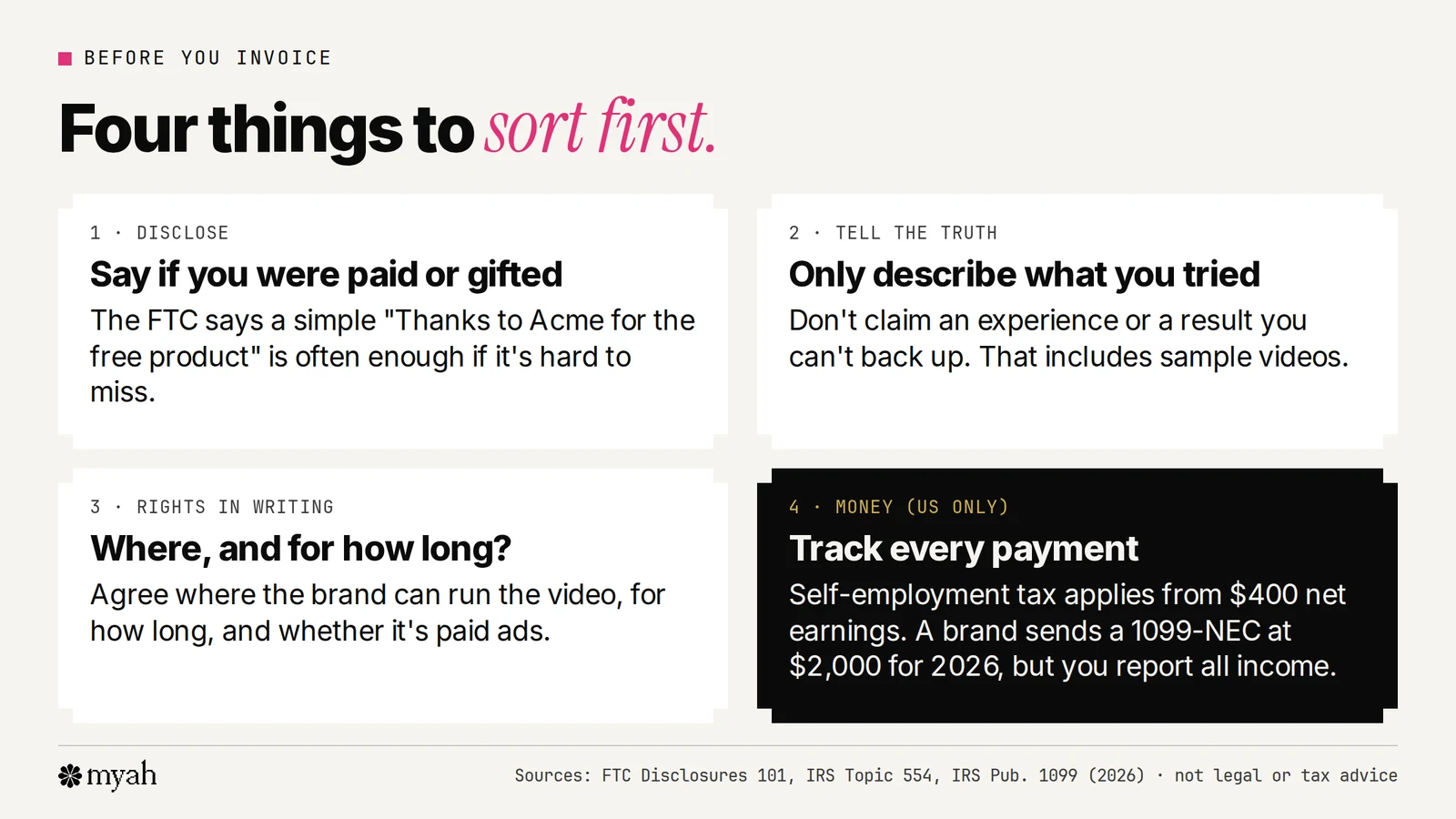
Disclose. If you got paid or received a free product, the FTC says that connection must be disclosed clearly. Its influencer guide says simple wording such as "Thanks to Acme brand for the free product" is often enough if it's hard to miss, and that it's your responsibility to make the disclosure. If the brand posts or runs the video itself, ask who is responsible for disclosure and get the answer in the brief.
Tell the truth. Don't say you've used something for months if you haven't. That applies to sample videos too.
Put rights in writing. Where can the brand run the video, for how long, and is paid advertising included? A platform permission isn't a contract; see our guide to usage rights and partnership-ad permissions.
Track the money (US). In the US you usually owe self-employment tax if your net earnings from self-employment are $400 or more. The IRS says the reporting threshold for Form 1099-NEC rises to $2,000 for payments made from 2026, so a brand may not send you a form for smaller payments. You still report the income. Outside the US, the rules differ. This is general information, not tax advice, so check with a qualified adviser.
Free checklist
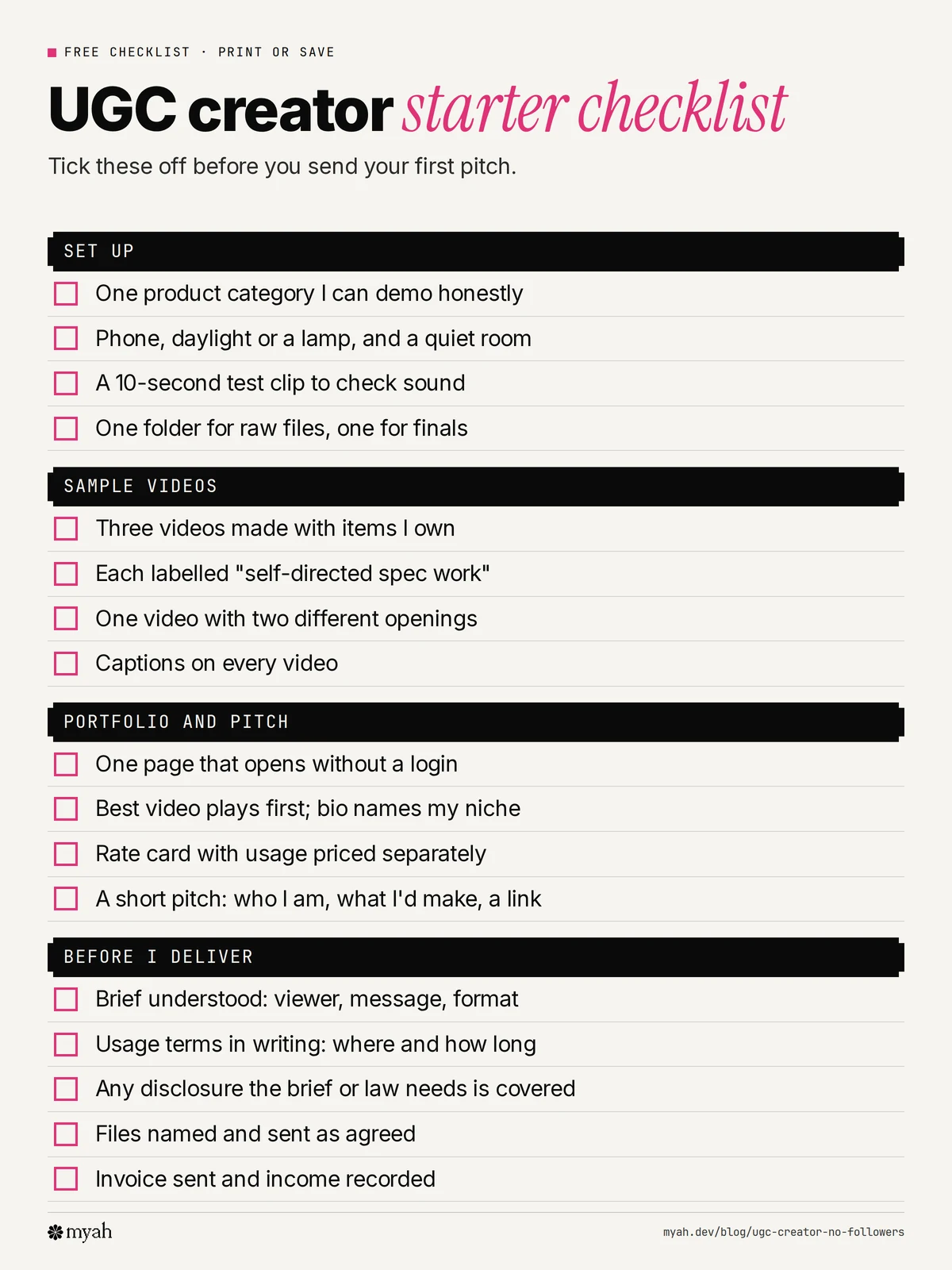
A one-page checklist covering setup, samples, portfolio, pitch and delivery. Download the PDF or save the image below.
What nobody can promise
Plenty of guides quote monthly incomes for beginners. Those figures come from the guides' authors, we didn't find independent data behind them and we haven't repeated them. Your results depend on your niche, your work, how often you apply and what brands need that month.
Brands are also trying AI-generated video alongside creator content. We cover what the research and the rules say in The rise of AI creators.
Common questions
Can I really do UGC with zero followers?
Yes, for deals where the brand posts the video itself. You may not qualify for briefs that filter by audience, or for ads that run from your own account.
Do I need to show my face?
It depends on the brief. Some ask for a creator on camera, while others accept hands-only demos or voiceover. Read the brief, and only agree to formats you're comfortable with.
Do I need expensive equipment?
No. A phone, daylight or a simple lamp and a quiet room are enough to start. Check your sound before you buy anything.
Should I work for free to build a portfolio?
You don't need a client to build one. Make self-directed samples with products you own. If you do take an unpaid job, agree in writing what you'll deliver and how it can be used.
Do brands pay more for a creator with followers?
Sometimes, particularly when the brief includes posting on your account. UGC rates are usually based on deliverables, the length of use and any exclusivity, so followers are not the only factor.
Start with the work
Pick a niche, film three honest samples, put them on one page and write a rate card that prices the video and the rights separately. That gives you something concrete to send and something honest to improve.
Myah is building a performance-UGC marketplace for brands and creators. Join creator early access for updates from Myah. Signing up does not guarantee campaigns, acceptance or earnings; you can build your samples while you wait.