

A UGC creator is someone brands pay to make photos and videos that look and feel like content from real customers: reviews, demos, unboxings and "here's how I use it" clips. The brand then uses that content in its ads, on product pages and on its own social accounts. Unlike an influencer, a UGC creator is paid for the content itself, not for their audience, and the video often never appears on the creator's own account.
This guide explains what a UGC creator is and what the job involves day to day, how UGC creators get paid, how it differs from influencer work, and where to learn each skill. It's also a map of every guide we've written for creators and brands.
What "UGC" means, and why a UGC creator is a bit of a paradox
UGC stands for user-generated content. In its 2007 report on the participative web, the OECD defined it as content made publicly available over the internet that reflects a certain amount of creative effort and is created outside of professional routines and practices. Think of a customer filming a review of something they bought, unprompted and unpaid.
A UGC creator flips that around. They're paid, briefed and often experienced, but they make content in the same natural, phone-shot style. Brands want it because it feels like a recommendation from a person rather than an ad. So "UGC creator" really means "creator of UGC-style content", and the job is to make something that feels unpolished while hitting a brief.
What a UGC creator actually does
Most UGC jobs follow the same steps, from the brand's brief to a video running as an ad.
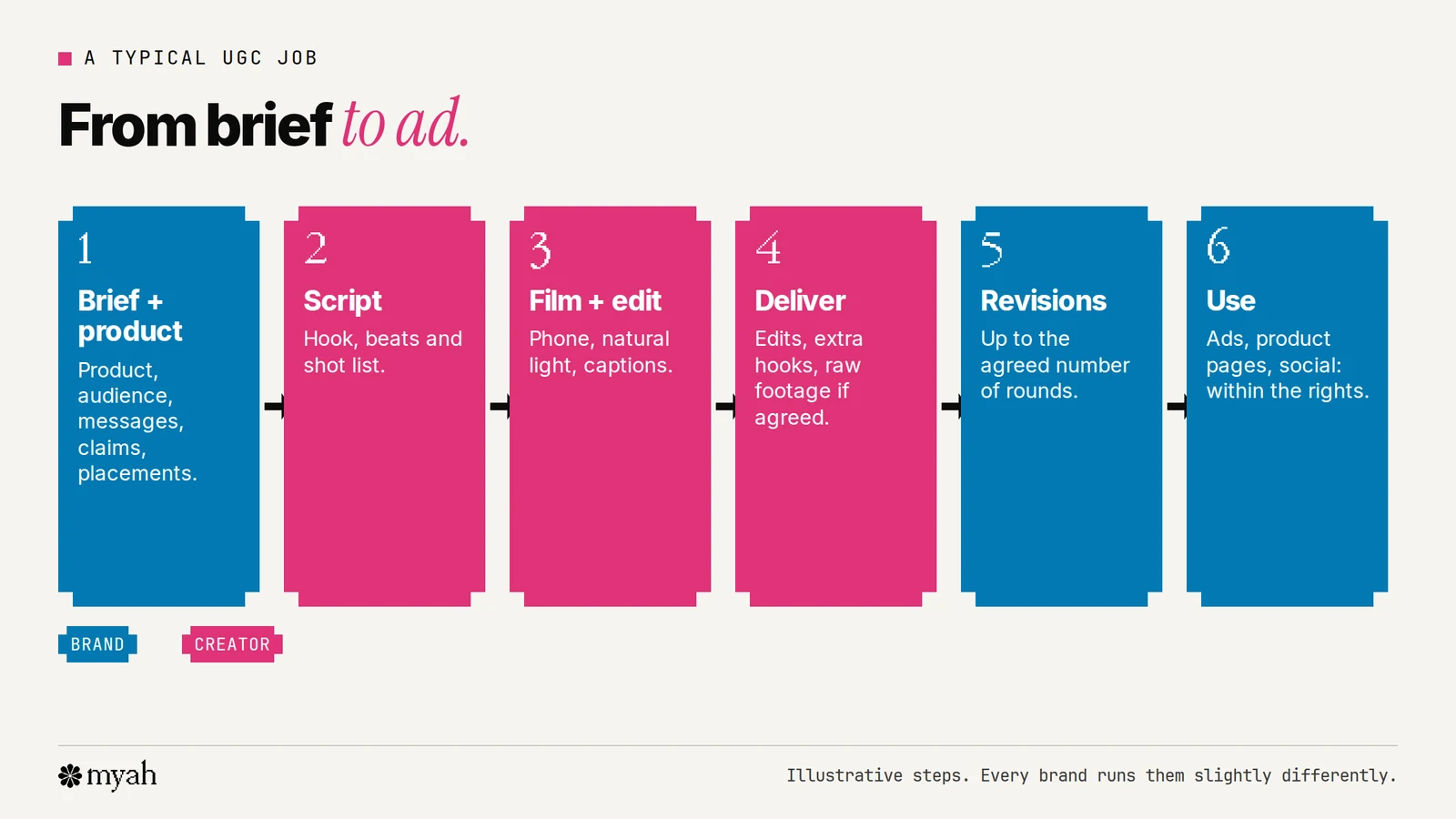
- Brief and product. The brand explains the product, the audience, the key messages, the must-say claims and where the video will run. It usually ships the product. Our UGC brief template shows what a good brief includes.
- Script. The creator plans the hook, the beats and the shots. Some brands write the script, many leave it to the creator. See our UGC script template.
- Filming and editing. Usually on a phone, at home, in natural light. Our guide to filming and editing UGC covers setup, sound and apps.
- Delivery. Edited videos, often with alternative hooks, raw footage or a version without captions, depending on the brief.
- Revisions. The brand asks for changes, up to the number of rounds agreed up front.
- Use. The brand runs the video under the agreed usage rights, for example as a Meta partnership ad with the creator's handle on it, or on a product page.
The typical formats are the ones that feel like a real person talking about a real product: problem-to-solution, honest review, unboxing, demo, before-and-after and day in the life.
UGC creator vs influencer
The two get mixed up because both are creators paid by brands. The difference is what the brand is buying.
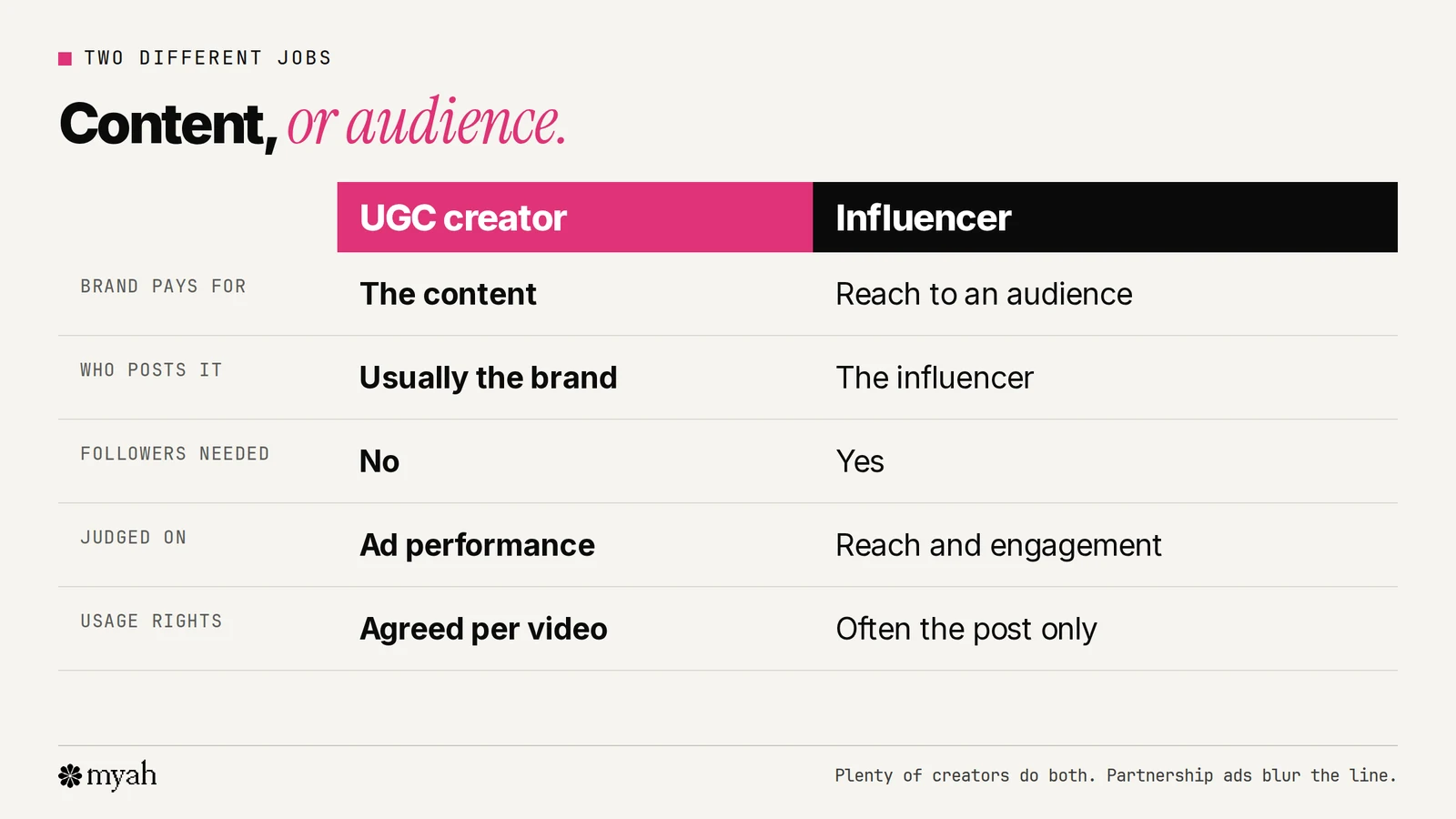
| UGC creator | Influencer | |
|---|---|---|
| The brand pays for | The content | Reach: access to the influencer's audience |
| Who posts it | Usually the brand, in its ads or channels | The influencer, on their own account |
| Followers needed | No | Yes, it's the product |
| How it's judged | How the content performs in the brand's ads | Reach and engagement on the influencer's posts |
| Usage rights | Agreed per video: how long and where the brand can run it | Often limited to the influencer's post, unless negotiated |
Plenty of people do both, and the line is blurring. With partnership ads, a brand can run a creator's video from the brand's ad account with the creator's name on it. If you're starting from zero, read how to become a UGC creator without followers.
Where brands use UGC
One video can work in several places, which is part of why brands buy it.
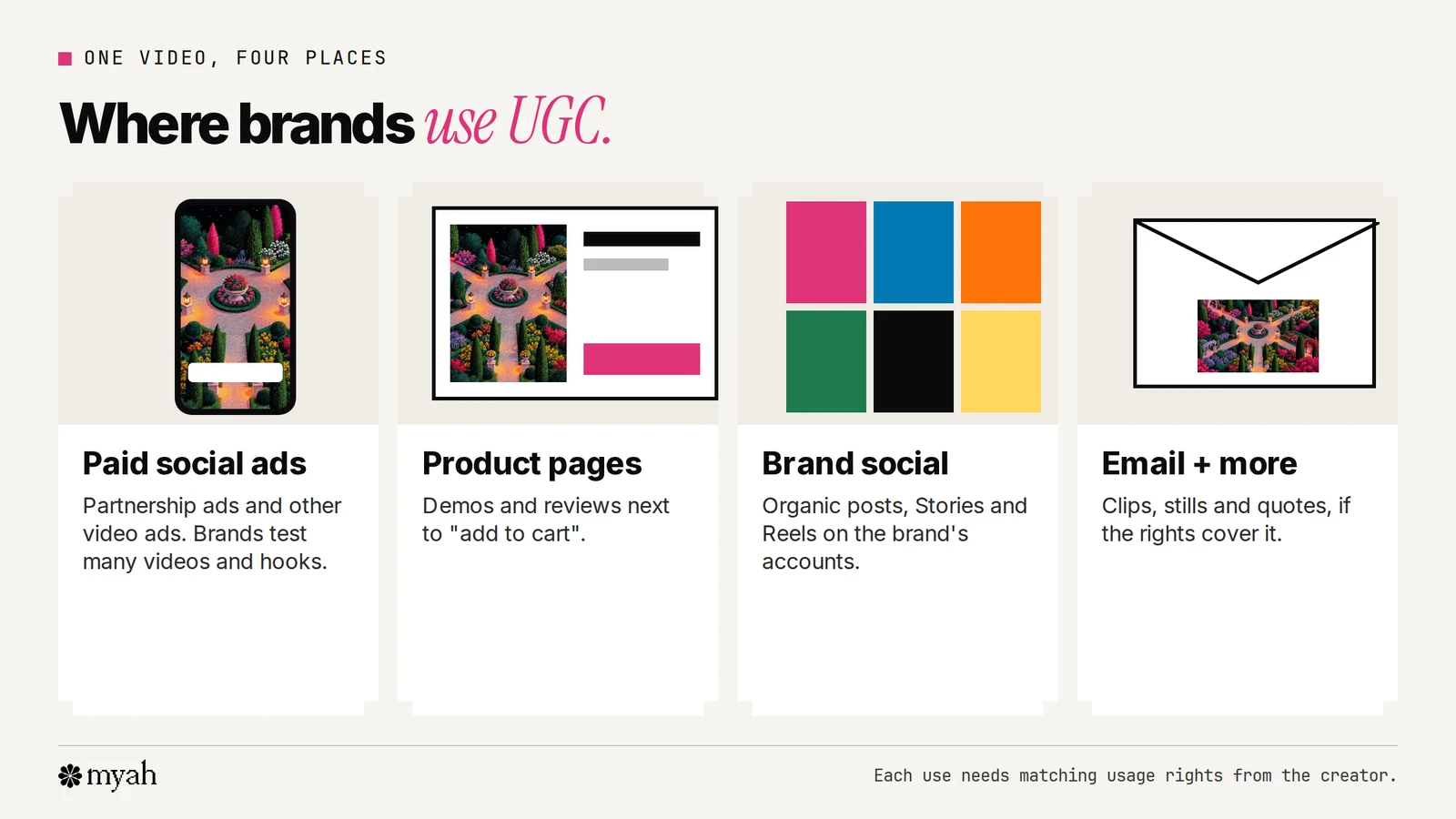
- Paid social ads. Brands test several creator videos and hooks to find the ones that sell. See how brands measure the first 3 seconds and how to make UGC a brand can actually test.
- Product and landing pages. Short demos and reviews next to the "add to cart" button.
- The brand's own social accounts. Organic posts, Stories and Reels.
- Email and other marketing. Clips, stills or quotes, if the rights cover it.
Each of these needs permission. A creator who agrees to "organic use on the brand's channels" hasn't agreed to paid ads, which is why rights are priced separately.
How UGC creators get paid
Most UGC work is paid per deliverable: a fee for each video, plus extra for things that add value for the brand.
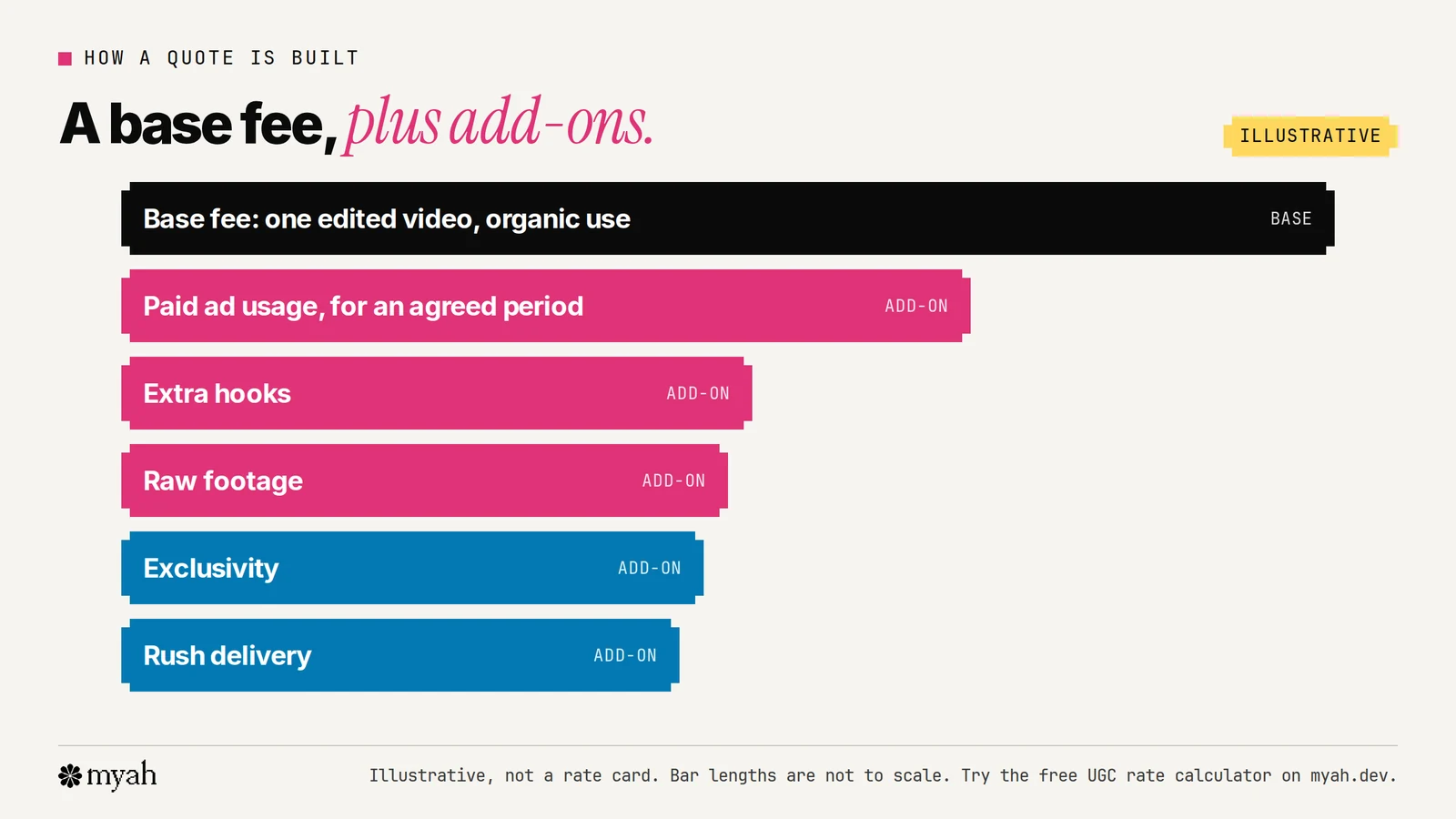
- A base fee per video, for an edited video with organic use on the brand's channels.
- Add-ons for paid ad usage and its length, extra hooks, raw footage, exclusivity and rush delivery.
- Other models. Some brands offer product only (gifted), monthly retainers for a set number of videos, or a share of sales on top of a fee. Our guide to flat fee vs commission explains the trade-offs.
Published rate data is thin and mostly comes from platforms that sell UGC services, so treat it as a rough guide. As examples of that vendor data:
- Pitchlo, a job board, found a median advertised rate of $100 across 593 per-video briefs listed between December 2025 and September 2026.
- UGC Roster's Q3 2026 report puts the median signed contract at $140, based on just 32 contracts.
- UGC Roster's live rates report, updated 1 October 2026, shows a median of $200 across 155 public brand listings with posted budgets, which it describes as opening offers.
To work out a starting price for your own deliverables, try our free UGC rate calculator.
Do you need followers to be a UGC creator?
No. Brands pay for the video, and in most UGC deals the brand posts it, not you. What you do need is proof you can make good content, which is what a portfolio is for. Read how to build a UGC portfolio with no client experience and how to become a UGC creator without followers.
Interest in UGC creation keeps climbing
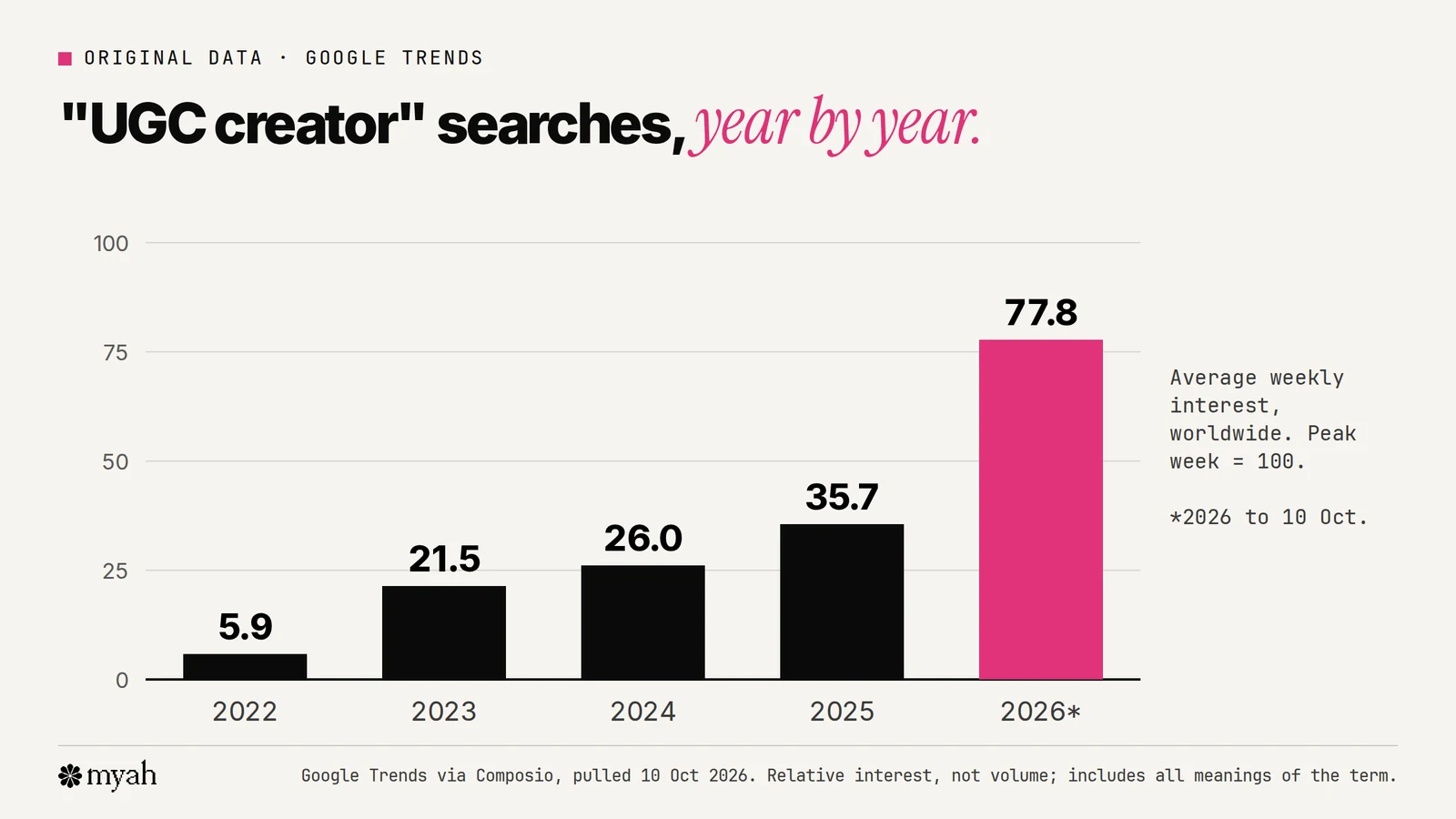
We pulled five years of Google Trends data for the term. Worldwide search interest in "ugc creator" has risen every year since 2022.
| Year | Average interest in "ugc creator" (peak = 100) |
|---|---|
| 2022 | 5.9 |
| 2023 | 21.5 |
| 2024 | 26.0 |
| 2025 | 35.7 |
| 2026 (to 10 October) | 77.8 |
Two caveats: Google Trends shows relative interest, not search volumes, and the term includes people searching for the Roblox meaning (below). So read it as a direction, not a market size. You can download the weekly data (CSV), which also includes "ugc jobs", "ugc portfolio" and "ugc rates".
Not to be confused with: Roblox UGC and UGC NET
"UGC creator" means something different in two other places:
- Roblox. On Roblox, UGC usually means avatar items such as hats, hair, clothing and bodies that community members make and sell. Roblox's help center says players sometimes call these UGC items, and Roblox has run a UGC Creator Program for them. That's 3D design work inside a game, not brand video.
- UGC NET. In India, UGC is also the University Grants Commission, and UGC NET is the exam for assistant professor eligibility and junior research fellowships. Unrelated to creator work.
This guide, and everything on our blog, uses the marketing meaning.
The skills, and where to learn each one
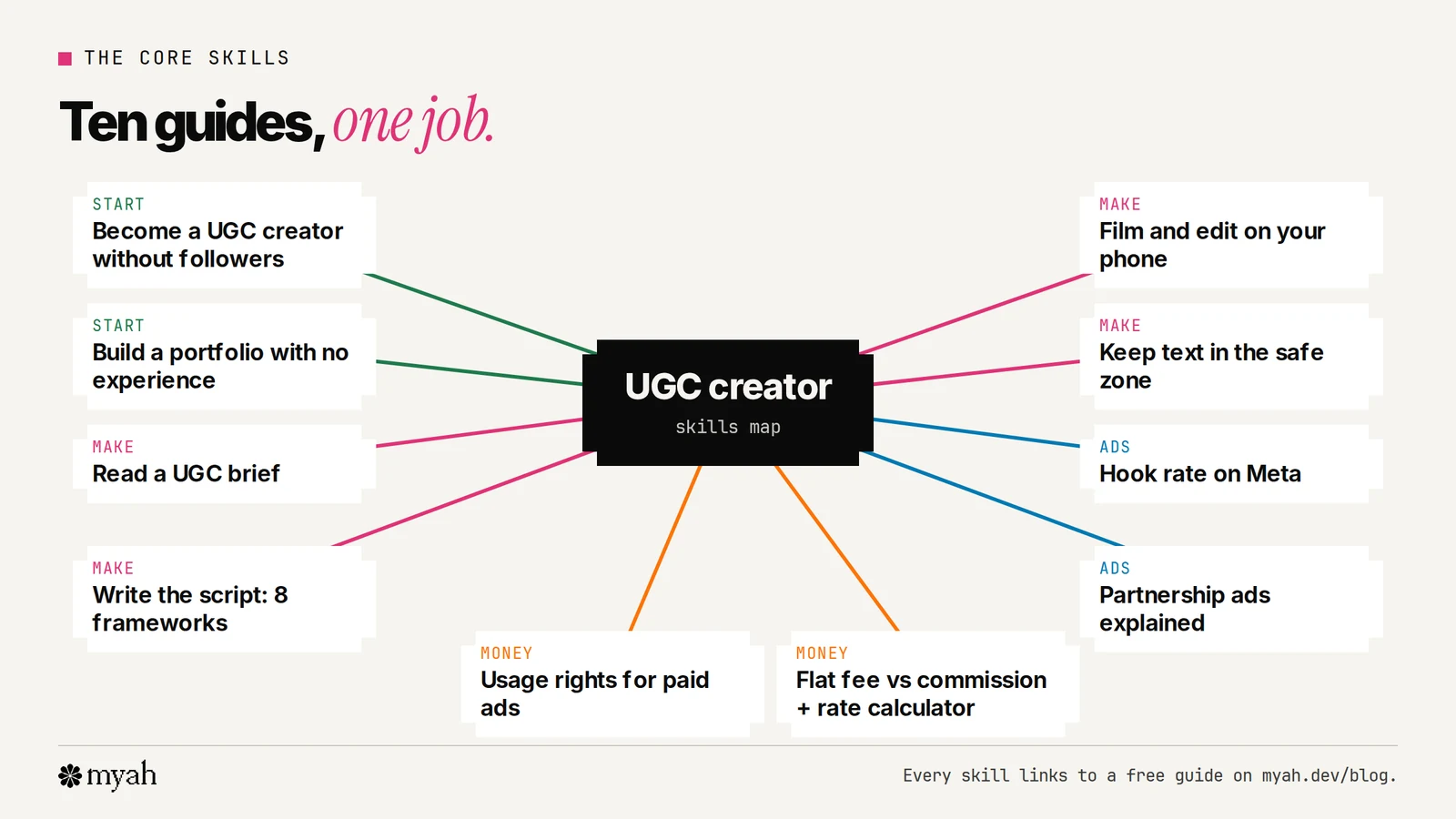
Being a good UGC creator means getting a handful of skills right. Here's the full set, with our guide for each.
Getting started
- How to become a UGC creator without followers
- How to build a UGC portfolio with no client experience
Making the video
- UGC brief template for Meta ads
- UGC script template: 8 frameworks
- How to film and edit UGC on your phone
- Instagram Reels safe zone template
When it runs as an ad
Money and rights
The bigger picture
Being honest: disclosure and real experience
When a UGC creator posts paid content on their own account, it's an endorsement, and it needs to be disclosed. The FTC's guidance for influencers says to disclose any financial relationship with a brand, and that you can't talk about your experience with a product you haven't tried. When the brand runs the video as a partnership ad, Meta shows both names in the ad's header. Either way, only say what's true for you.
UGC glossary
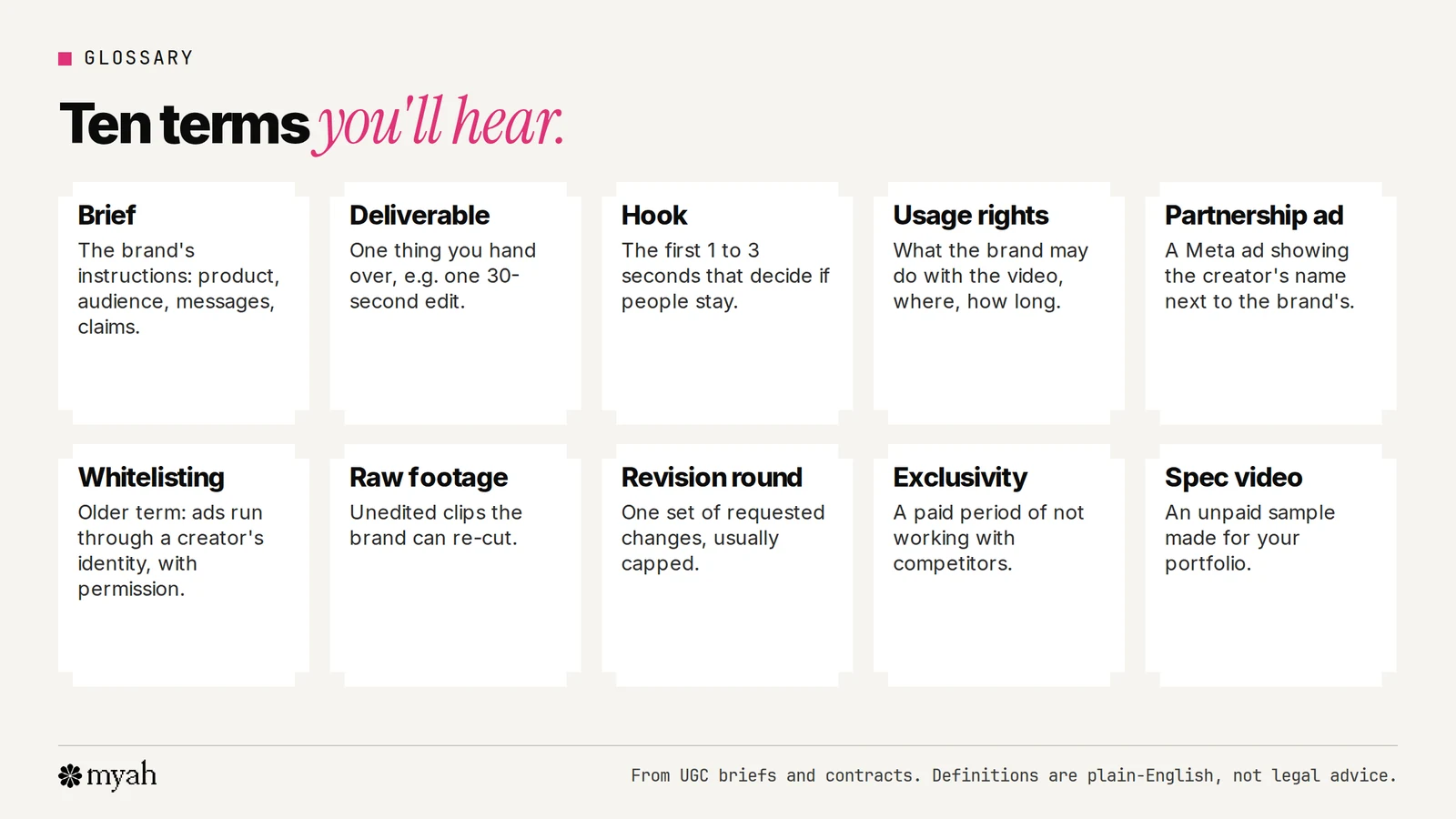
- Brief: the brand's instructions for the video, including product, audience, messages, claims and deliverables.
- Deliverable: one thing you hand over, such as one edited 30-second video.
- Hook: the first 1 to 3 seconds, which decide whether people keep watching.
- Usage rights: what the brand can do with the video, where and for how long.
- Partnership ad: a Meta ad the brand runs with the creator's name shown alongside the brand's.
- Whitelisting: an older term for a brand running ads through a creator's account or identity, with permission.
- Raw footage: the unedited clips, which brands sometimes buy to make their own edits.
- Revision round: one set of requested changes. Contracts usually cap the number.
- Exclusivity: a period when you agree not to work with the brand's competitors, usually paid extra.
- Spec video: a sample video made unpaid, for a portfolio, not for a client.
Common questions
What is a UGC creator?
A UGC creator is someone brands pay to make photos and videos in the natural style of customer content, such as reviews, demos and unboxings, which the brand uses in ads, on product pages and on its own social accounts.
What does a UGC creator do?
They read a brief, write a script, film and edit short videos (usually on a phone), deliver them to the brand and make any agreed revisions. The brand then uses the videos under the usage rights they agreed.
How do UGC creators get paid?
Usually a fee per video, plus add-ons for paid ad usage, extra hooks, raw footage, exclusivity or rush delivery. Some deals add a share of sales, a monthly retainer or product only.
What is the difference between a UGC creator and an influencer?
A UGC creator is paid for the content, and the brand usually posts it. An influencer is paid for reach, and posts to their own audience.
Do UGC creators need followers?
No. Brands buy the video, not the audience. A portfolio that shows you can make good content matters more.
Is being a UGC creator a real job?
It can be full-time work or a side income. Either way, it's freelance work: you find clients, agree terms, deliver videos and invoice, so treat it like a small business, with contracts and tax records.
What is a UGC creator on Roblox?
On Roblox, a UGC creator makes avatar items such as hats, hair and clothing that players buy in the Marketplace. It's a different job from brand UGC video.
Myah is building a performance-UGC marketplace for brands and creators. Brands run approved videos as ads in their own Meta Ads Manager. Join creator early access or join brand early access for updates from Myah. Early access does not guarantee campaigns, availability or earnings.