

There are five ways to hire UGC creators for Meta ads: a UGC marketplace (fastest to start), a freelance site like Upwork (most control over who you hire), an agency (least work, highest cost), direct outreach on Instagram and TikTok, and your own customers. Most brands start on a marketplace, brief three to five creators on one product, then rehire whoever's videos perform.
This guide is for small and growing e-commerce, app and SaaS brands running Facebook and Instagram ads. It covers where to hire, how to vet a portfolio, how to brief and test a first batch, the Meta specs and policies your videos need to pass, the rights to agree before anyone films, and the mistakes that waste a budget.
Five places to hire UGC creators
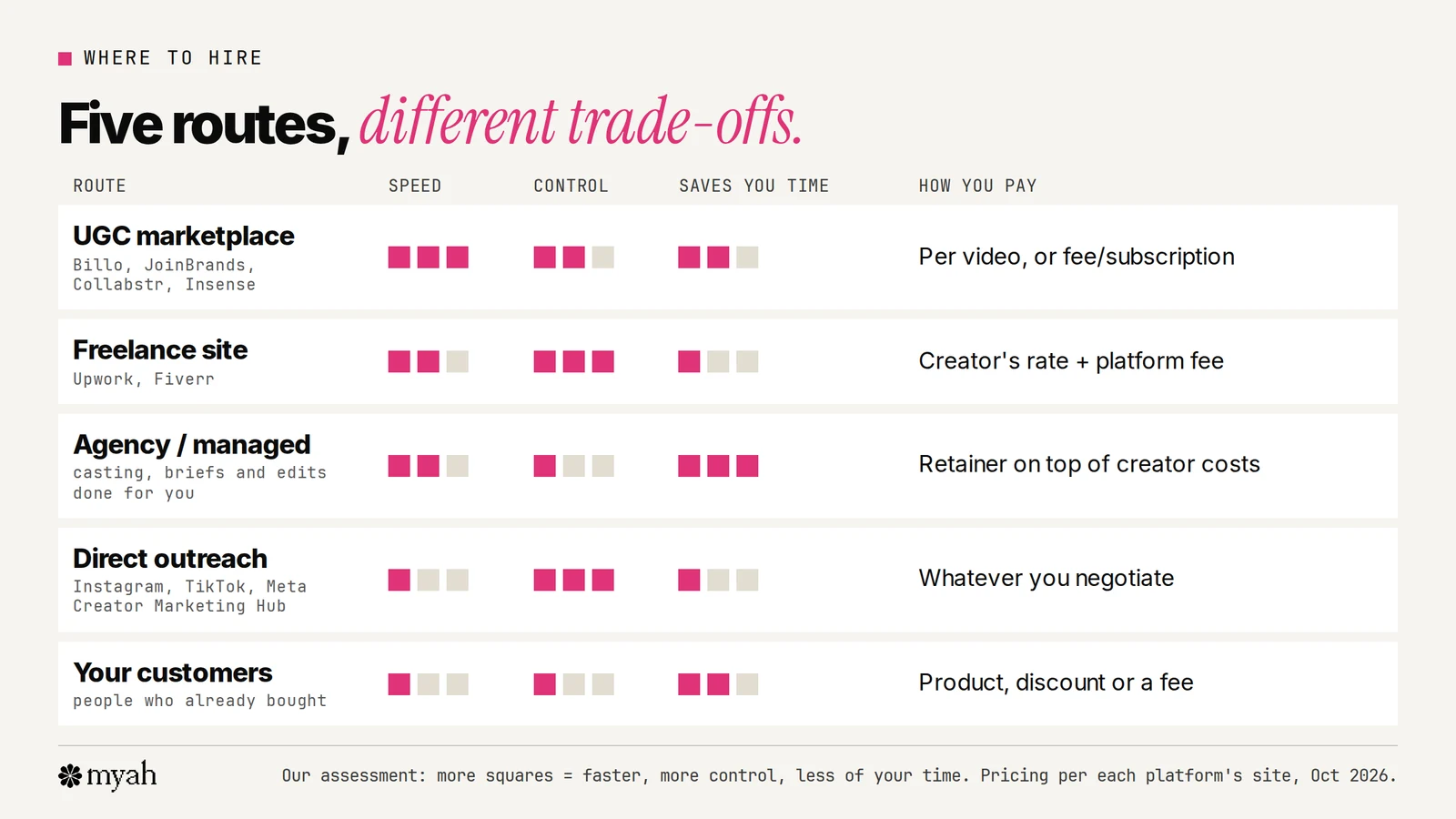
| Route | How you pay | Speed to first video | Your control over who | Your effort |
|---|---|---|---|---|
| UGC marketplace (Billo, JoinBrands, Collabstr, Insense) | Per video, or a fee or subscription on top of creator pay | Fast: days to a couple of weeks | Medium: you pick from applicants | Low to medium |
| Freelance site (Upwork, Fiverr) | Creator's rate plus a platform fee | Medium | High: you choose and negotiate | Medium to high |
| Agency or managed service | Monthly retainer or package on top of creator costs | Medium | Low to medium | Lowest |
| Direct outreach (Instagram, TikTok, Meta Creator Marketing Hub) | Whatever you negotiate | Slow | Highest | Highest |
| Your own customers | Product, discount or a fee | Slow and uneven | Low | Medium |
UGC marketplaces are where most brands start. You post a brief, creators apply with samples and the platform handles payment, often in escrow until you approve. Pricing models differ a lot: Billo starts at $99 a video all-in, Collabstr adds a 10% hiring fee and JoinBrands 15% on pay-as-you-go. Our Billo alternatives and Insense alternatives guides compare platforms on price, commitment and rights, and the best UGC platforms for creators shows which countries each one recruits from.
Freelance sites suit you when you want one specific person or a longer working relationship. Upwork's client fee is 5% on its Basic plan and Fiverr adds a 5.5% service fee, but neither is built for UGC, so you handle product shipping, briefs and ad permissions yourself.
Agencies and managed services cast, brief, chase and edit for you. Expect a monthly fee on top of creator costs; Billo's managed service, for example, starts at $2,000 a month. Worth it if you have budget but no time.
Direct outreach gives you full control and no platform fee. Meta's own Creator Marketing Hub, in Business Suite and Ads Manager, lets eligible brands discover creators and manage partnership ad permissions. But it only lists creators who meet Meta's Creator Marketplace requirements, including at least 1,000 followers. Many good UGC creators have a portfolio and no audience, so you won't find them there.
Your own customers make the most authentic videos, because they've really used the product. They're hard to brief and slow to scale, and the FTC notes that even the chance to be featured in an ad can count as something of value, so treat them like any other paid endorser.
How to hire UGC creators, step by step
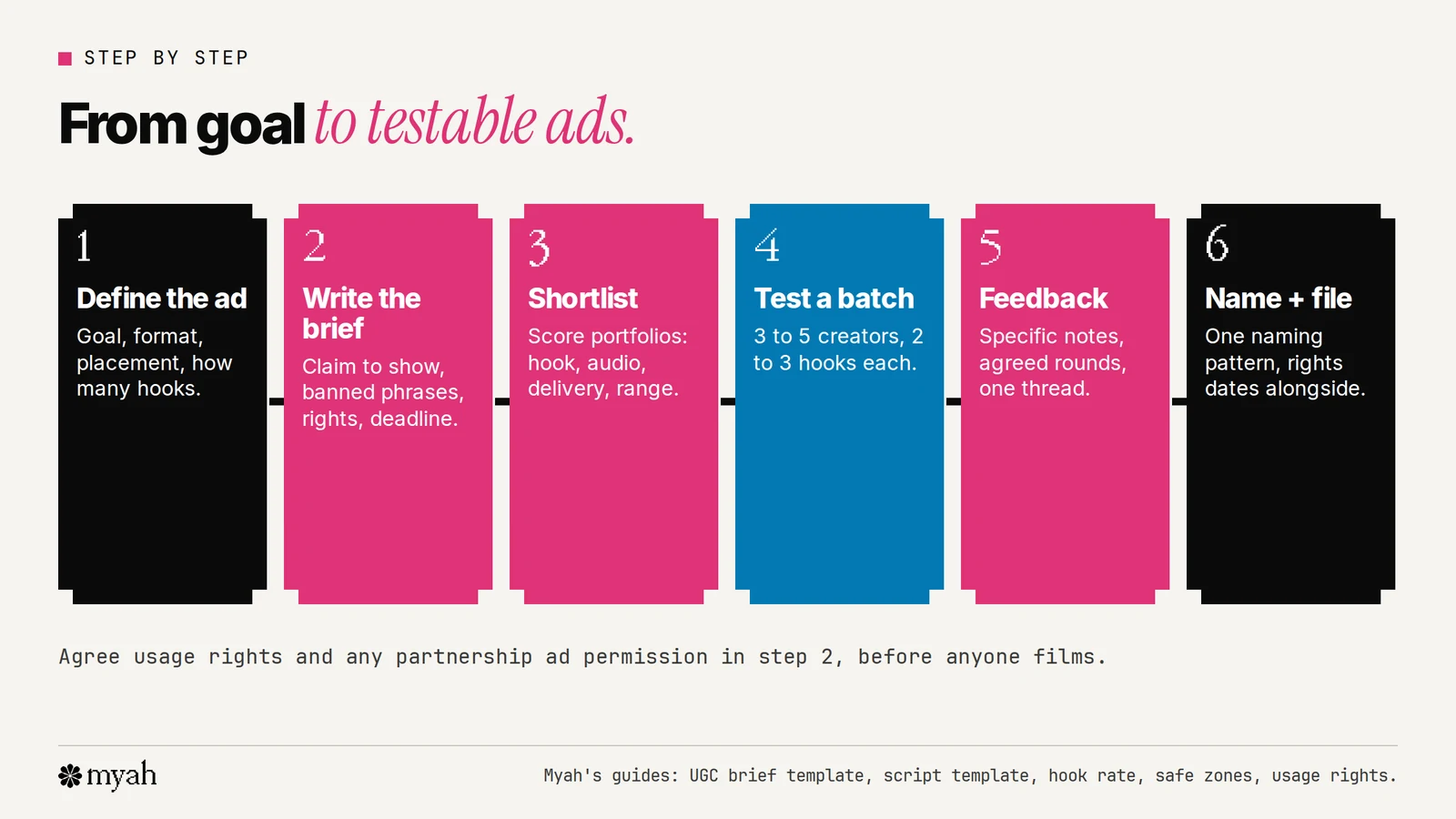
1. Define the ad goal and format
Start from the ad, not the creator. Decide:
- The goal: a cold-audience prospecting ad needs a different video from a retargeting ad for people who already visited.
- The format: problem and solution, honest review, unboxing, demo, before and after, or a founder or expert talking to camera. Our UGC script template covers eight formats with timings.
- Where it runs: for Reels and Stories, vertical 9:16 is the default. Decide now if you also need 4:5 or 1:1 cuts for Feed.
- How many videos and hooks: for a first test, three to five creators with two or three opening hooks each.
2. Write the brief
A good brief tells the creator what the video has to communicate, what to deliver and how you'll approve it. Include the product and who it's for, the one claim the creator must show on camera, things they must not say, the format and length, hook ideas, deliverables, deadline and the usage rights you're paying for. Ship the product early enough for the creator to actually use it.
Our UGC brief template for Meta ads has a filled example you can copy.
3. Shortlist from portfolios
Followers don't predict ad performance, so judge the work. Watch the first three seconds of every sample before anything else.
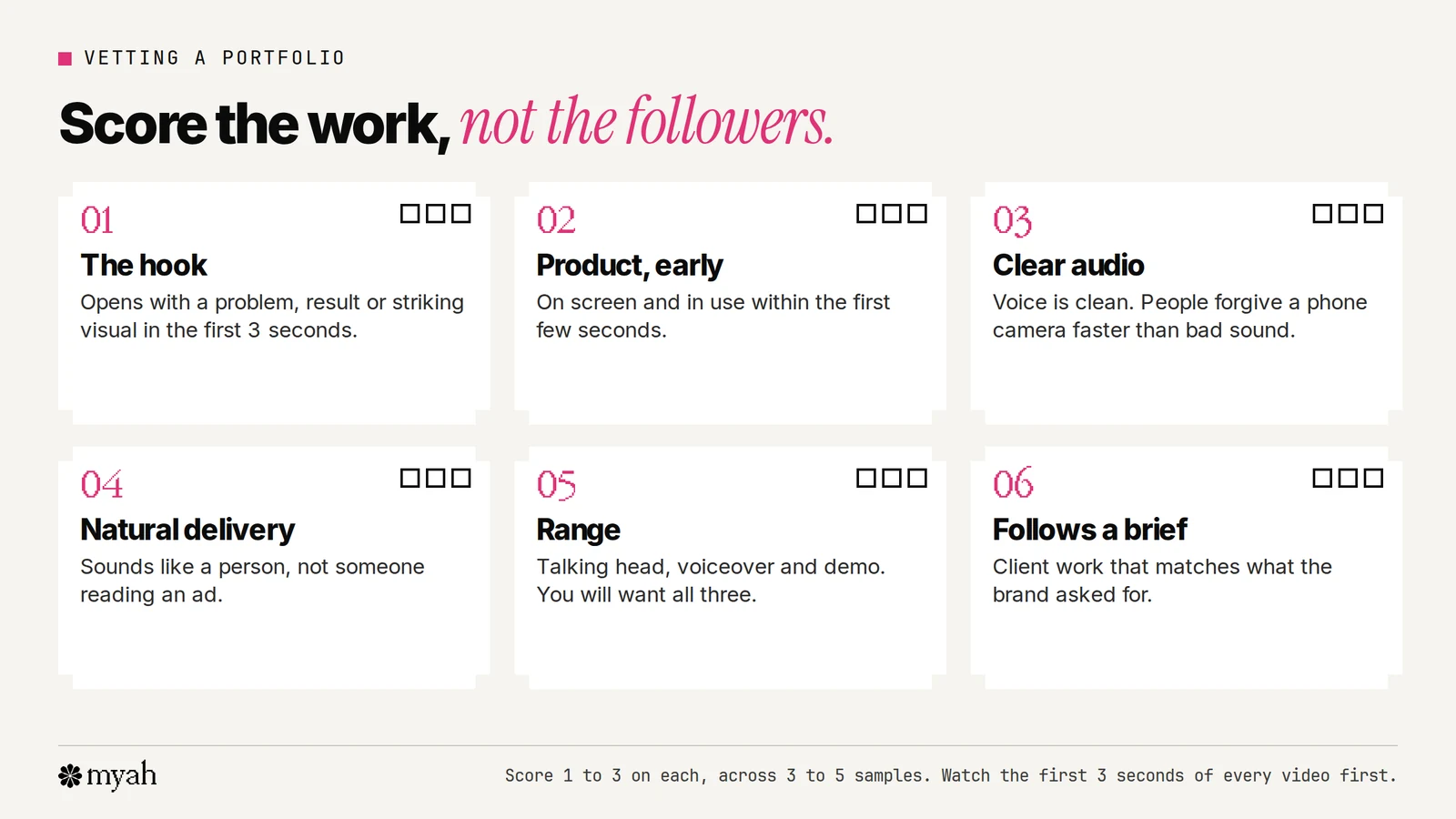
- The hook: does the video open with a problem, a result or a striking visual, instead of "Hey guys"?
- The product, early: is it on screen and in use within the first few seconds?
- Audio: is the voice clear without background noise? People forgive a phone camera faster than bad sound.
- Delivery: do they sound like a person, not someone reading an ad?
- Range: can they do talking head, voiceover and demo? You'll want all three for testing.
- Following a brief: have they made work for other brands, and does it match what those brands would have asked for?
If a creator has no client work yet, a clearly labelled spec video for a similar product is a fair test of skill.
4. Test with a small batch
Most ads don't win, so hire for volume of ideas, not one perfect video. In Motion's Creative Benchmarks 2026, which analysed 578,750 Meta creatives, only about 5% qualified as winners (spending at least 10 times their account's median). That's why a first round should give you several distinct ideas to test.
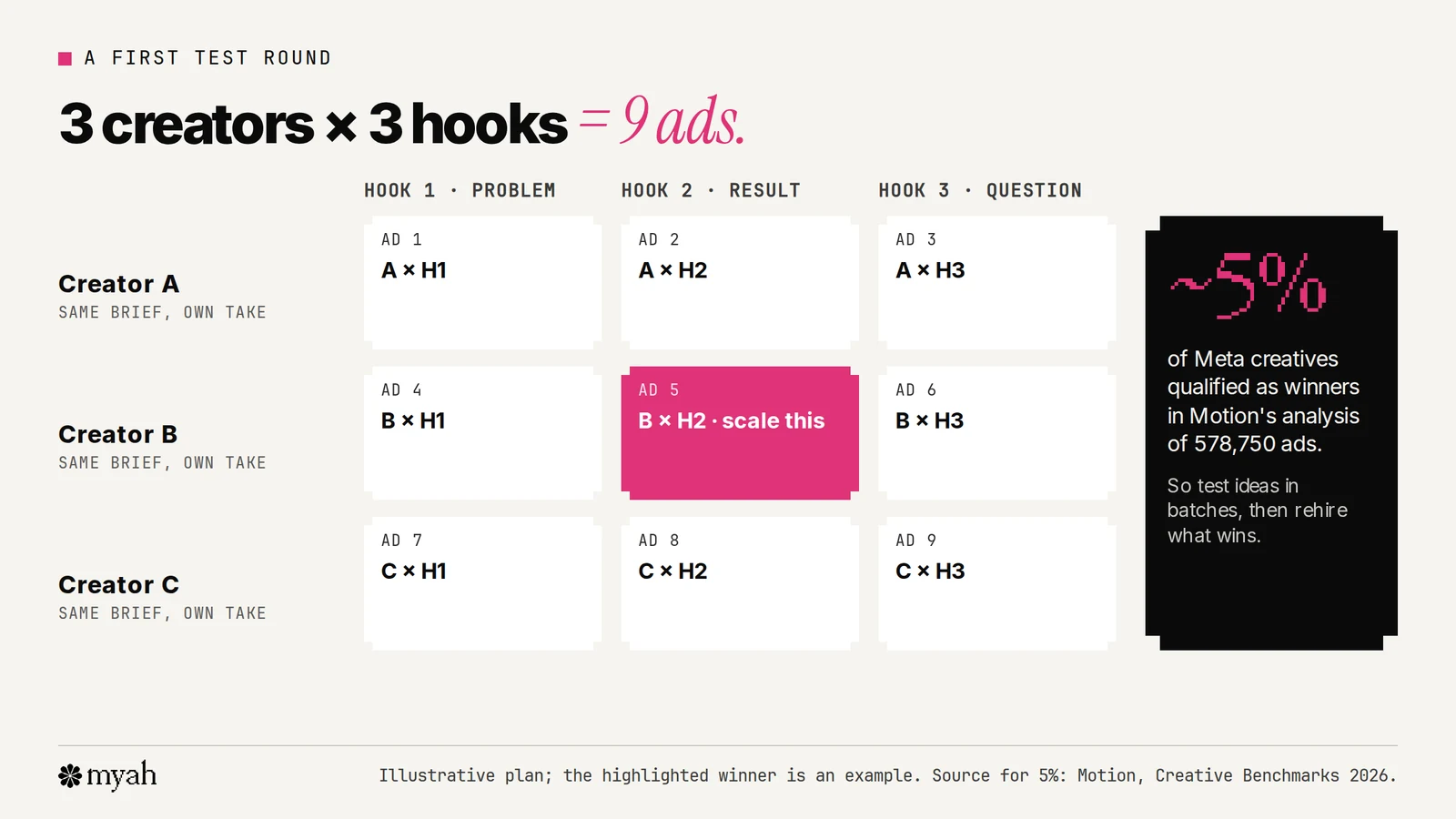
A simple first batch:
- Three to five creators, same product and brief, so you're comparing creators rather than briefs.
- Two or three hooks per video, the opening few seconds re-filmed or re-cut, with the same body.
- One variable at a time after that: once a creator wins, test new angles with them before you test new creators.
Read early results with hook rate, the share of impressions that turn into a 3-second play, alongside your cost per result. Our guide to making UGC a brand can actually test explains which variations are worth asking for.
5. Give feedback and revisions
Agree the number of revision rounds before filming, and make each note specific: "move the before-and-after to the first two seconds" is a revision, while "make it pop" isn't. Separate fixes the brief asked for (included) from new ideas (a new request, usually paid). Keep every version and note in one thread so nothing gets lost between rounds.
6. Organise and name the files
When you're testing nine or more ads a round, file names are your reporting. Pick one pattern and use it everywhere, from the delivery folder to the ad name in Ads Manager.
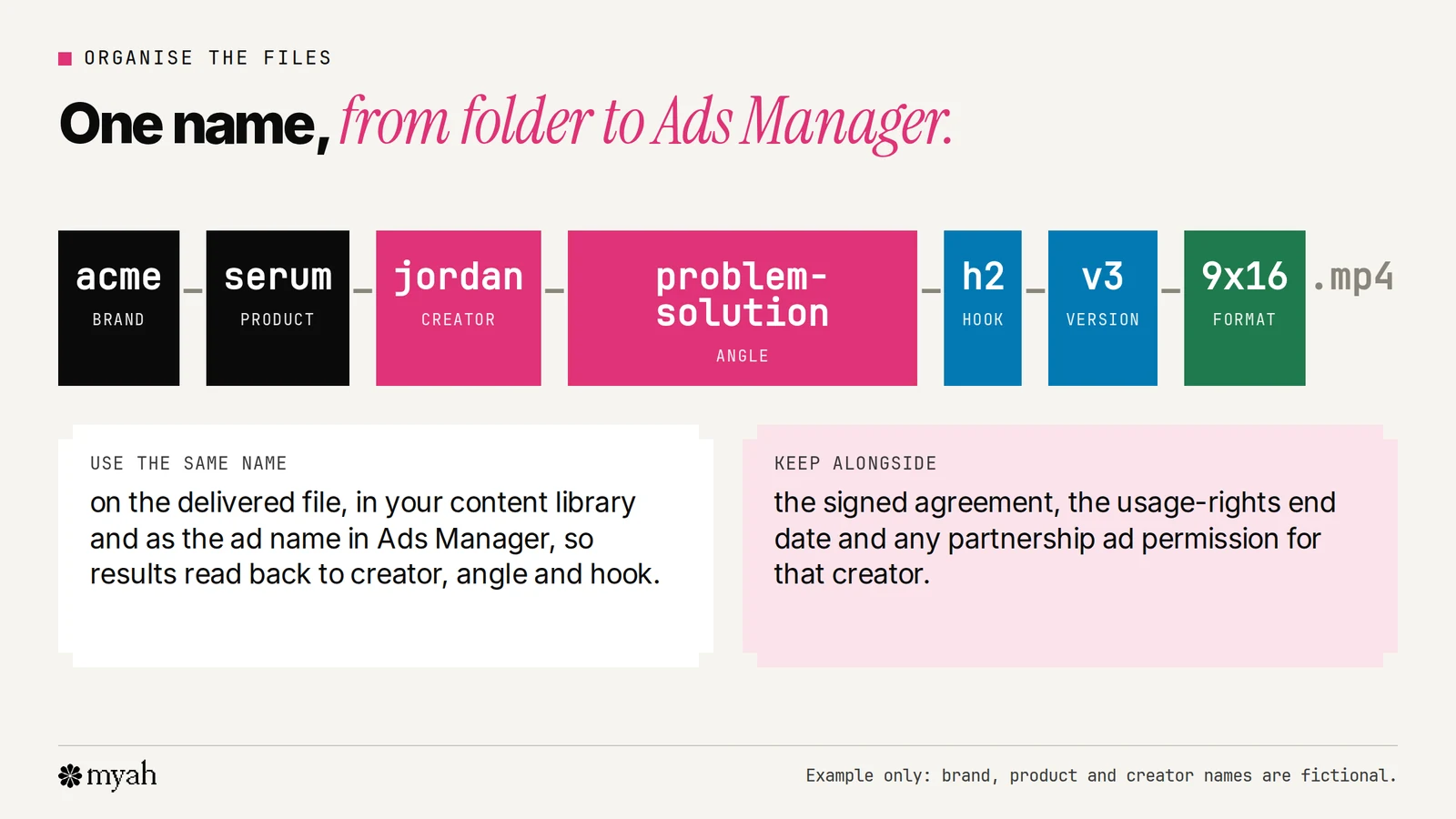
Also keep the signed agreement, the usage-rights end date and any partnership ad permission next to each video. You'll need them when an ad wins and you want to keep it running.
What Meta needs from a UGC video
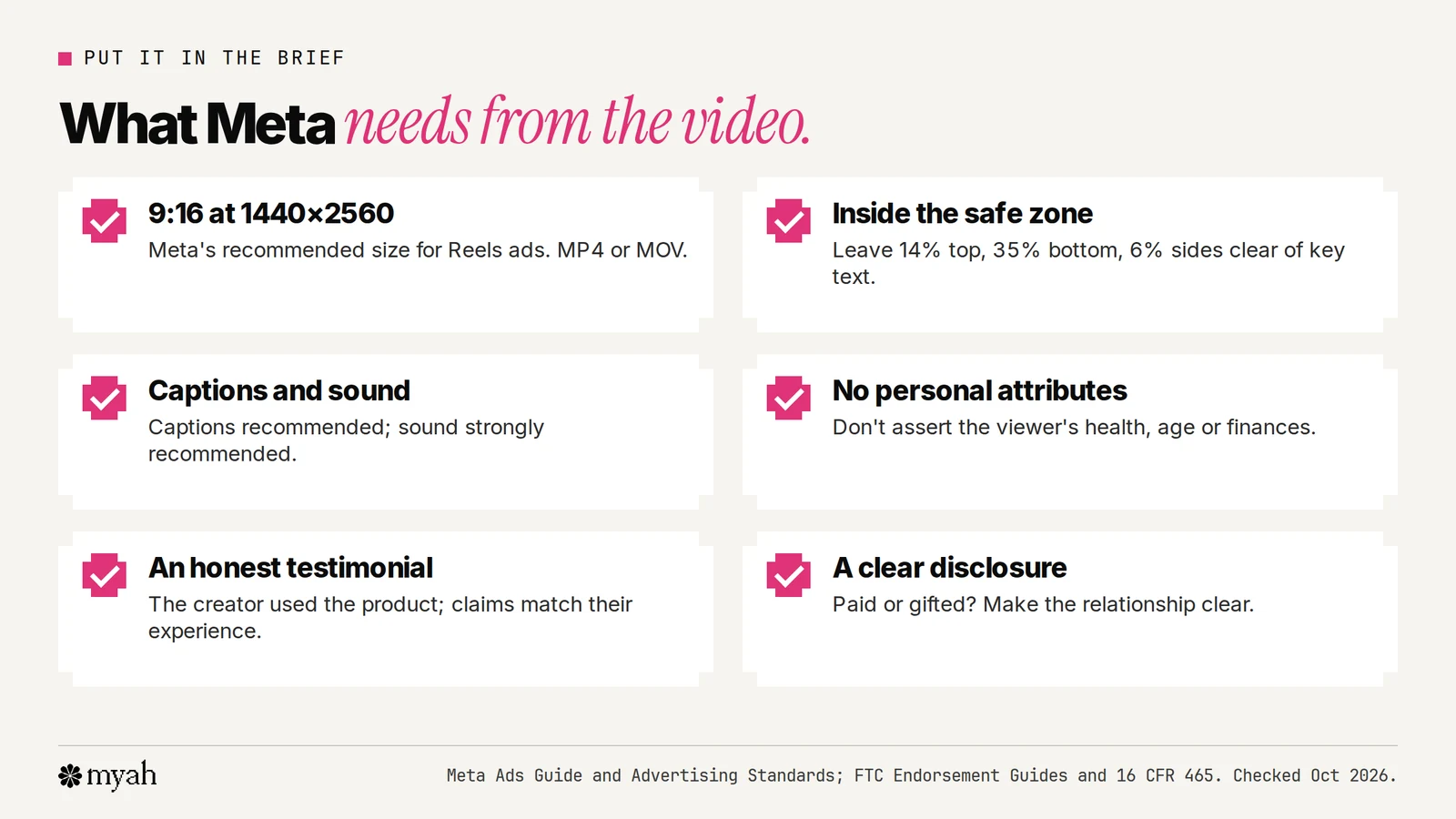
Specs. Meta's Reels ad specs recommend 9:16 at 1440×2560 pixels, MP4 or MOV, with captions recommended and sound strongly recommended.
Safe zones. Meta suggests leaving at least 14% of the top, 35% of the bottom and 6% on each side free of text, logos and other key elements, so the interface doesn't cover them. Give creators our free Instagram Reels safe zone template with the brief.
Hooks. The first few seconds decide whether anyone sees the rest. Ask for alternative openings and measure them with hook rate.
Claims. Meta's personal attributes policy doesn't allow ads that assert or imply things about the viewer, such as their health, age or finances. "You/your" is fine on its own, but a line like "Ready to upgrade your skin to look younger?" is one of Meta's own rejected examples. Meta's health and wellness policy adds stricter rules for weight-loss, supplement and cosmetic products, such as no statements of inferiority about someone's appearance. List banned phrases in the brief.
Honest testimonials. In the US, the FTC's Endorsement Guides say an endorsement must reflect the endorser's honest opinion and can't make a claim you couldn't legally make yourself. The FTC's rule on consumer reviews and testimonials, in force since October 2024, makes it unlawful to create a testimonial that misrepresents whether the person used the product or what their experience was. If a script says "I've used this for three months", the creator needs to have done that.
Disclosure. The same FTC guidance says a material connection, like payment or free product, should be disclosed clearly, and that a platform's built-in label might not be enough on its own. When you run a creator's video as a Meta partnership ad, both accounts can appear in the ad's header, which helps make the relationship clear. Other countries have similar rules, so check the ones where your ads run.
Rights and permissions to agree before filming
Two separate things decide whether you can run a video as an ad:
- Usage rights: what you may do with the video, where, for how long and with what edits. Spell out paid ads, organic posts, website and email, the time period, whether you can cut new versions and whether raw footage is included.
- Platform permission: if you want to run the ad from the creator's handle as a partnership ad, the creator has to grant that permission in Meta, separately from the contract.
Default rights vary a lot by platform, from a time-limited licence to full ownership, as our Billo alternatives comparison shows. When you agree terms directly, our guide to UGC usage rights for paid ads covers what to ask for. Put it in writing before the creator films, and price paid usage and longer terms separately.
Red flags and common mistakes
When vetting creators
- Samples you can't attribute. If a portfolio is all finished brand ads, ask what the creator filmed and edited themselves and what the brand's editor did.
- Bought followers or engagement. Platforms such as Insense say they screen for it, but if you're hiring directly, check that comments and views look real.
- No questions about your brief. Good creators ask about the audience, the claim and the deliverables.
When running the program
- Hiring for followers. For ads you pay to reach people, the audience you're buying is Meta's, not the creator's.
- One creator, one video. With a winner rate around 5% in Motion's data, a single video is a coin toss.
- Vague briefs. "Make it authentic" leads to rounds of revisions. Name the claim, the hook ideas and the banned phrases.
- No rights in writing. A winning ad you can't legally keep running is a wasted win.
- Testing too many things at once. Change the creator or the angle, not both.
- Paying for product only and expecting ad-ready work. Gifting can work for organic posts, but ad-ready video is paid work.
Where Myah fits
Myah is a marketplace for performance UGC, built around campaigns. You post a campaign with the pay, the products and a brief with examples, angles and top-performing formats, and choose whether it's open for creators to discover or invite-only. Creators apply with up to five portfolio videos, or you browse and invite them, and you accept or decline.
Creators request a product sample, you ship it with tracking, and they confirm delivery. Videos come back into one thread where you approve, request a revision with a note or reject, and every version stays together. For Shopify stores, each approved video gets its own tracking link and optional discount code, so you can see the orders behind it. Myah is in early access. See how it works for brands.
Common questions
How much do UGC creators charge?
Published data puts a typical single video around $100 to $200. Pitchlo found a median advertised rate of $100 across 593 per-video briefs listed between December 2025 and September 2026, and UGC Roster's live rates report shows a median opening offer of $200 across 155 public listings. Both are vendor data. Paid usage, extra hooks, raw footage and exclusivity cost more. Our UGC rate calculator gives a starting point by deliverable.
Where can I find UGC creators?
On UGC marketplaces such as Billo, JoinBrands, Collabstr and Insense, on freelance sites such as Upwork and Fiverr, through agencies, by searching Instagram and TikTok directly or through Meta's Creator Marketing Hub, and among your own customers.
How many UGC creators should I hire for a first test?
Three to five, briefed on the same product with two or three hooks each. That gives you enough distinct ads to learn which creator and which angle to scale.
Do UGC creators need followers to make good ads?
No. When you run their video as an ad, you're paying Meta to reach your audience. Judge the portfolio, especially the first three seconds and the audio, not the follower count.
Can I run a UGC video from the creator's account?
Yes, as a Meta partnership ad, if the creator grants permission in Meta. That's separate from the usage rights in your contract, so agree both. See Meta partnership ads explained.
Do UGC ads need an "ad" disclosure?
If there's a material connection, like payment or free product, the FTC says it should be clear and conspicuous, and that a platform's built-in label might not be enough by itself. Partnership ads show both accounts in the header. Check the rules in each country where your ads run.
Should I use an agency or a marketplace?
A marketplace if you have time to brief and review and want to keep costs per video down. An agency or managed service if you have budget but not time, since they handle casting, briefs and revisions for a monthly fee.
Sources
Checked in October 2026.
- Meta: Creator Marketing Hub, brand eligibility, creator eligibility, partnership ads, Instagram Reels ad specs, personal attributes policy
- FTC: Endorsement Guides: what people are asking, 16 CFR 465.2, Consumer Reviews and Testimonials Rule Q&A
- Testing data: Motion, Creative Benchmarks 2026
- Rates: Pitchlo pay report, UGC Roster rates report
- Platform pricing: Billo, Collabstr, JoinBrands, Upwork, Fiverr
Myah is a marketplace where brands post UGC campaigns, ship samples, review videos and track Shopify sales from each approved video. Join brand early access. Early access does not guarantee availability.