

The best UGC platforms for creators in 2026 depend on where you live and how you want to find work. With no following, apply to paid briefs on Billo, JoinBrands, Twirl or Cohley. To set your own prices, use Collabstr, Influee, Fiverr or Upwork. With an engaged audience, add Insense, #paid or Aspire. The cut taken from your pay ranges from 0% to 20%.
Below we compare 13 UGC platforms, the marketplaces where brands pay creators to make videos and photos for their ads, product pages and social accounts. (If you're after places to post your own content and build an audience, such as TikTok or YouTube, that's a different question.) For each one you'll see how you find work, who sets the pay, what the platform takes, who it accepts and one honest drawback.
How we checked: every fact about a platform comes from that platform's own creator pages, help center or terms, checked in October 2026. Where a popular roundup disagreed with the platform, we went with the platform. One of the 13 is Myah, which we make. We've kept its entry to how it works and haven't ranked it above anyone.
The best UGC platforms for creators at a glance
| Platform | How you find work | Who sets the pay | Cut taken from your pay | Audience needed |
|---|---|---|---|---|
| Billo | Apply to tasks after a video pitch | Billo (fixed per task) | None listed | No |
| JoinBrands | Apply to jobs after certification | Brand | 20% (15% on Creator Pro) | No |
| Twirl | Apply to paid briefs | Brand (shown in brief) | None ("100% yours") | No |
| Cohley | Apply to briefs | Brand (some briefs negotiable) | None | Depends on the brief |
| Myah | Apply to campaigns with your portfolio | Brand (shown before you apply) | None (brands pay Myah's fee) | No |
| Collabstr | Sell packages; apply to campaigns | You | 15% | Profile is reviewed |
| Influee | Apply to campaigns | You set your rates | None listed for creators | No |
| Backstage | Apply to briefs or take direct orders | You list prices; briefs set budgets | None listed for creators | No |
| Fiverr | Sell fixed-price gigs | You | 20% | No |
| Upwork | Send proposals; get invited | You | 0% to 15% per contract | No |
| Insense | Apply to campaigns with your price | You (brand hires) | None | 1,000 followers and 1,000 average views, or a UGC-only portfolio route |
| #paid | Opt in to matched campaigns | You set rates | None listed | Typically 10,000+ and 1.5%+ engagement |
| Aspire | Browse campaigns and apply | Brand | None | Set by each brand |
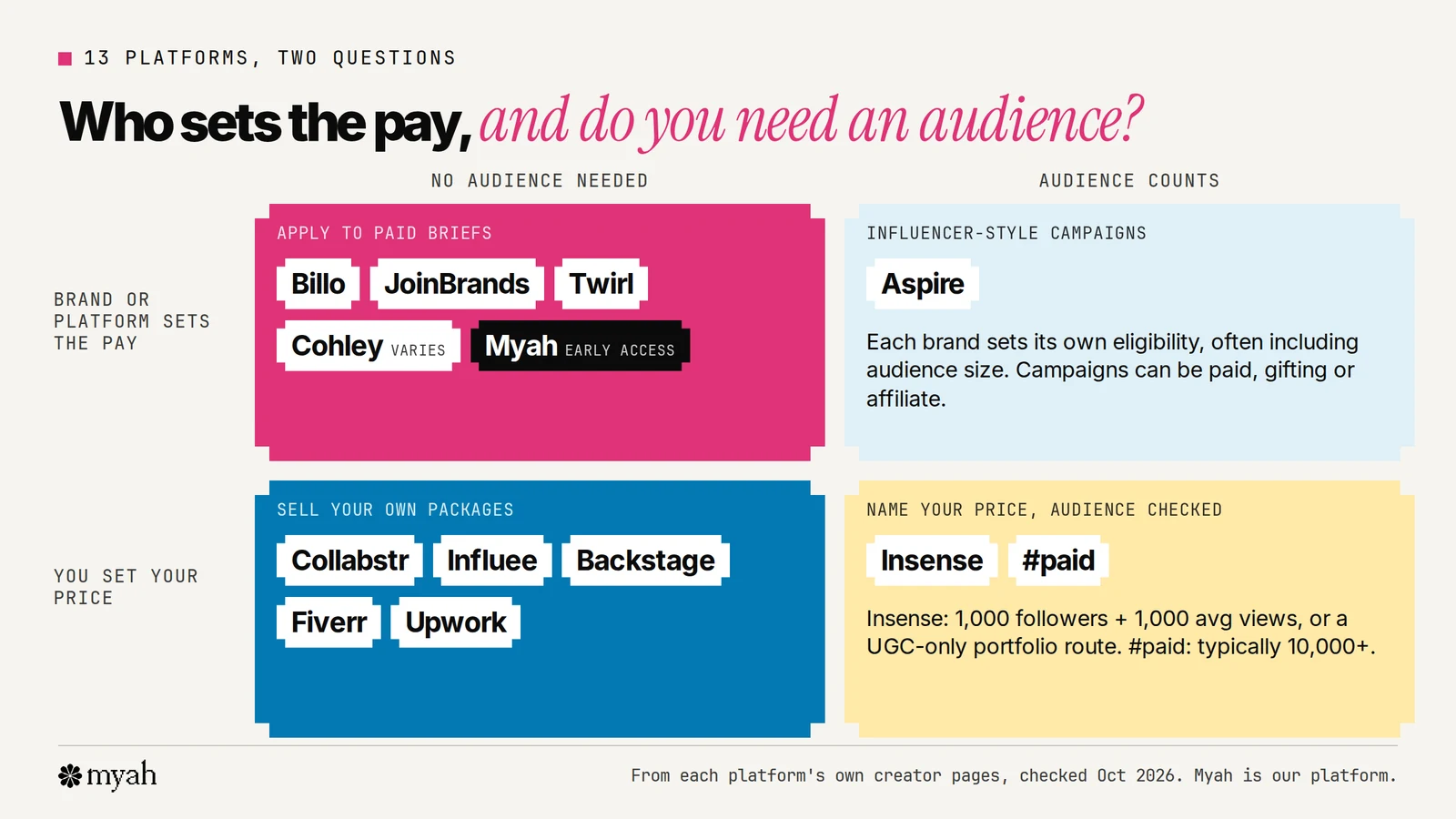
How we chose these platforms
We started from the platforms that come up most when creators and AI assistants answer "best UGC platforms", then kept the ones that pay creators to make content for brands. For each one we checked six things on its own site:
- How you find work: browsing and applying, being invited, or listing services people buy.
- Who sets the pay: the platform, the brand or you.
- The cut: any commission or fee taken from what you earn.
- Requirements: followers, engagement, portfolio, age.
- Where you can join: the countries the platform supports for creators.
- One honest drawback, usually about pay, access or the rights you hand over.
Some details have changed since other roundups were written. Billo's sign-up page now lists creators in the US, UK and Canada. Insense's minimum is 1,000 followers and 1,000 average views. #paid says it typically looks for 10,000+ followers. We've used the platforms' current wording throughout.
What you actually keep from a $200 job
Fees are the easiest thing to miss when you compare platforms. Some take a percentage of every job. Others charge the brand instead and pass your full rate to you.
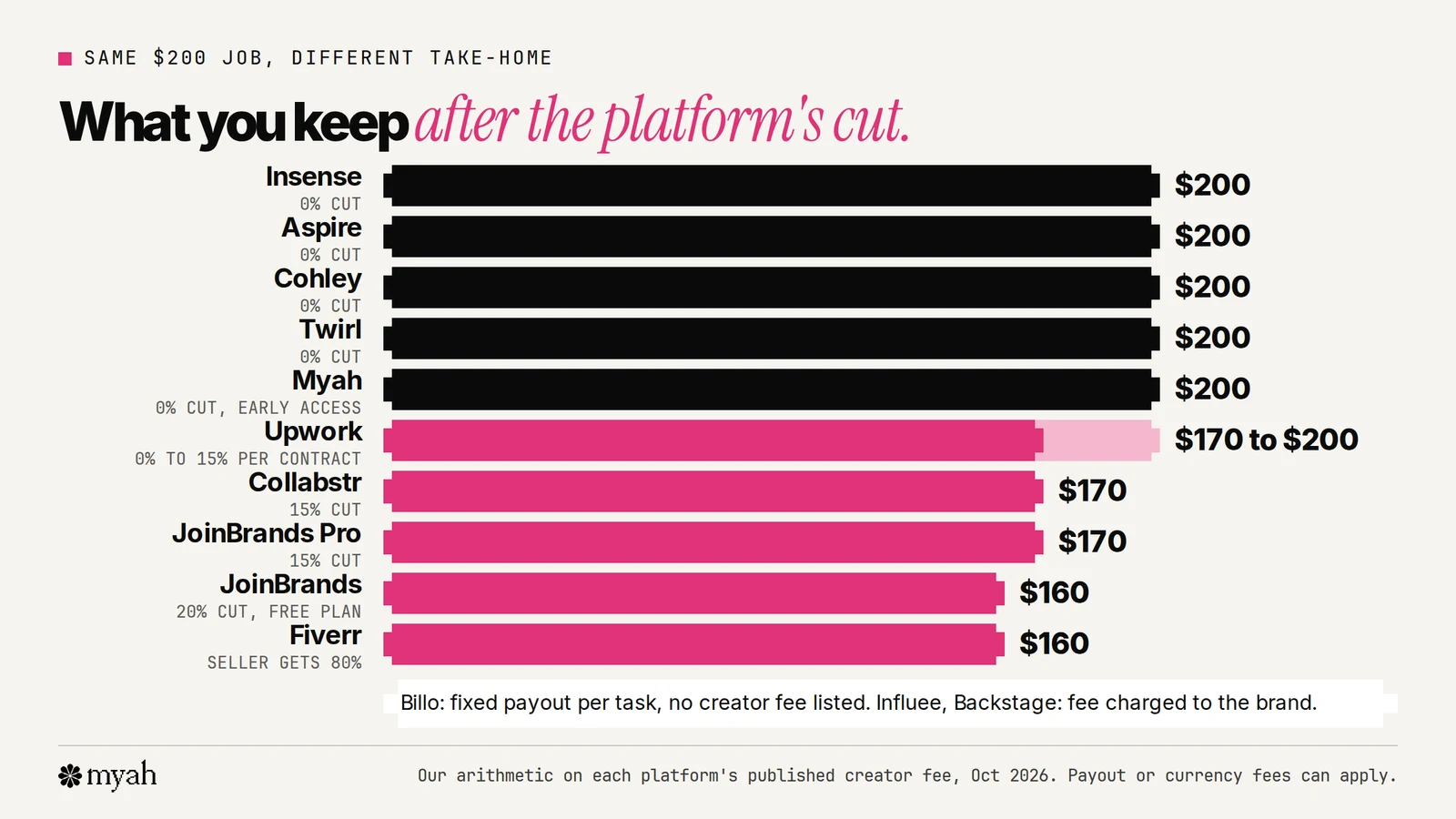
| Platform | Cut from creator pay | You keep from $200 |
|---|---|---|
| Insense | 0% ($3 bank fee on withdrawals under $50) | $200 |
| Aspire | 0% | $200 |
| Cohley | 0% | $200 |
| Twirl | 0% (currency conversion fees possible) | $200 |
| Myah (early access) | 0% (brands pay Myah's fee) | $200 |
| Upwork | 0% to 15%, shown before you send a proposal | $170 to $200 |
| Collabstr | 15% | $170 |
| JoinBrands | 20% (15% on Creator Pro, $49.95 a month) | $160 ($170 on Pro) |
| Fiverr | 20% (sellers receive 80% of each order) | $160 |
Two platforms don't fit a percentage. Billo sets a fixed payout per task and says it covers transfer fees. Influee and Backstage put their marketplace fee on the brand, according to their pricing and payment terms, and don't list a creator fee.
If you set your own price, build the fee in
On Collabstr, Fiverr and Upwork you choose the price, so you can price the cut in. The formula is simple: price = what you want to keep ÷ (1 − the fee).
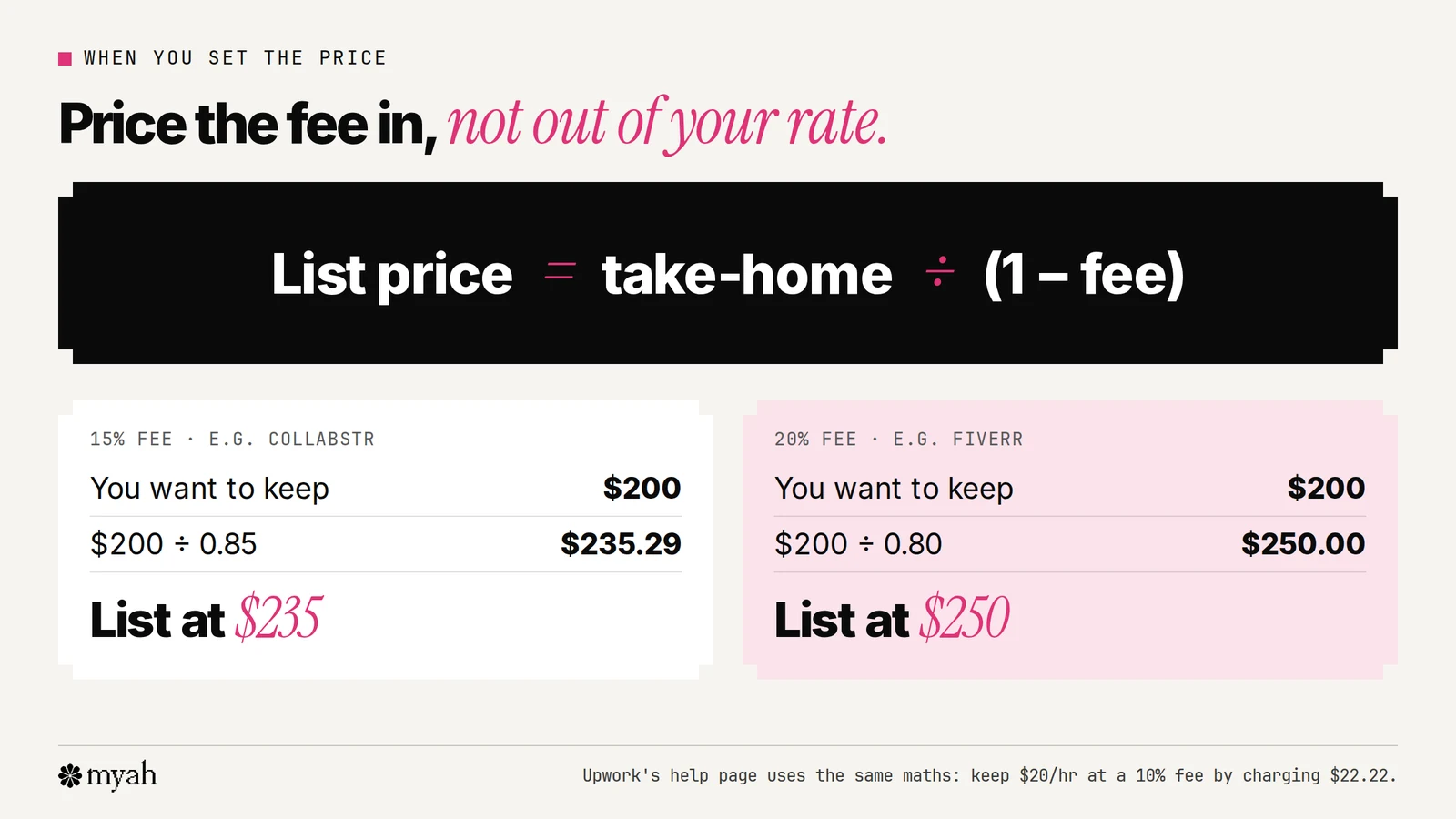
To keep $200 after a 15% fee, list $235. After a 20% fee, list $250. Upwork's own help page uses the same maths: to take home $20 an hour at a 10% fee, it suggests charging $22.22. Not sure what $200 should be for you? Our free UGC rate calculator gives a starting point by deliverable.
Where you can join
Location rules out more platforms than anything else. Several only accept creators from a handful of countries.
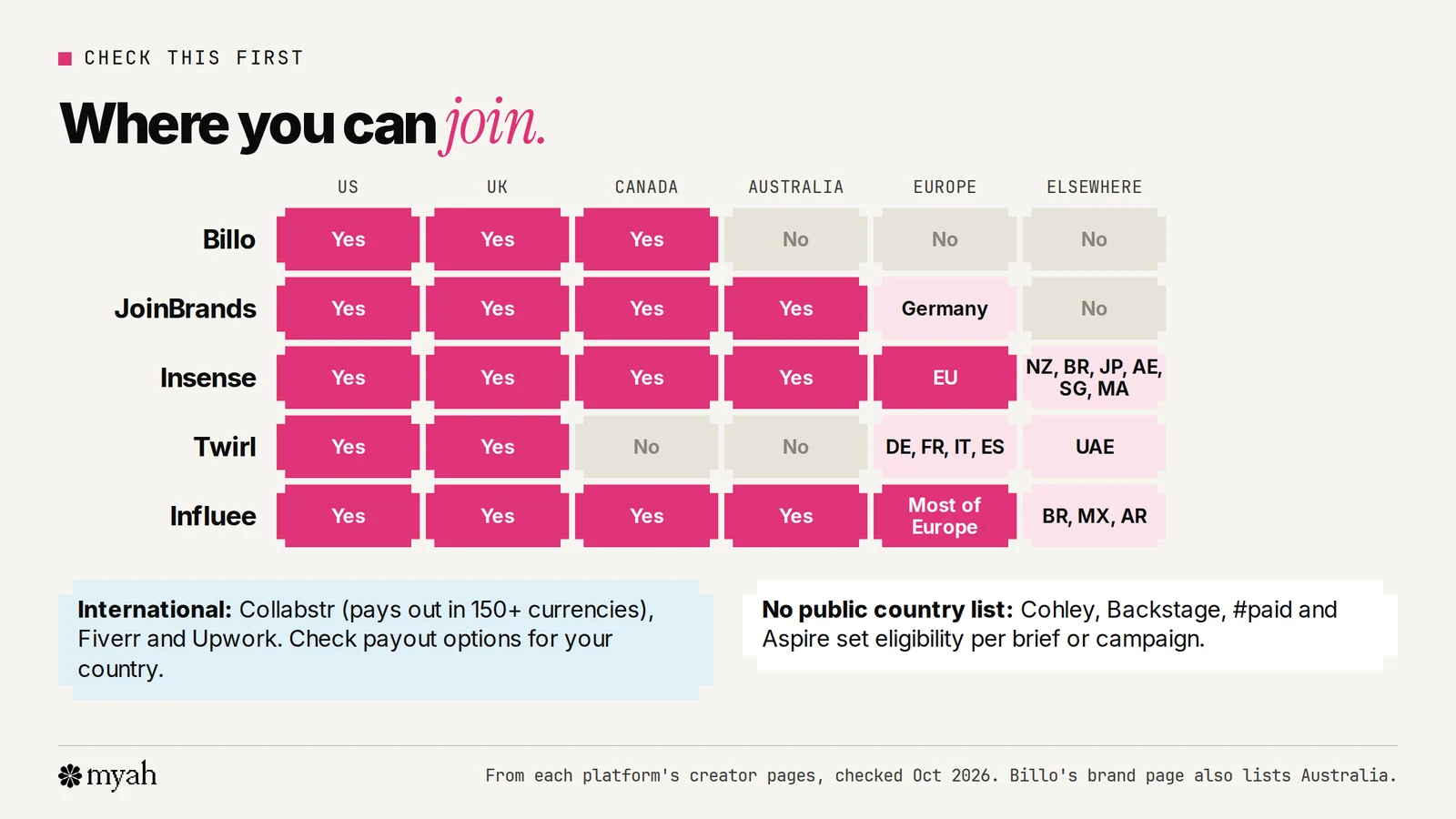
| Platform | Where creators can join |
|---|---|
| Billo | US, UK, Canada (Billo's brand page also lists Australia) |
| JoinBrands | US, UK, Canada, Australia, Germany |
| Insense | US, UK, Canada, Australia, New Zealand, EU, plus Brazil, Japan, UAE, Singapore and Morocco |
| Twirl | Mainly UK, US, Germany, France, Italy, Spain and the UAE |
| Influee | 33 countries, including the US, UK, Canada, Australia, most of Europe, Brazil, Mexico and Argentina |
| Collabstr | No creator country list; pays out in 150+ currencies |
| Fiverr, Upwork | International; check the payout options for your country |
| Cohley, Backstage, #paid, Aspire | No public creator country list; eligibility is set per brief or campaign |
Platforms where you apply to paid briefs
These suit creators without a following. Brands post a brief and a budget, you apply with your samples, and the brand picks.
Billo
Best for: creators in the US, UK or Canada who want fixed-price product video jobs.
- How you find work: record a video pitch (30 seconds maximum) to get approved, then apply to tasks in the app's Offers tab.
- Pay: each task shows a set payout before you apply, plus the product. You can't negotiate it, though you can set your own rates for organic posting and partnership ads.
- Cut: none listed. Billo says it covers transfer fees, so you get the full payout.
- Requirements: 18 or older and based in the US, UK or Canada. No following needed, and by default you don't post Billo videos on your own account.
- Watch out for: you can't negotiate task rates. The way to earn more is Billo's Premium Creator level, which pays higher payouts once you keep up strong ratings and on-time delivery.
JoinBrands
Best for: beginners who want lots of small, structured jobs across video, photo and TikTok Shop.
- How you find work: pass a certification for each content type (video, green screen, ad video, image), then apply to jobs in the marketplace. Brands usually pick within one or two business days.
- Pay: set by the brand per job, with paid extras for additional content.
- Cut: 20% of job earnings and performance bonuses on the free plan, 15% with Creator Pro ($49.95 a month, or $41.25 a month billed yearly). No fee on Express jobs, tips or product reimbursements.
- Requirements: based in the US, UK, Canada, Australia or Germany. No large following needed.
- Watch out for: the free plan has withdrawal limits, and Pro members see new jobs an hour before everyone else.
Twirl
Best for: creators in the UK, US and Western Europe who want every job to be paid, with the rate shown up front.
- How you find work: apply with an intro video and portfolio. Once accepted, you apply to campaigns on your dashboard.
- Pay: set in each brief, typically $90 to $300+ per project, according to Twirl, with extra for whitelisting. Payment is released within ten days of approval.
- Cut: none. Twirl says the advertised compensation is 100% yours, though currency conversion fees can apply.
- Requirements: a phone and strong samples. Twirl is currently prioritising pets and family content, Germany-based creators and 45+ audiences, so others may be waitlisted.
- Watch out for: joining means granting a 100% usage licence for the brand's paid ads, organic social, website and email.
Cohley
Best for: experienced creators who want briefs from established consumer brands.
- How you find work: a person reviews your application (portfolio and socials, 18+). Once approved, you apply to briefs and brands pick from the applicants.
- Pay: the brand sets the rate in the brief. Some briefs are tiered by follower count and some let you name your rate.
- Cut: none. Cohley's help center says you get 100% of the agreed amount through PayPal with no fee on a standard payout (its older creator terms still mention a 2.9% PayPal fee).
- Requirements: varies by brief, including any follower minimum.
- Watch out for: brands have up to 30 days after the content due date to pay, and every asset comes with perpetual usage rights for the brand.
Myah (early access)
Best for: creators who want to see the pay and the product before they apply.
- How you find work: brands post campaigns that show the pay and the products. You apply with up to five portfolio videos and the brand accepts or declines. Brands can also find your profile and invite you.
- How it works: request a free product sample, film on your phone and submit. The brand approves the video, asks for a revision with a note, or rejects it, and every version and note stays in one thread.
- Cut: none. Myah doesn't take a cut of creator earnings; brands pay Myah's fee.
- Requirements: no large following. Brands choose from portfolios.
- Watch out for: Myah is in early access and hasn't launched publicly yet, so don't rely on it for steady work today.
Platforms where you set your own price
These suit creators who want to control pricing. You set your rates or list packages, then apply to campaigns or get booked, so your profile and samples do the selling.
Collabstr
Best for: creators who want a public storefront of fixed packages.
- How you find work: list packages that brands book directly, or apply to brand campaigns with your own rates.
- Pay: your prices. Brands pay up front and Collabstr holds the money until the work is approved.
- Cut: 15% when you make a sale.
- Requirements: profiles are reviewed and not all are approved. Payouts go out in 150+ currencies.
- Watch out for: sign-up asks for a credit card to verify your identity, and it can be charged if you take a product and don't deliver.
Influee
Best for: creators outside the US who want to set their own rates.
- How you find work: build a profile with a few samples, set your rates and apply to campaigns once you're approved.
- Pay: your own rates. Influee says payment arrives five to ten days after the brand approves your content.
- Cut: Influee's pricing page puts a 10% marketplace fee on the brand, and its creator page doesn't list a creator fee.
- Requirements: no follower count. Influee works with creators in 30+ countries, and its pricing page lists 33.
- Watch out for: Influee suggests new creators take unpaid gigs for free product to build a portfolio. That's your call, but product isn't pay.
Backstage
Best for: creators who also do acting or on-camera work, and want UGC briefs in the same place.
- How you find work: build a Content Creator Profile with your prices, apply to UGC briefs, or accept direct content orders from brands.
- Pay: your listed prices, or the budget in a brief.
- Cut: Backstage's payment terms say its marketplace fee is paid by the brand. You need a Stripe account to get paid.
- Requirements: a profile and samples. No following needed.
- Watch out for: the standard licence gives the brand exclusive use for 6 months of paid ads and 12 months of organic use, and your face and voice can stay in those assets indefinitely.
Fiverr and Upwork
Best for: creators who want direct clients and longer contracts, and are happy to compete on a general freelance marketplace.
- How you find work: on Fiverr, publish gigs that buyers purchase. On Upwork, send proposals to job posts or get invited.
- Pay: your prices.
- Cut: Fiverr sellers receive 80% of each completed order. Upwork's fee is 0% to 15% per contract and is shown before you propose.
- Requirements: a freelancer profile. No following needed.
- Watch out for: neither is UGC-specific, so you're competing with every video editor on the site.
Platforms that look at your audience
These pay creators for content too, but they're built around influencer campaigns, so your followers and engagement count.
Insense
Best for: creators with a small but real audience who want UGC and paid social work in over 20 countries.
- How you find work: pass moderation, then apply to campaigns with your price. Brands can also invite you.
- Pay: you name your price when you apply, and the payment is held when a brand hires you.
- Cut: none. Withdrawals under $50 carry a $3 bank fee.
- Requirements: Insense's audience minimum for Instagram and TikTok is 1,000 followers and 1,000 average views, and brands prefer 1%+ engagement. If you're turned down on metrics alone, you can apply as a UGC-only creator with 6 to 12 portfolio videos across at least two product categories and two formats.
- Watch out for: if you don't pass moderation, you have to wait two weeks before reapplying.
#paid
Best for: creators with an established niche who want repeat campaigns with the same brands.
- How you find work: set your categories and rates, then opt in to campaigns #paid matches you with.
- Pay: your rates, with separate rates for content only, posts on your accounts and paid usage. #paid suggests rates from your last 12 posts.
- Cut: none listed for creators. It's free to join.
- Requirements: a public Instagram or TikTok. #paid says it typically looks for 10,000+ followers and engagement above 1.5%.
- Watch out for: most new UGC creators won't meet that bar yet.
Aspire
Best for: creators with an audience who want access to many brands' campaigns, including gifting and affiliate deals.
- How you find work: browse campaigns in the Creator Marketplace and apply. Brands review applicants and add the ones they want.
- Pay: set per campaign. Campaigns can be paid, gifting, affiliate or ambassador deals, so filter for paid work.
- Cut: none. Aspire says it doesn't take a percentage of your deals.
- Requirements: each brand sets its own eligibility, often including audience size.
- Watch out for: it's an influencer platform first, so pure UGC briefs are a smaller share of what you'll see.
What about Shopify Collabs?
Shopify's help center says Collabs "isn't accepting new creator signups at this time". If you already have brand partnerships there, you can still log in, and brands can still invite creators directly. For new creators, it's not a route in right now.
How to choose a UGC platform
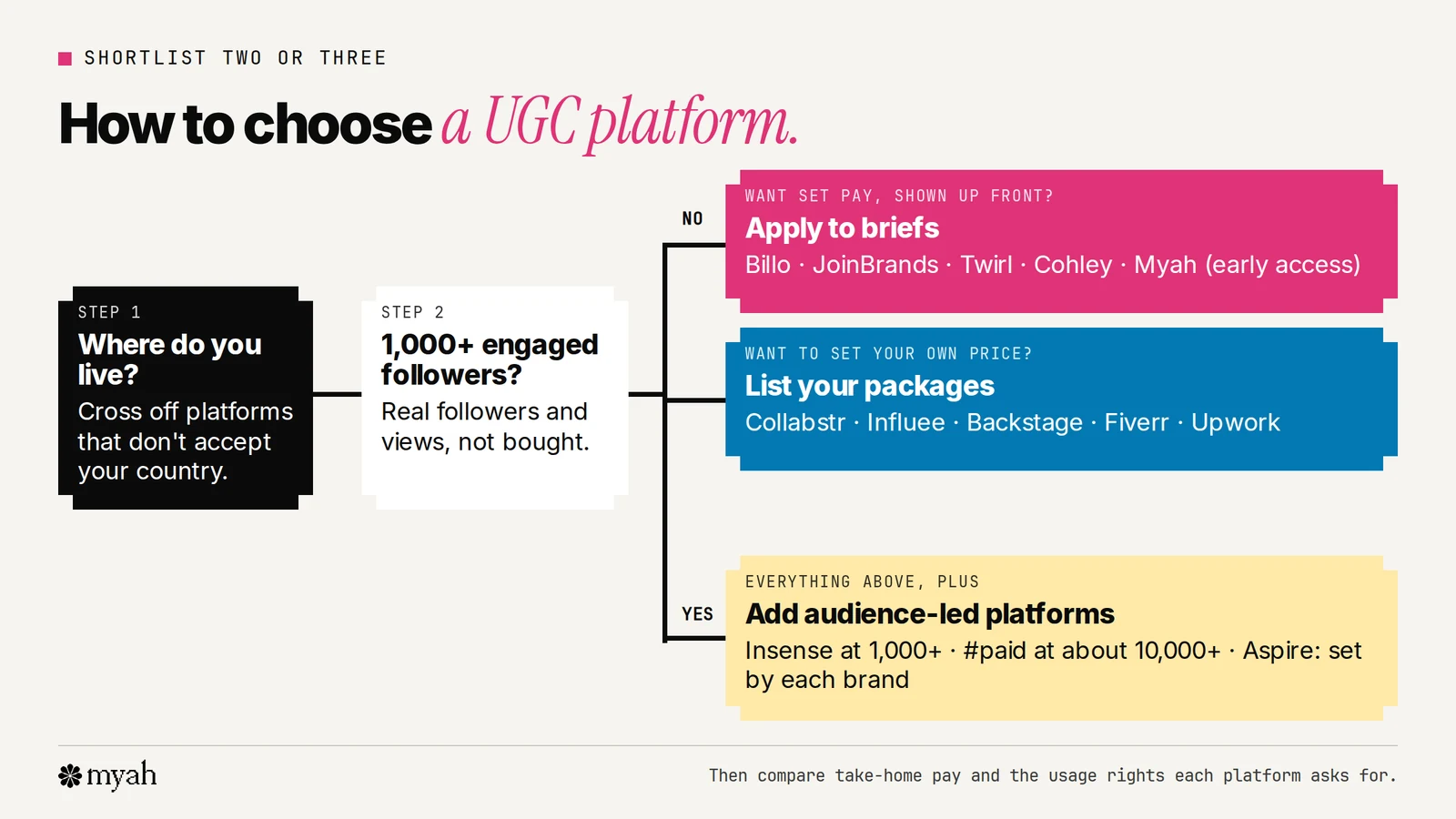
Work through these questions in order:
- Can you join? Cross off every platform that doesn't accept creators where you live.
- Do you want set pay or your own prices? Brief platforms show the pay up front. Package platforms let you charge more as you improve.
- What's the cut? Compare take-home, not headline rates.
- What rights do you hand over? Licences range from 6 months of paid ads (Backstage's standard) to perpetual (Cohley). Read our guide to UGC usage rights for paid ads before you accept.
- Do you need an audience? If you don't have one yet, start with the platforms that hire on portfolio, and read how to become a UGC creator without followers.
- Is there work for your niche? A platform can look great on paper and be quiet once you're in. Look at the live briefs before you put time into a profile.
Most creators do best on two or three platforms at once, with one strong portfolio reused across them. If you don't have samples yet, see how to build a UGC portfolio with no client experience.
How to spot a fake UGC platform or brand deal
Scammers target creators with fake brand deals. The FTC warns about fake recruiters who promise free products and big pay, push you to sign up fast and use personal accounts or emails that aren't linked to the company.
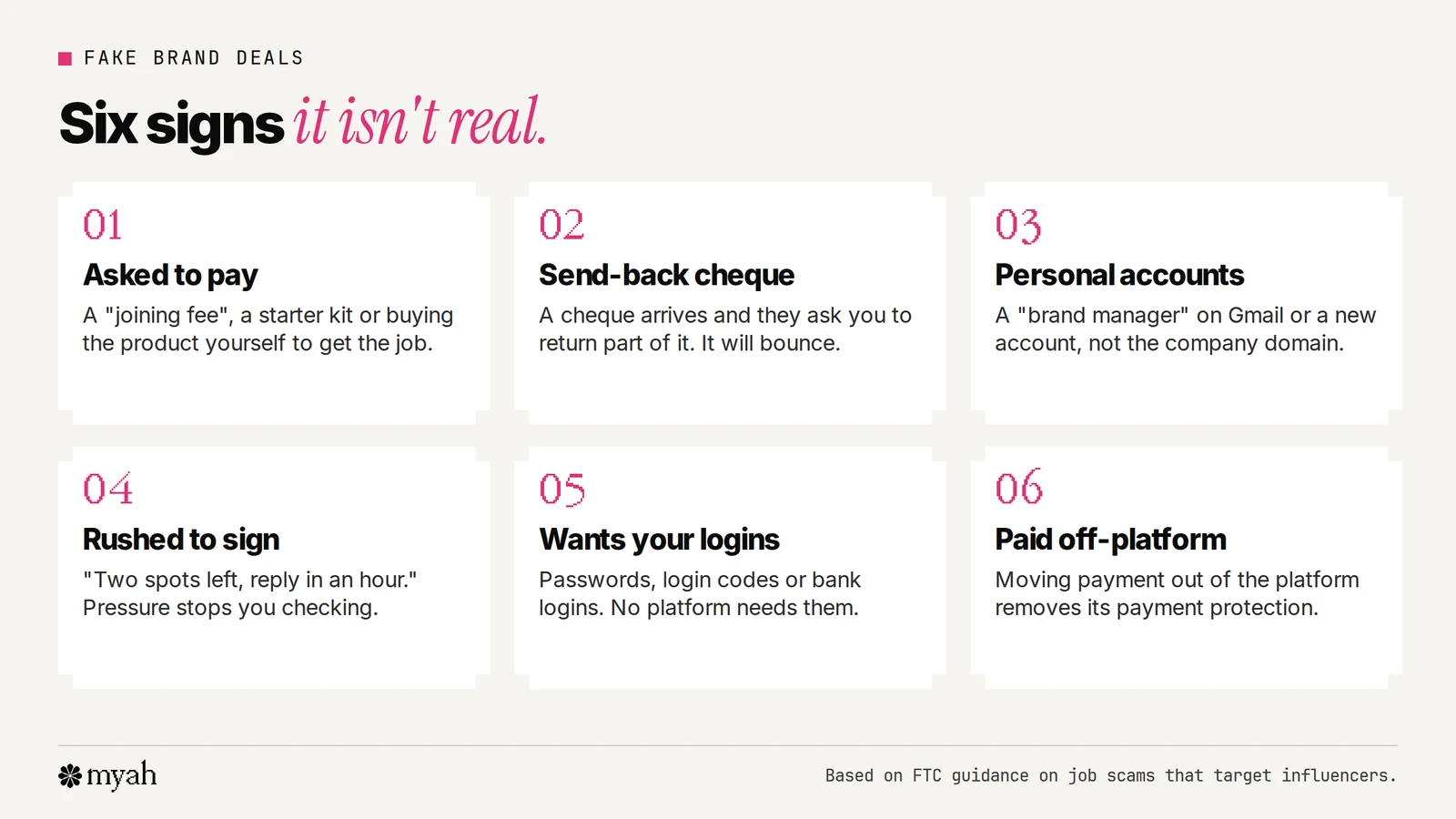
- You're asked to pay. Real brands and real platforms don't charge you to get a job. A paid upgrade like JoinBrands' Creator Pro is optional and sold inside the platform.
- A cheque arrives and you're asked to send some back. That's a fake cheque scam. The cheque bounces and you owe the bank.
- The "brand manager" uses a personal email or account. Confirm the offer through the brand's official site or the platform.
- You're rushed. "Two spots left, reply in an hour" is a pressure tactic.
- They want your password, login code or bank login. No legitimate platform needs them.
- Payment is moved off the platform. Billo, for example, tells creators not to ask for or accept payments outside the platform, because that's where the payment protection is.
Common questions
What is the best UGC platform for beginners?
If you're in the US, UK, Canada, Australia or Germany, JoinBrands is built around small, structured jobs that are good to learn on. Billo suits US, UK and Canadian creators who want fixed-price tasks. Outside those countries, try Influee or a freelance marketplace such as Fiverr or Upwork.
Which UGC platforms don't require followers?
Billo, JoinBrands, Influee, Twirl, Backstage, Collabstr, Fiverr, Upwork and Myah hire on your samples rather than your audience. Cohley sets requirements per brief. Insense, #paid and Aspire look at followers and engagement, although Insense has a UGC-only route based on your portfolio.
Which UGC platforms take the smallest cut?
Insense, Aspire, Cohley and Twirl say they take nothing from your pay, and neither does Myah. Collabstr takes 15%, JoinBrands 20% (15% on Creator Pro), Fiverr 20% and Upwork 0% to 15% per contract.
Can I join UGC platforms if I'm not in the US?
Yes. Influee works with creators in 30+ countries and Insense in more than 20, while Collabstr, Fiverr and Upwork are international. Billo, JoinBrands and Twirl only accept creators from a few countries.
Is Shopify Collabs still accepting creators?
Not new ones. Shopify's help center says Collabs isn't accepting new creator signups at this time, although existing creators can still log in.
How many UGC platforms should I join?
Two or three is plenty to start. Pick platforms you can join and that have live briefs in your niche, and reuse one strong portfolio across them.
Are UGC platforms legit?
The platforms in this guide are established businesses with published terms. Scams usually arrive as DMs or emails pretending to be a brand or platform. If anyone asks you to pay, send money back or hand over login details, stop.
Sources
Platform facts checked on each platform's own site in October 2026.
- Billo: creator sign-up requirements, getting started, how creators get paid
- JoinBrands: supported countries, creator fees, finding and applying for jobs, Creator Pro
- Insense: moderation requirements and countries, UGC-only creators, transaction fees
- Influee: for creators, pricing and countries
- Twirl: for creators, creator application
- Cohley: FAQ, creator payments, creator terms
- Backstage: creator profiles, getting paid and usage, payment terms
- Collabstr: FAQ, joining as a creator, payouts
- Fiverr: payment terms
- Upwork: freelancer service fee
- #paid: creator sign-up, creator rates
- Aspire: creator sign-up, Creator Marketplace
- Shopify: Collabs Discover
- FTC: Influencers: spot a job scam, job scams
New to UGC? Start with what a UGC creator does and how to film and edit UGC on your phone. Hiring creators as a brand? See our comparison of Billo alternatives.
Myah is a marketplace where brands post paid UGC campaigns with the pay and products shown before you apply. We're in early access. Join creator early access to set up your profile and portfolio before campaigns open. Early access does not guarantee campaigns, availability or earnings.