

Use product seeding when you want relevant creators to try your product and can accept no public posts. Choose paid UGC when you need agreed video files, a brief and a deadline. For either route, check the intended advertising use separately: a gift or production payment is not a reason to assume every use is covered. Start with the outcome you need, then budget for the work and permissions needed to get there.
What is product seeding, and is influencer gifting the same thing?
In this guide, product seeding, also called influencer gifting, means sending a product without requiring a post. The creator can try it privately, share feedback or choose to publish. A product-for-content deal with a promised deliverable is a different arrangement, even if no cash changes hands.
The terminology is not consistent. Aspire defines product seeding as gifting products without an obligation to post. Its glossary uses that voluntary definition. Insense uses product seeding to describe products exchanged for honest reviews or organic promotion, without strict briefs. See its creator guidance. These are vendors' definitions, not interchangeable contract terms. Ask what the proposed arrangement actually requires.
For paid UGC, specify whether you are commissioning files, buying a creator-account post, or both. Content production need not include posting to the creator's audience: Insense explicitly offers UGC-only campaigns without that requirement. Its content-only guidance illustrates the distinction.
Do not treat a gifted endorsement as independent customer feedback with no brand relationship. The disclosure rules below still matter. If the terminology is new, start with what UGC is and what a UGC creator does.
When should a small brand gift a product or pay for UGC?
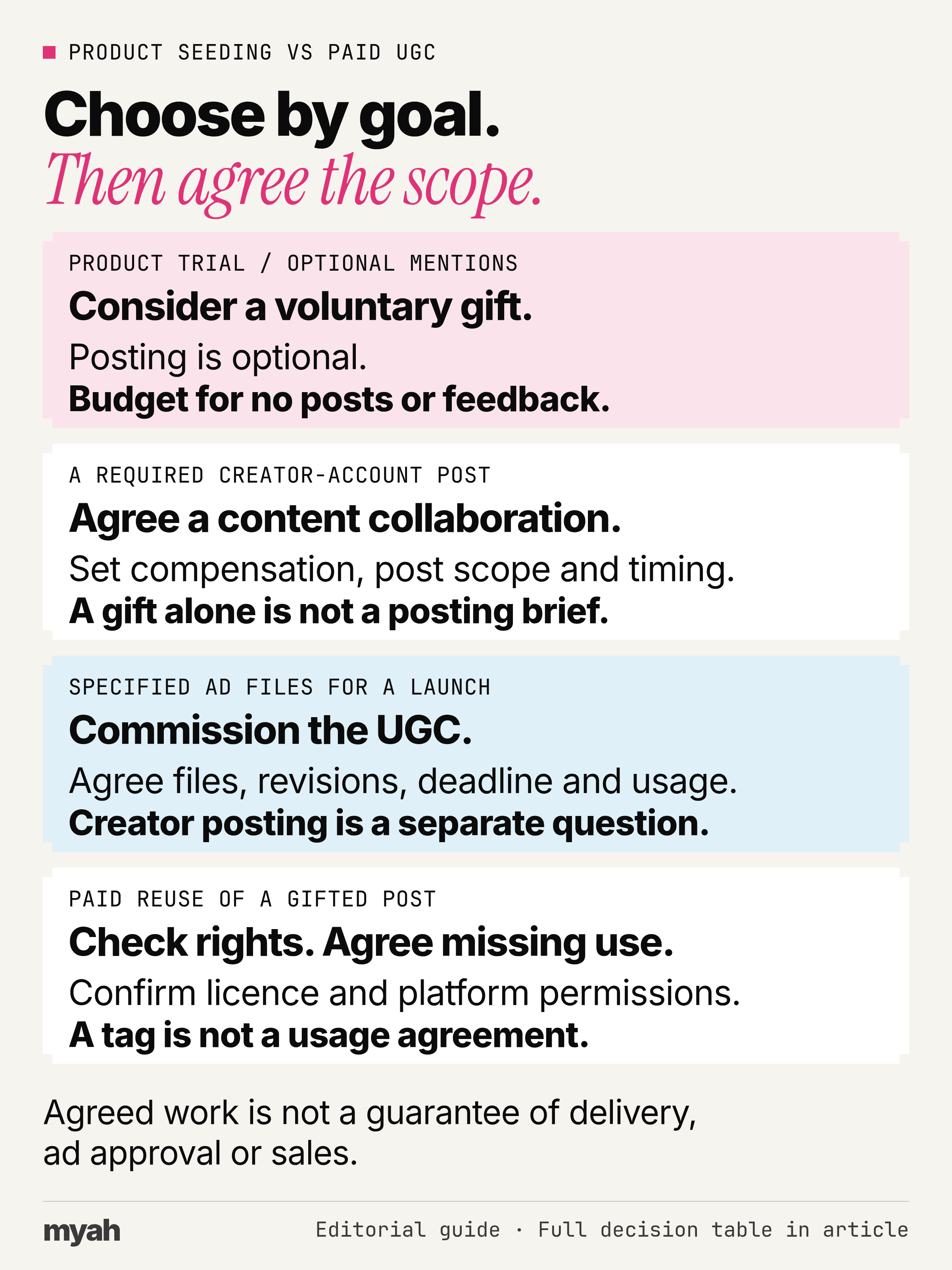
Influencer gifting is worth considering for product trial and relationship discovery when your budget can absorb no posts. If your launch depends on specified creative arriving, commission the work rather than relying on optional mentions. A paid agreement sets expectations; it does not guarantee delivery, ad approval or sales.
Use this decision table as editorial guidance, not a prediction of results.
| Goal | Arrangement to consider | Agree or check | Do not assume |
|---|---|---|---|
| Product trial or private feedback | Voluntary gift | Consent, product fit and optional posting | Feedback, a post or praise |
| Optional organic mentions | No-obligation seeding | Clear optionality and disclosure guidance | A posting volume or date |
| Required creator-account post | Explicit content collaboration | Accepted compensation, post scope, timing and disclosure | Receiving a gift creates a posting obligation |
| Specified ad files for a launch | Commissioned UGC | Deliverables, acceptance criteria, revisions, deadline and usage | Creator posting, ad approval or sales |
| Paid reuse of a gifted post | Check existing rights; negotiate missing usage | Asset, licence scope and relevant platform permission | A gift, tag or file grants ad rights |
For commissioned work, write the brief, agree scope, pay and rights, ship the product, review against the agreed criteria, receive the files and check them before testing. Our guide to how to hire UGC creators and copyable UGC brief template cover that process.
Keep content production, creator posting, media spend and usage rights as separate budget questions, even when a quote bundles them.
What does a usable piece of content actually cost?
Compare the same output. An observed organic post is not the same as a file cleared for your intended ad use. Count actual unit or landed product cost, not retail value, then add fulfilment, staff time, production, licences and editing where applicable.
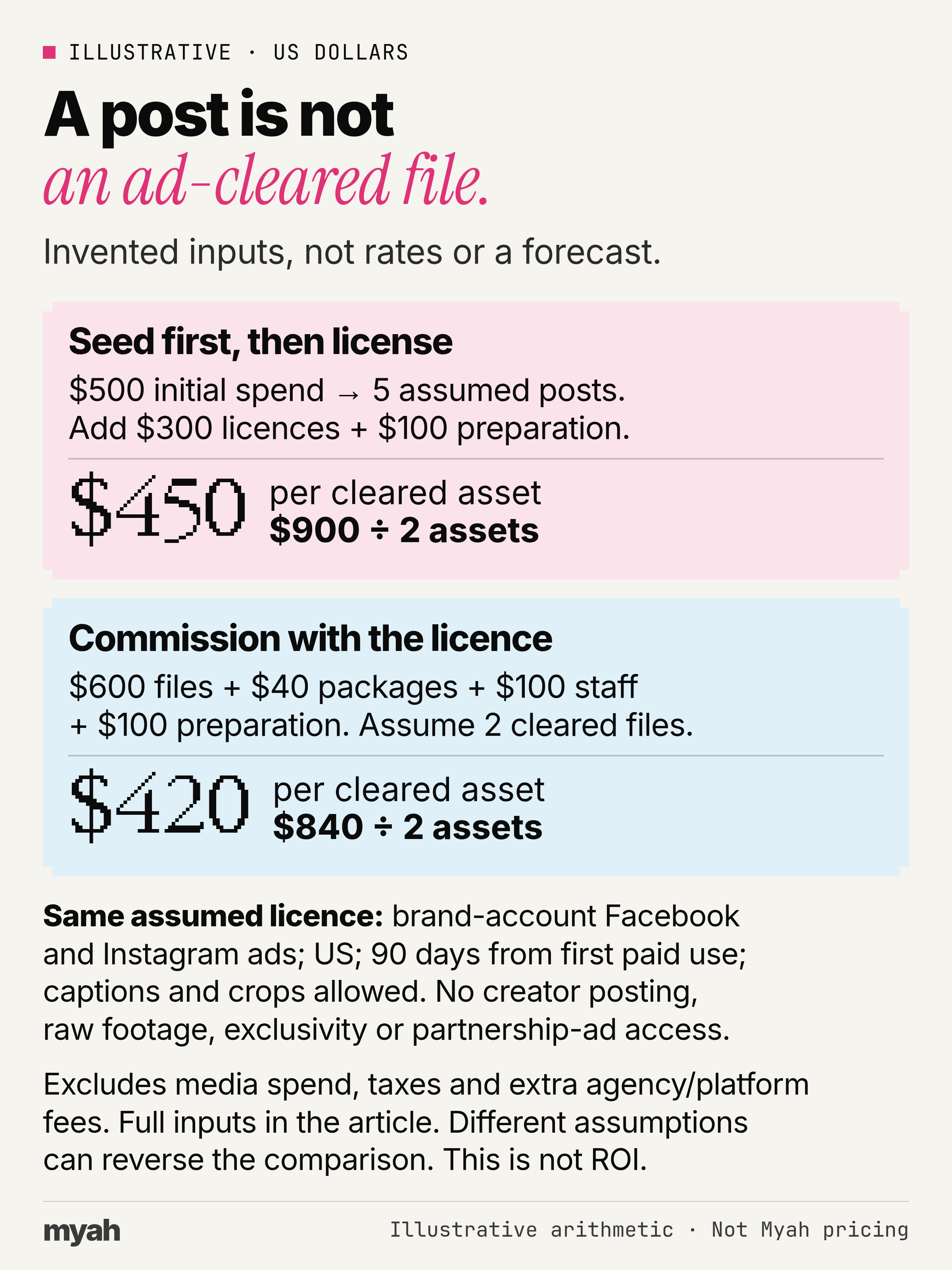
Illustrative only: these invented costs and outputs are not market rates, Myah pricing, a recommended budget or a forecast.
For both routes, assume the same licence: brand-account Facebook and Instagram ads targeting the US for 90 days from first paid use, with captions and crops allowed. Creator posting, raw footage, exclusivity and partnership-ad access are not included.
| Cost or output | Seed first, then license selected assets | Commission files with the licence included |
|---|---|---|
| Product plus packaging and shipping | 20 packages × $20 = $400 | 2 packages × $20 = $40 |
| Assigned staff cost | $100 | $100 |
| Initial gifting spend | $400 + $100 = $500 | Not applicable |
| Assumed organic output | 5 recipients each publish 1 post | No creator-account posts included |
| Initial cost per observed post | $500 ÷ 5 = $100 | Not applicable |
| Assumed files selected or accepted and cleared for ads | 2 | 2 |
| Production including the defined licence | No production fee at gifting stage | 2 files × $300 = $600 |
| Added paid-use licences | 2 licences × $150 = $300 | Included in production fee |
| Preparation for ads | 2 files × $50 = $100 | 2 files × $50 = $100 |
| Total acquisition, rights and preparation | $500 + $300 + $100 = $900 | $600 + $40 + $100 + $100 = $840 |
| Cost per cleared asset | $900 ÷ 2 = $450 | $840 ÷ 2 = $420 |
Both fictional totals exclude media spend, taxes and any additional agency or platform fees. Add applicable costs before comparing real quotes.
Cost per cleared asset = total acquisition, rights and preparation cost ÷ cleared assets.
The initial cost per seeded post leaves out the subsequent licence and preparation. The commissioned route assumes accepted files and an included licence, not guaranteed output. Changing the fees, rights, labour or number of usable files can reverse this comparison.
With zero cleared assets, report spend and zero assets; cost per cleared asset is not calculable. This is an acquisition-cost comparison, not ROI, customer acquisition cost or evidence that either route produces better ads.
Do gifted posts need a disclosure?
Yes, for resulting endorsements covered by US guidance. For US-facing endorsements, the FTC says to disclose a free product from a brand even if the brand did not ask you to mention that product. See the FTC's disclosure guidance. An unposted gift has no public post to label.
Put the disclosure with the endorsement, where it is hard to miss. For a video endorsement, put the disclosure in the video, not just its description. The FTC gives this example: “Thanks to Acme brand for the free product”. The agency says that wording is often enough when placed where it is hard to miss, not that it clears every arrangement.
The FTC says a disclosure must clearly communicate the nature of the connection so consumers can evaluate its significance. If the creator also received money, a gift-only disclosure is not enough to explain the relationship. Its Endorsement Guides explain these requirements.
The FTC advises advertisers to guide endorsers on avoiding misleading statements and disclosing unexpected material connections, and to monitor their compliance. Address missing disclosures and questionable claims. Do not ask for praise or an experience the creator has not had. A creator cannot describe an experience with a product they have not tried or misrepresent their opinion of it.
Meta requires its paid partnership label for branded content, which can include posts featuring a product gifted by a brand. Follow Meta's branded-content rules. Do not assume a platform's disclosure label is enough by itself.
This is general US-focused information, not legal advice. Other jurisdictions may also apply.
Can you run gifted creator content as an ad?
Yes, if the intended use is covered by the applicable rights and permissions. Check the agreement rather than assuming a gift, tag or delivered file settles the question. Paid production also needs a defined usage scope; a fee can include a licence, but inspect what it includes.
US copyright law separates ownership of a copy from ownership of copyright in the work. The official statutory text explains that distinction. For these collaborations, use a practical rule: no agreed paid use, no paid reuse. Confirm sufficient existing rights or negotiate the missing scope before running the ad.
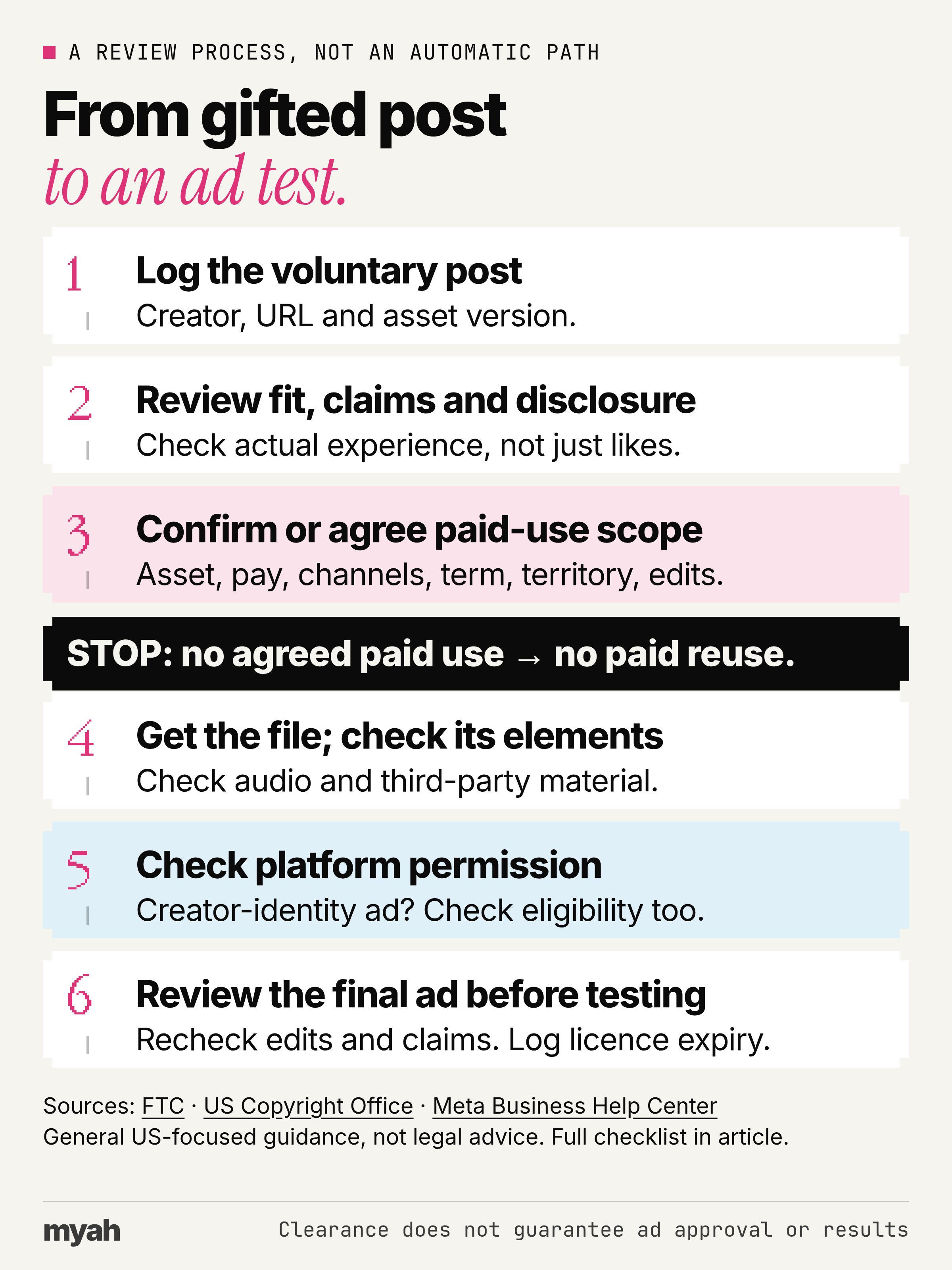
Use this checklist when a voluntary post looks suitable for paid use:
- Log the voluntary post. Record the creator, post URL and asset version. Do not treat posting as permission to advertise.
- Review suitability and disclosure. Check the creator's actual experience, supported product claims and disclosure. Do not select solely on likes.
- Confirm or agree paid-use scope. Record the asset/version, compensation, paid versus organic channels and accounts, term and start trigger, territory, permitted edits and relevant likeness rights. No agreement: no paid reuse.
- Get the usable file and check its elements. Confirm that the intended audio and any third-party material are covered. Do not assume the organic soundtrack is cleared for your ad.
- Check platform permission where required. For an independent creator's Meta partnership ad, obtain the appropriate permission and check eligibility.
- Review the final version before testing. Recheck edits, claims and disclosure. Log licence expiry and who is responsible for stopping use. Clearance is not proof of ad approval or performance.
In an independent creator-brand partnership, Meta requires permission from the partner whose handle the partnership ad will include. Its permission guidance is separate from your commercial usage agreement. Creators and advertisers must meet and remain compliant with Meta's eligibility requirements to run partnership ads. Check the eligibility rules, too.
Here is a copyable discussion prompt, not a contract:
We'd like to discuss paid use of [asset/version]. Are you open to a licence for [channels/accounts], [territory] and [term/start trigger], with [permitted edits]? Please quote the fee and confirm any audio or other third-party restrictions. If we want a partnership ad through your identity, we will agree that permission separately. We will not run it before the intended use is agreed.
For the fuller negotiation checklist, read UGC usage rights for paid ads. For the platform handoff, see Meta partnership ads and permissions.
How do you run and track a small product seeding pilot?
Start with a goal and a loss cap you can afford. Our recommendation is to shortlist for product fit, ask before shipping, state whether posting is optional, and share disclosure guidance without demanding praise. Record delivery and choose a reasonable follow-up point. A single courteous follow-up is a suggested boundary, not an industry timing rule.
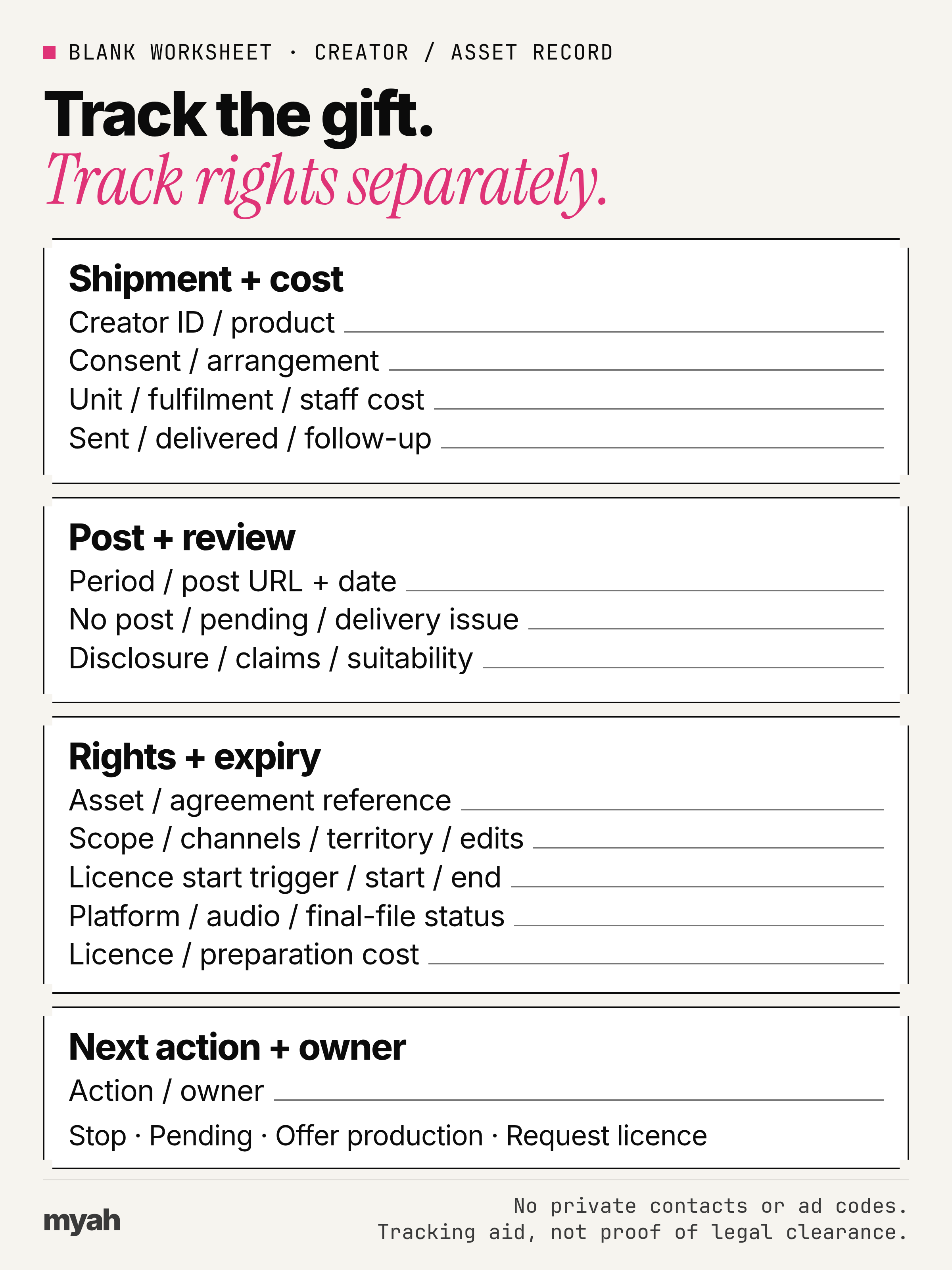
Keep shipment, outcomes and ad clearance separate. These copyable fields are a tracking aid, not legal certification:
- Shipment and cost: creator handle or internal ID; consent; arrangement type; product/variant; actual unit cost; packaging, shipping and other fulfilment costs; assigned staff cost; sent and delivered dates; follow-up date.
- Outcomes: observation period; post URL/date or no post yet; delivery-failure or pending status; disclosure review; truthful-claim review; creative suitability.
- Ad clearance: asset/version; rights-agreement reference; paid/organic scope; channels/accounts; territory; permitted edits; licence start trigger/date and end date; relevant platform permission status; audio/third-party review; licence and preparation costs; final-file status.
- Decision: next action; owner; stop, keep pending, offer paid production or request a licence.
| Creator | Shipment | Outcome | Ad clearance | Next action |
|---|---|---|---|---|
| Creator A | Consent recorded; no-obligation gift; sample product delivered | No post yet; disclosure review pending | Paid-use rights not agreed; final file not received | Courteous follow-up; campaign owner responsible |
Keep addresses, private contact details, login information and ad codes out of public examples or shared worksheets.
Download the printable seeding tracker (PDF).
Before measuring results, define the observation period and recipient denominator. Keep undelivered shipments, pending responses and no-post records visible. Count recipients who posted, individual posts and cleared files separately. Judge the pilot against its original goal and actual spend, not a borrowed posting-rate target.
When should you turn gifting into paid creator work?
Offer paid work when a creator's product fit and content justify a new brief, and they want to continue. You might license an existing asset or commission something different. Do not treat accepting a gift as an obligation to accept future work, or organic engagement as proof of ad results.
If a launch already needs creative by a deadline, commission it upfront. Voluntary trials can remain a separate activity rather than becoming your production plan.
Define qualification and tracking; do not budget commission-only work as cost-free.
Our guide to flat-fee, commission and hybrid UGC deals covers the economics. Use the UGC video formats and examples to shape the next brief. If you are choosing software, you can also compare creator campaign tools.
Where does Myah fit if you choose paid UGC?
Myah is an early-access UGC marketplace. Brands post paid video campaigns with a brief and pay, and creators apply to make videos for them. Brands review submitted videos and can approve them or request revisions. The marketplace is not open to everyone yet; brands can sign up for early access.
If that is the route you want to explore, see how Myah works for brands. Decide your deliverables, budget and intended usage before choosing a tool. Do not plan a launch around assumed creator availability or promised ad results.