

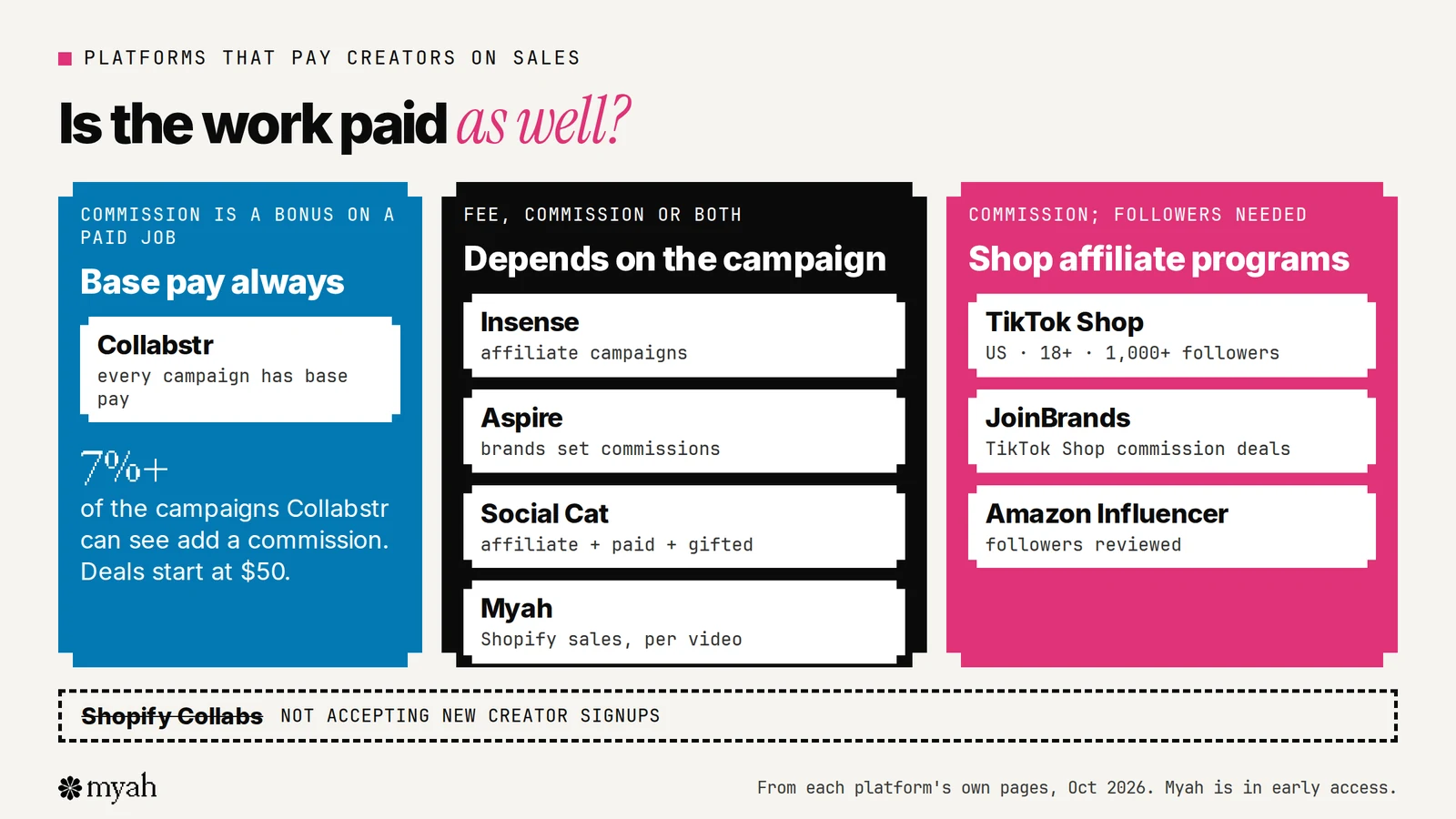
Platforms that pay UGC creators on sales include Insense, Aspire and Social Cat (affiliate campaigns), Collabstr (commission on top of base pay), JoinBrands (TikTok Shop commission deals) and Myah (commission tracked on Shopify sales for each approved video). TikTok Shop and Amazon's Influencer Program also pay creators commission, but want followers. Most sales deals work best paired with a base fee.
This guide is about earning a share of a brand's product sales from content you make for it. It isn't about selling your own digital products. It covers how pay on sales works, which platforms offer it, when a flat fee pays more, and the risks on both sides: commission-only offers for creators, and tracking gaps for brands.
Shopify Collabs, which many guides still recommend, isn't accepting new creator signups. Creators with existing brand partnerships can still log in.
What "paid on sales" means
Performance-based UGC ties some or all of a creator's pay to results. There are three common versions:
- Commission (a share of sales): you earn a percentage of the sales your link or discount code drives. No sales, no commission.
- Affiliate campaigns: the same idea, run as an open program. You promote a product with your own link or code and earn on what it sells.
- Hybrid: a flat fee for the video, plus commission on top. You're paid for the work either way, and you share in the upside.
Collabstr also counts pay per 1,000 views and whitelisting, where a brand runs ads from your account, as performance structures. This guide focuses on pay tied to sales.
How pay on sales works: links, codes, windows and refunds
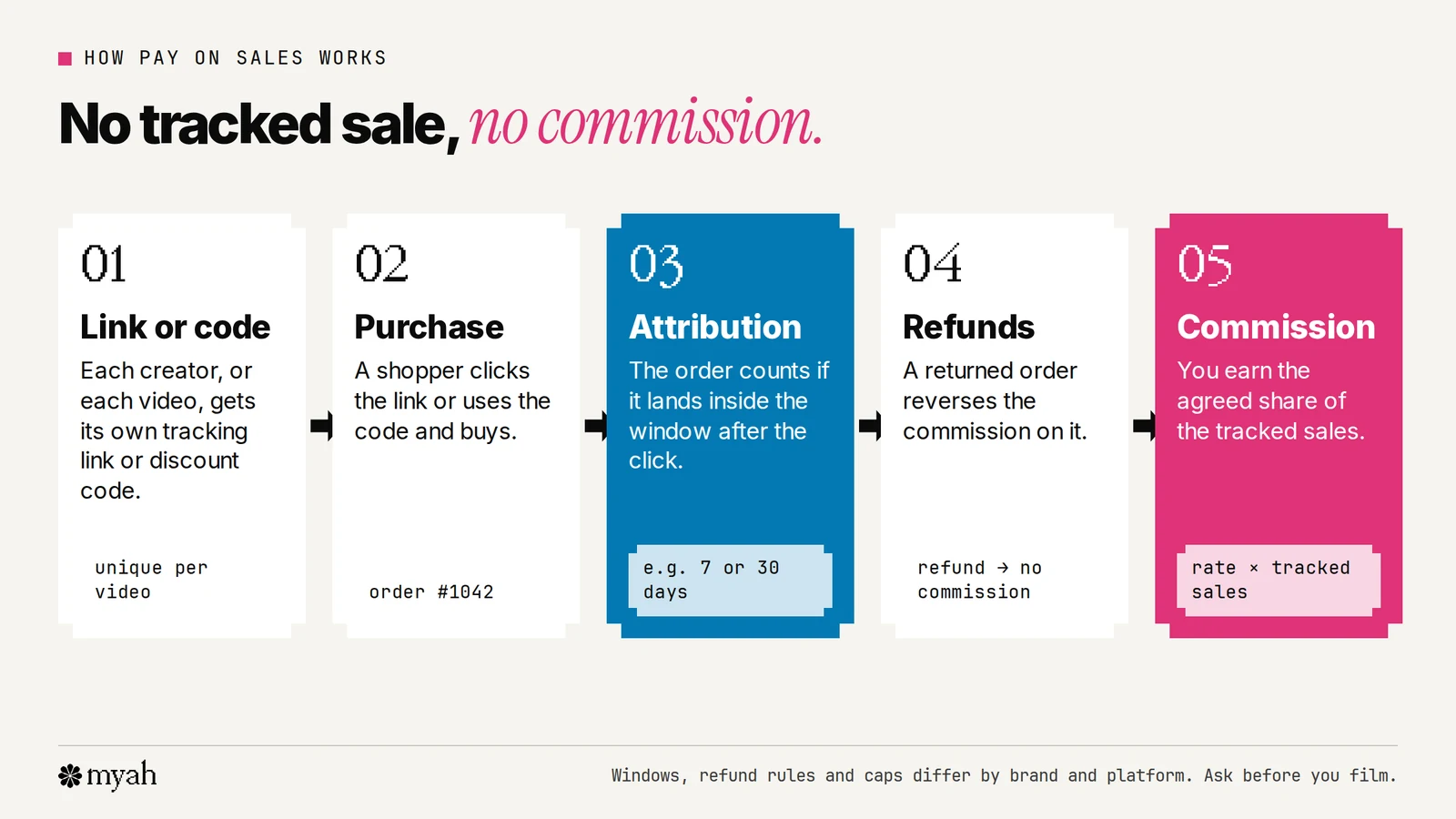
- A unique link or code. Each creator, or each video, gets its own tracking link, discount code, or both.
- A purchase. A shopper clicks the link or uses the code and buys.
- Attribution. The order is matched to you if it falls inside the attribution window: the number of days after a click during which a purchase still counts. Collabstr says the industry typically uses 30 to 90 days; some programs use much shorter windows.
- Refunds. A returned order normally reverses the commission on it.
- Payment. You earn the agreed share of the tracked sales. Collabstr says commissions typically follow the sale by 30 to 90 days, once purchases are confirmed.
The small print matters more than the headline rate. Ask how long the window is, whether links and codes both count, whether a refund reverses your commission and whether there's a cap.
Platforms that pay UGC creators on sales
| Platform | How sales pay works | Base pay as well? | Who can take part |
|---|---|---|---|
| Collabstr | Brands can add a commission to a campaign | Always. Every campaign includes base pay, from a $50 minimum | Creators on Collabstr |
| Insense | Affiliate campaigns pay on sales, clicks or actions through your link or promo code | Depends on the campaign | Creators who pass moderation: 1,000 followers and 1,000 average views on Instagram or TikTok, or a UGC-only route |
| Aspire | Brands set flat, percentage or tiered commissions per creator, with links and promo codes | Depends on the campaign | Each brand sets the eligibility for its campaigns |
| Social Cat | Affiliate campaigns alongside gifted and paid ones | Depends on the campaign | Creators in the US, UK, Australia and Canada |
| JoinBrands | Commission Only tab lists TikTok Shop deals; TikTok tracks and pays the commission | No, for Commission Only deals | US creators who are approved TikTok Shop affiliates |
| TikTok Shop | Commission on orders from shoppable videos, LIVEs and affiliate links | No. Sellers "only pay when a sale is made" | US, 18+, at least 1,000 followers |
| Amazon Influencer Program | Commission on qualifying purchases through your storefront or affiliate links | Some brands add bonus commissions or flat fees through Creator Connections | Amazon reviews follower count, engagement and content quality |
| Shopify Collabs | Affiliate links and codes from Shopify brands | Gifts and commission, set by the brand | Not accepting new creator signups |
| Myah (early access) | Each approved video gets its own tracking link and optional discount code; Shopify stores only | Each campaign pays a flat fee per approved video, a share of sales, or both | No large following needed; brands choose from portfolios |
Collabstr
Collabstr says every campaign includes base pay and commission-only campaigns don't exist on the platform. Deals start at $50. At least 7% of the campaigns it can see name a commission in the brief, so commission there is always a bonus on top of a paid job.
Insense
Insense runs affiliate campaigns that pay commission on sales, clicks or specific actions driven by your unique affiliate link or promo code. Insense separates these from product seeding, where you receive a product with no further payment.
Aspire
Aspire is a platform brands use to run creator programs. It lets brands set flat, percentage or tiered commissions per creator and track them with unique links and promo codes. In Aspire's Creator Marketplace, each brand sets the eligibility for its campaigns, and Aspire says it never takes a percentage of creator payments.
Social Cat
Social Cat lists gifted, paid and affiliate campaigns for creators in the US, UK, Australia and Canada, and says it takes no commission from creators.
JoinBrands
JoinBrands' Commission Only tab lists TikTok Shop commission deals for US creators who are approved TikTok Shop affiliates. These deals happen entirely on TikTok Shop, which handles the tracking, commission and payouts. JoinBrands' separate Affiliate tab pays a product fee plus a possible performance bonus for posting to TikTok.
TikTok Shop and Amazon
Both pay commission from their own shops, and both want an audience. TikTok Shop's creator requirements say affiliate creators must be US-based, at least 18 and have at least 1,000 followers. Under 5,000 followers, you start in a 30-day pilot program with posting limits. TikTok tells sellers they only pay when a sale is made. The Amazon Influencer Program pays commission on qualifying purchases and looks at your followers and engagement when you apply. Amazon says its Creator Connections marketplace also lets brands offer bonus commissions and flat-rate fees for sponsored content.
Shopify Collabs
Shopify Collabs let creators earn commission from Shopify brands through affiliate links and codes. Shopify's help center now says it isn't accepting new creator signups. Brands can still use it to invite creators and track affiliate sales.
Myah
Myah campaigns show the pay before you apply: a flat fee per approved video, a share of sales, or both. Sales tracking works with Shopify stores only, with a tracking link and optional discount code for each approved video. Myah is in early access. How the tracking works is covered under "Where Myah fits" below.
Flat fee, commission or both?
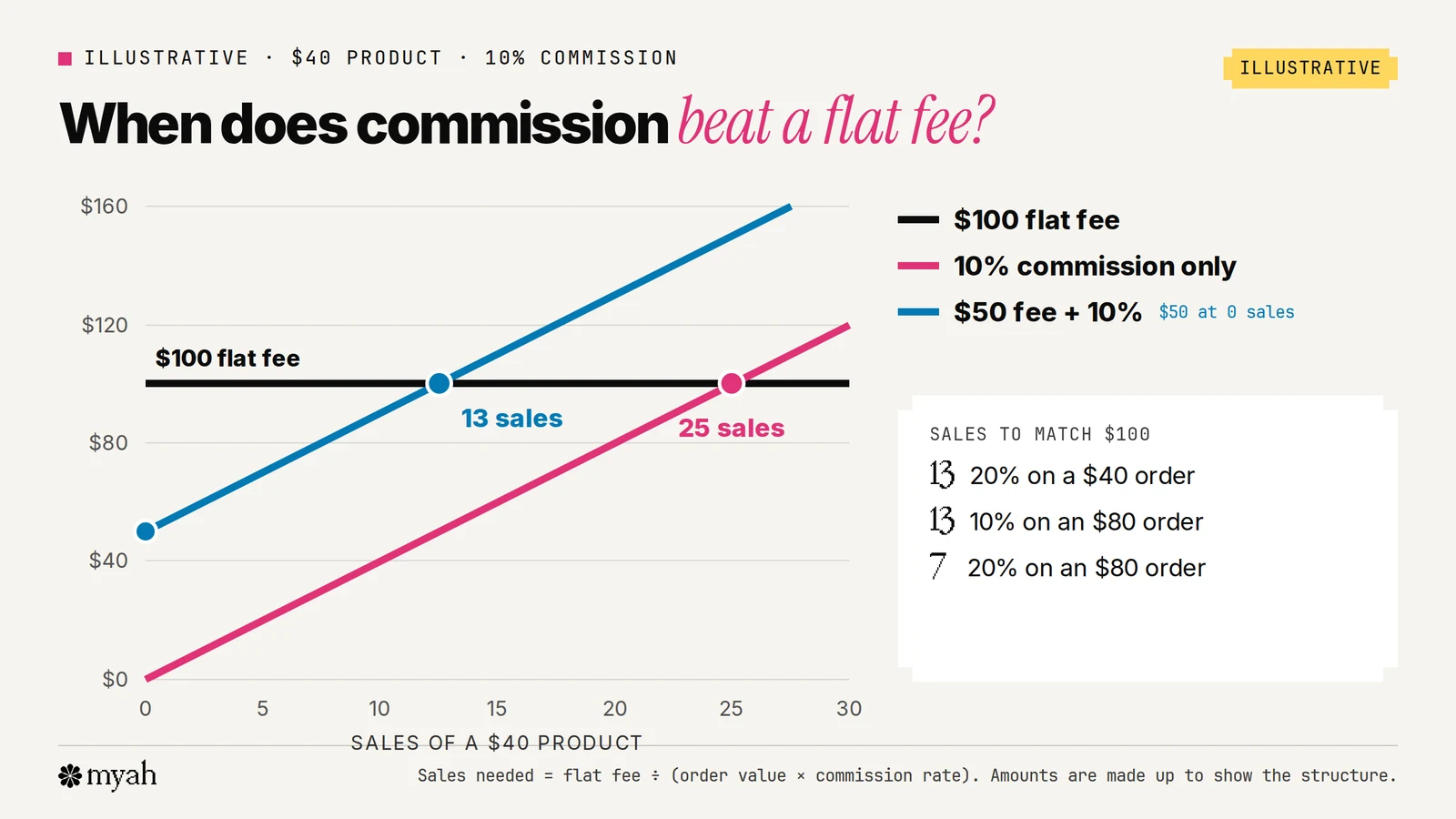
For a creator, the question is how many sales it would take for commission to beat a flat fee. That depends on the order value and the rate:
Sales needed = flat fee ÷ (order value × commission rate)
| Illustrative deal | Commission per sale | Sales to match a $100 flat fee |
|---|---|---|
| 10% on a $40 order | $4 | 25 |
| 20% on a $40 order | $8 | 13 |
| 10% on an $80 order | $8 | 13 |
| 20% on an $80 order | $16 | 7 |
| $50 fee plus 10% on $40 orders | $4 | 13 to reach $100 in total, with $50 guaranteed |
Commission is still the minority. In UGC Roster's Q3 2026 report, 24% of 156 labelled campaigns included commission, and of 115 contracts, 14% were affiliate only and 9% were revenue shares. UGC Roster advises creators to treat gifted and commission offers as a separate market from cash contracts.
Our guide to flat fee vs commission works through the maths from the brand's side too, and how much UGC creators make covers what a flat fee usually pays.
Risks for creators: commission-only offers
A commission-only deal means you do the work now and might earn nothing. Collabstr puts it plainly: commission-only collaborations ask a creator to work for a maybe. That can still make sense for a product you'd promote anyway, or for a brand whose sales you can estimate. For an unknown brand, ask for a base fee.
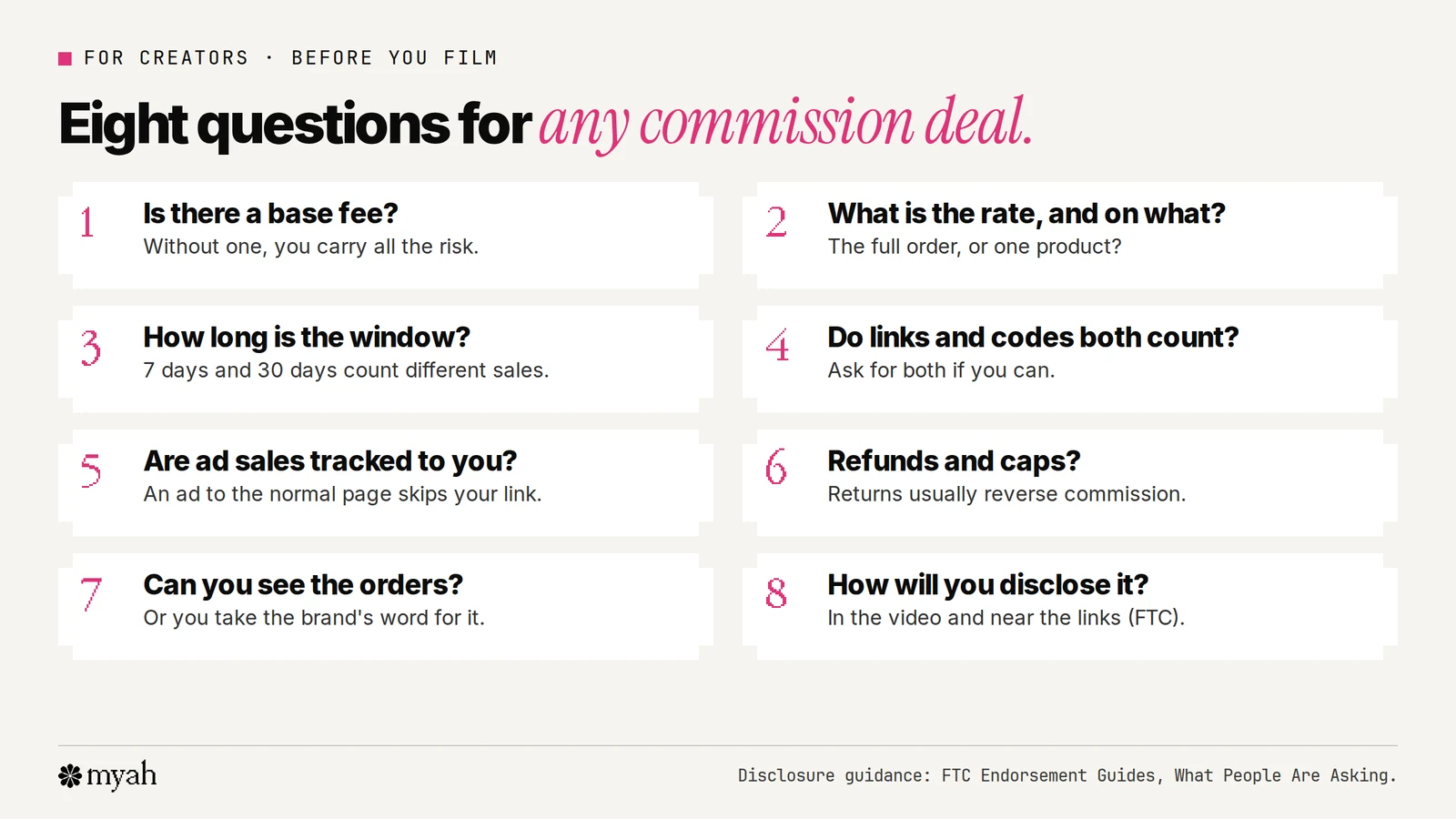
Before you agree, ask:
- Is there a base fee? Without one, you carry all the risk.
- What's the rate, and on what? The full order, or one product?
- How long is the attribution window? A 7-day window and a 30-day window count different sales.
- Do links and discount codes both count?
- If the brand runs your video as an ad, are those sales tracked to you? If the ad sends people to the brand's normal page, your link won't see them.
- How are refunds handled, and is there a cap?
- Can you see the orders behind your commission? Without that, you're taking the brand's word for it.
- How will you disclose it? The FTC says to disclose an affiliate relationship in the video and near the links. It also says "affiliate link" on its own may not be clear enough; "I get commissions for purchases made through links in this post" is the kind of wording it suggests.
Risks for brands: tracking misses sales
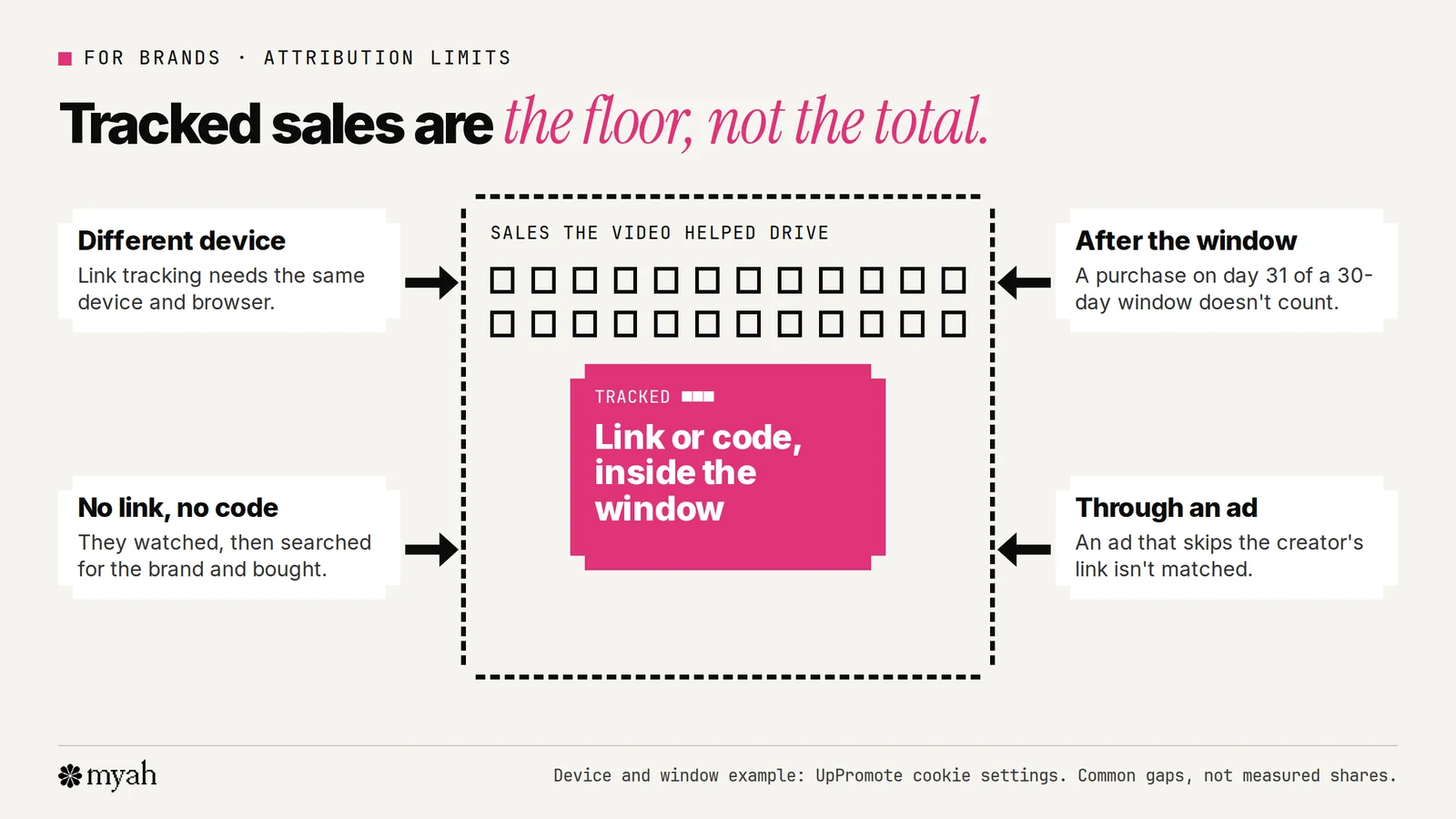
Commission keeps your cost tied to results, but tracking only sees part of what a creator drives:
- Different device or browser. Link tracking usually relies on a browser cookie. UpPromote, a Shopify affiliate app, says the customer needs to use the same device and browser as when they clicked.
- Outside the window. A purchase made after the attribution window ends doesn't count.
- No link and no code. Someone who watches the video, then searches for your brand and buys, won't be matched to the creator.
- Ads. If you run a creator's video as a Meta partnership ad, agree up front whether the ad uses the creator's tracking link and how those sales are paid.
That means commission usually undercounts what creators drive. Two practical fixes: pay a base fee for content you need on time, since Collabstr says commission-only offers stall, and agree usage rights separately, because commission pays for sales, not for running the video as an ad.
How Shopify brands track creator commission
If you sell on Shopify, these are the main options:
| Option | How sales are matched | Watch out for |
|---|---|---|
| A discount code per creator | Orders that use the code; Shopify's "Sales by discount" report shows them | Misses buyers who don't use the code; codes can be shared beyond the creator's audience |
| Shopify Collabs | Affiliate links and codes; a Sales report shows sales and commission per creator | Not accepting new creator signups, so you're limited to creators already on it |
| An affiliate app, such as UpPromote | A link click starts a window you set (for example 30 days); codes can be tracked too | Link tracking needs the same device and browser |
| Myah (early access) | A tracking link and optional discount code for each approved video; the last click within 7 days counts; refunds reverse commission | Shopify stores only |
Where Myah fits
Myah is a marketplace where brands post paid video campaigns and creators apply with a portfolio. Each campaign shows its pay before creators apply: a flat fee per approved video, a share of sales, or both. Creators don't need a large following; brands choose from portfolios.
For Shopify stores, each approved video gets its own tracking link and an optional discount code. The last click within 7 days counts, refunds reverse commission, and brands and creators can both see the orders behind each commission. Myah is free for creators, and the brand's fee is paid on top, never taken from creator earnings. We're in early access.
Join creator early access or see how Myah works for brands. Early access does not guarantee campaigns, availability or earnings.
Common questions
Which platforms pay UGC creators on sales?
Insense, Aspire and Social Cat run affiliate campaigns; Collabstr lets brands add commission on top of base pay; JoinBrands lists TikTok Shop commission deals; and Myah tracks commission on Shopify sales for each approved video. TikTok Shop and the Amazon Influencer Program pay commission too, but want followers. Shopify Collabs isn't taking new creators.
Is commission-only UGC worth it?
Rarely with a brand you don't know, because you could do the work and earn nothing. A base fee plus commission is fairer to the creator and still ties the brand's cost to results.
How is UGC commission tracked?
With a unique link or discount code per creator, or per video. Orders are matched within an attribution window, and refunds usually reverse the commission. Ask how long the window is and whether you can see the orders.
What is a typical UGC commission rate?
There's no standard: each brand or seller sets its own, based on its margins. Work out what a rate is worth with the formula above: sales needed = flat fee ÷ (order value × rate).
Do I need followers to be paid on sales?
On TikTok Shop, yes: at least 1,000 in the US. Amazon reviews your followers when you apply. Marketplaces such as Insense, Collabstr and Myah set their own rules, and on Myah brands choose creators from portfolios.
Can I still join Shopify Collabs?
Not as a new creator. Shopify says Collabs isn't accepting new creator signups at this time, though creators with existing brand partnerships can still log in.
Do I have to disclose affiliate links in UGC?
Yes, whenever you post the content yourself and earn from it. The FTC says to disclose the affiliate relationship in the video and near the links, in words people will understand.
Sources
Platform facts are from each platform's own pages as published in October 2026.
- Collabstr: performance-based influencer marketing, influencer affiliate marketing
- Insense: affiliate campaigns, moderation requirements
- Aspire: platform features, Creator Marketplace overview
- Social Cat: for creators
- JoinBrands: job marketplace tabs
- TikTok Shop: what you need to know before becoming a TikTok Shop creator, affiliate marketing
- Amazon: Influencer Program, how the Influencer Program works
- Shopify: Collabs for creators, Shopify Collabs, managing creators in Collabs, sales reports
- UpPromote: cookie settings
- UGC Roster: UGC Rates Report Q3 2026
- FTC: Endorsement Guides: what people are asking
Comparing platforms more broadly? See the best UGC platforms for creators and, for brands, how to hire UGC creators.