

To research competitors' UGC-style ads, open Meta Ad Library, choose a market and ad category, search an advertiser, then inspect relevant videos. Record what you can see separately from what you think might work. Use those observations to write an original creator brief, not to declare a competitor's ad a winner.
Where do I open the Meta Ad Library?
The official Meta Ad Library lets you search ads currently running across Meta technologies. If you searched for “Facebook Ad Library,” start here too. Search by advertiser or keyword, then inspect the available creative.
Anyone can view and search the Ad Library, but some age-restricted creative is hidden from underage viewers and people who are not logged into Facebook. Meta's overview explains those restrictions.
Use the library for public creative research, not as a substitute for campaign reporting. In this guide, “UGC-style” describes how a video is made: a person explaining, handling or using a product. It does not establish that the person is a customer, who paid them, or whether the ad sold anything.
How do I find a competitor's Facebook and Instagram ads?
Start with a known advertiser so you can confirm whose ads you are studying. Then broaden the search to adjacent brands or product-category keywords. A keyword match is not enough to establish that the ad belongs to the brand you typed.
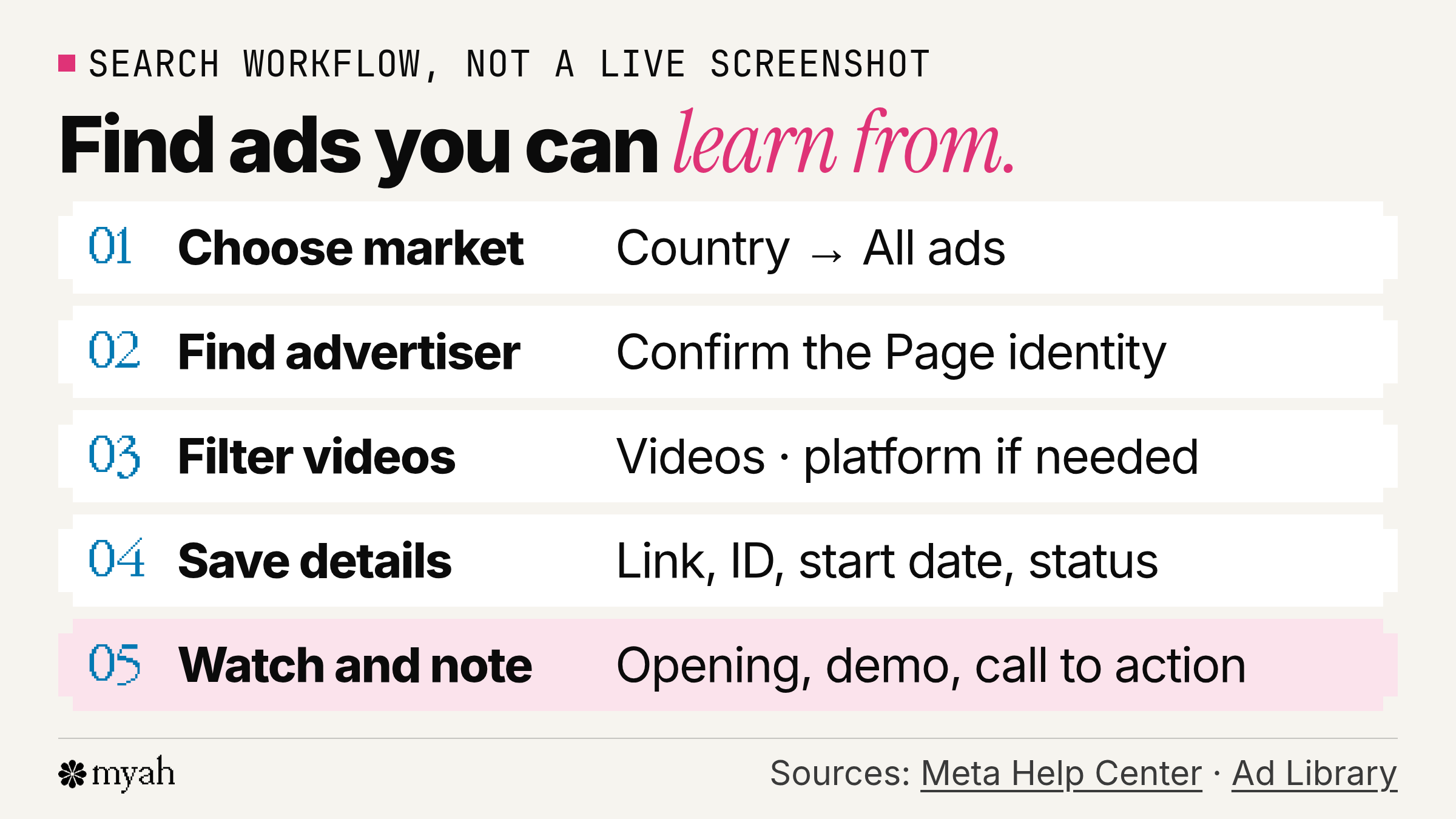
- Choose your research market. Use the country selector to view ads from a specific country. Choose the market you want to study; do not treat the selection as the advertiser's headquarters or a complete targeting report.
- Select the category. For ordinary commercial research, select All ads and search by keyword or advertiser. Confirm the advertiser's Page identity before saving a result.
- Narrow to video. Use Media type: Videos to narrow the search to video ads. Where a platform filter is shown, use it to narrow the results. Leave the platform filter broad when you want to compare platforms.
- Open the available details. Use See ad details where shown. Save the source link, Library ID, displayed status and Started running on date. Record platform and identity labels only when you can read them.
- Watch and describe. Note the opening, product demonstration and call to action. Paraphrase the idea rather than copying the script. Keep the source link beside your notes.
These steps use Meta's advertiser-search guidance and the filters shown in its commercial Facebook video search. The diagram is a workflow, not a reconstruction of the interface.
If results are empty, clear restrictive filters, check the Page spelling, reconsider the market and broaden the query. An empty filtered search does not prove that a brand is not advertising. Do not label an unavailable preview “no creative” or invent a reason it is missing.
How do I recognise UGC-style and creator ads?
Watch for a person or hands demonstrating the product, explaining a problem or showing a routine. Use these as descriptive tags, not as proof of the person's relationship with the brand. Searching for the word “UGC” is not a substitute for watching the available videos.
For each useful reference, ask:
- Opening: What appears first, and what is the spoken idea?
- Buying question: What uncertainty might this address? Mark your interpretation as a hypothesis.
- Demonstration: What can you actually see the product do?
- Format: Is this direct-to-camera explanation, a hands-on demo or routine footage?
- Offer and CTA: What does the viewer get asked to do?
A spoken claim is not automatically demonstrated proof. Record the difference. For more format vocabulary, see UGC video formats and examples.
Keep creative style separate from ad identity. Meta defines partnership ads as ads run with partners such as creators, brands and businesses. A partnership ad can feature the partner account, the advertiser account, or both in its header. Do not assume both names must appear.
Meta's separate branded-content search covers public, active Facebook and Instagram content tagged with a paid partnership label. In that search, select Facebook or Instagram and a date range, then search by Page or Instagram profile. Meta documents the distinction.
A branded-content search result alone does not establish that the content ran as a paid ad. If the creator or relationship is unclear, record “unknown.” Use the guide to Meta partnership ads and permissions when planning your own arrangement, not to infer a competitor's permission terms.
What does the Ad Library show outside the EU?
For ordinary commercial ads without EU, associated-territory or UK delivery, the library shows active ads rather than a general archive of stopped ads. The UK is an important exception outside the EU: it has an archive and additional transparency fields.
The distinction concerns where an ad delivers, not where the advertiser is based. This table summarises Meta's scope documentation and the UK qualification on the library's landing page.
| Scope | Creative, identity and dates | Archive | Additional transparency |
|---|---|---|---|
| Ordinary commercial ads without EU, associated-territory or UK delivery | Active creative, Page and displayed start date | No general inactive-ad archive | No disclosed spend, impression ranges, total reach, reach breakdowns or targeting selections |
| Commercial ads delivered to the EU or associated territories | Creative, Page and dates the ad ran | 1 year after the last impression | Ad-level age, gender and location targeting; regional reach and breakdowns; advertiser and payer information |
| Commercial ads delivered to the UK | Creative, Page and dates the ad ran | 1 year after the last impression; coverage is for ads run in the past year and after 1 July 2025 | Ad-level age, gender and location targeting; regional reach and breakdowns. Advertiser and payer information is not listed for the UK |
| Social-issue, election or political ads | Creative, Page, dates and active or inactive status | 7 years | Spend and impression ranges, demographic/location disclosures and disclaimer information where provided |
Preview restrictions still apply. Political and regional categories can overlap, in which case Meta says both sets of details appear. Political-ad disclosures are not standard features of every commercial ad.
Meta's comparison table does not provide amount spent or impression ranges for ordinary commercial ads, including its EU and UK columns. Regional reach fields are not worldwide reporting. Keep “reach” labelled as reach, rather than relabelling it impressions, conversions or sales. Treat missing information as unavailable, not zero.
Does a long-running ad mean it performs well?
No. A start date and active status do not establish uninterrupted delivery, return on ad spend or profitability. The same applies to repeated creative and visible variants: they do not tell you how the advertiser allocated budget or which version produced sales.
| Observation | Not established |
|---|---|
| Displayed start date and status at capture | Continuous delivery since that date or future availability |
| Related creative or multiple versions | Spend allocation or a winning version |
| Disclosed regional reach | Worldwide delivery, conversions or profit |
| A visible product demonstration | An improvement in sales |
These are limits on inference from Meta's disclosed fields, not performance findings. Prioritise references that address your buyer's question and show something you can describe clearly. Avoid scoring ads as “winners” using calendar age or variant counts.
Once you run your own approved creative, measure hook rate on your own Meta ads. That is a separate task from studying a competitor's public preview.
What should I record in a UGC ad swipe file?
Keep source details, observations and hypotheses separate. The useful output is a traceable idea for your own product, not a folder of copied ads.
Use this field dictionary for a spreadsheet. These are suggested research columns, not a Meta export format.
| Group | Columns | What to record |
|---|---|---|
| Source | record_type, advertiser, library_id, ad_url, market_filter | Mark observed or illustrative. Keep the Page name, source ID, link and selected research market. |
| Timing | captured_on, displayed_start_date, displayed_status, last_observed_on | Separate your observation dates from Meta's displayed date and status. Do not turn them into continuous run length. |
| Identity | platform_shown, identity_or_label_shown | Copy only readable platform, account or partnership labels. Otherwise use unknown. |
| Creative | format, opening_visual, hook_summary, buying_question, demonstration_or_proof, offer_and_cta | Describe the footage and paraphrase the hook. Mark inferred buying questions as interpretation; distinguish shown actions from unverified claims. |
| Reasoning | observation, hypothesis, original_test_idea | Write what you saw, a possible explanation, and an original production request in separate cells. |
Copy this header into a plain-text file saved with a .csv extension, or use the field names directly in your spreadsheet:
record_type,advertiser,library_id,ad_url,market_filter,captured_on,displayed_start_date,displayed_status,last_observed_on,platform_shown,identity_or_label_shown,format,opening_visual,hook_summary,buying_question,demonstration_or_proof,offer_and_cta,observation,hypothesis,original_test_idea
In Google Sheets on a computer, open a spreadsheet, choose File then Import, and select the CSV file and an import option. If needed, choose Comma as the separator, then click Import. See Google's import instructions.
Leave missing values blank or use “unknown.” Do not invent Library IDs, dates or customer relationships. Group related variants in your notes rather than treating each as independent evidence of success.
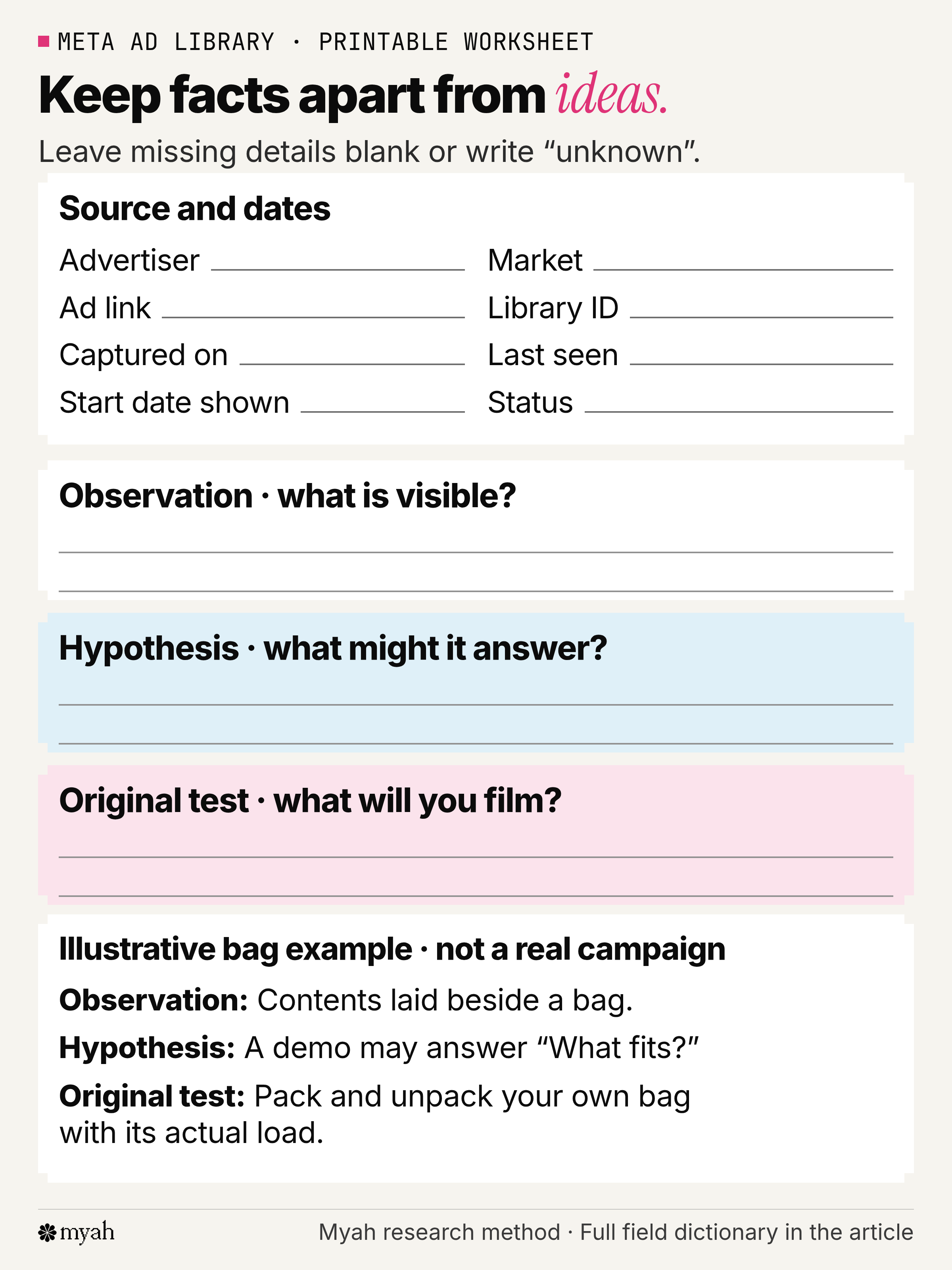
Download the printable UGC ad research worksheet. Use it for handwritten notes; use the copyable header above for spreadsheet research.
How do I turn an ad observation into an original creator brief?
Translate the buying question, not the competitor's script. Keep the useful question, replace the execution with footage of your own product, and specify what the creator can honestly demonstrate.
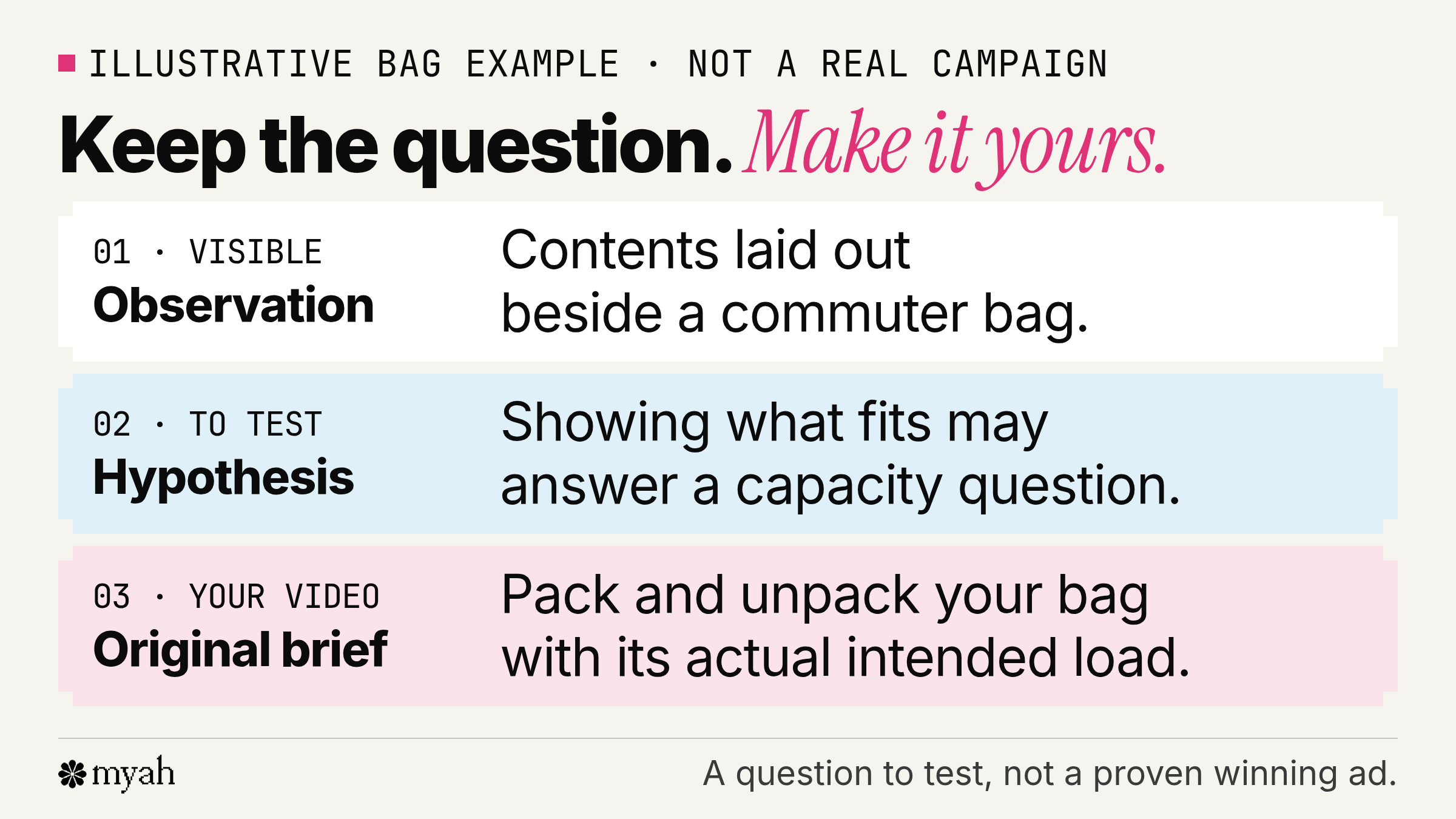
The following commuter-bag example is illustrative. It is not a real ad, customer story or validated concept; leave source IDs, links and dates blank if you add it to your worksheet.
- Illustrative observation: The opening shows the contents of a commuter bag laid out beside it.
- Hypothesis, not a result: Showing what fits may help answer a capacity question.
- Original brief: Film your own bag with its actual intended load. Show packing and retrieval, and only make capacity claims the product can support.
- Illustrative opening concept: Begin with the actual commuting items beside the empty bag, then pack them.
- Alternative illustrative opening: Begin by retrieving an item from the packed bag, then reveal where it was stored.
Before commissioning the video, specify:
- The audience and buying question.
- The product facts and actions the footage can genuinely demonstrate.
- Deliverables and alternative openings.
- Claims to avoid and the criteria for approval.
- Intended use and the permissions you need to agree.
For the illustrative bag, avoid unsupported waterproofing, universal laptop-fit or time-saving claims. A visible packing sequence should show what actually fits, not imply that every buyer carries the same load.
Treat public ads as research references, not reusable assets. Link to references; do not download and re-upload another brand's footage or copy its distinctive dialogue. Then copy the UGC brief template and use the guide to hiring and vetting UGC creators to find someone who can execute your own brief.
What should I do after building the shortlist?
Keep the source link, write down the uncertainty and choose an original production question. Complete the brief before hiring. Your research is ready when another person can distinguish what you observed from what you want to test.
Myah is an early-access UGC marketplace. Brands post paid video campaigns with a brief and pay, then review creator portfolios and applications. The marketplace is not live yet; brands and creators can sign up for early access. Myah's overview explains its current scope.