

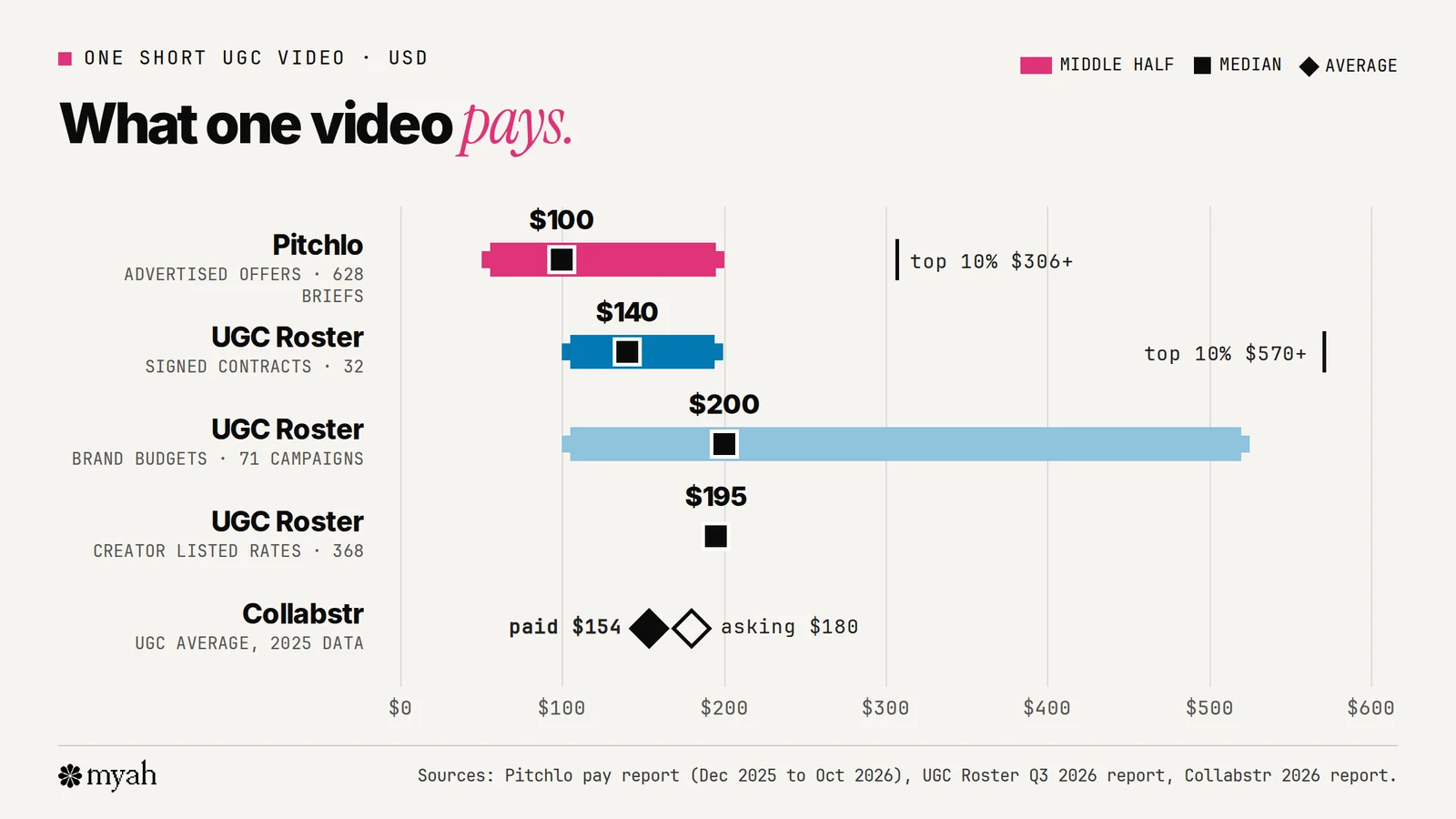
UGC creators typically make $50 to $200 per video in 2026. That's the middle half of 628 per-video briefs on the Pitchlo job board from December 2025 to October 2026, where the median offer was $100. On UGC Roster, the median signed contract was $140. Our rate calculator starts new creators at $50 to $150, and paid-ad rights cost extra.
This guide covers what one video pays, what a beginner should charge, what a month can add up to, the add-ons that raise your price, how and when creators get paid, and an honest answer to whether UGC is legit. UGC here means user-generated content: short videos and photos that creators make for a brand to post or run as ads.
Where the numbers come from: marketplaces and job boards that publish their own data, with sample sizes. Each one measures something different (advertised offers, listed rates or signed contracts), so we show them side by side and say which is which. None of these figures are Myah data.
How much do UGC creators make per video?
Most published data lands between $100 and $200 for one short video, with a long tail above that.
| Source | What it measures | Sample | Median | Middle half |
|---|---|---|---|---|
| Pitchlo | Advertised per-video offers, Dec 2025 to Oct 2026 | 628 briefs | $100 | $50 to $200 (top tenth $306+) |
| UGC Roster | Signed contracts | 32 contracts | $140 | $100 to $200 (top tenth $570+) |
| UGC Roster | Brand budgets per creator | 71 campaigns | $200 | $100 to $525 |
| UGC Roster | Rates creators list on their rate cards | 368 packages | $195 | Not published |
| Collabstr | UGC on its marketplace in 2025 | Not stated for UGC | Average paid $154 (average asking price $180) | Not published |
Why the numbers don't match
Three things explain most of the gap between sources:
- Asks, offers and signatures are different numbers. On UGC Roster, creators list a median of $195 and brands budget $200, but signed contracts settle at $140, roughly 28% below the listed rate.
- Pitchlo counts the bottom of each pay band. Where a brief says "$100 to $150", Pitchlo records $100. It says most listings state a single number, so the effect is small.
- Some samples are small. UGC Roster's signed-contract median rests on 32 contracts. Treat it as a signal, not a market price.
Pitchlo also found that four out of five advertised rates are exact multiples of $50. Brands think in round numbers, and so should your quotes.
How much should a beginner UGC creator charge per video?
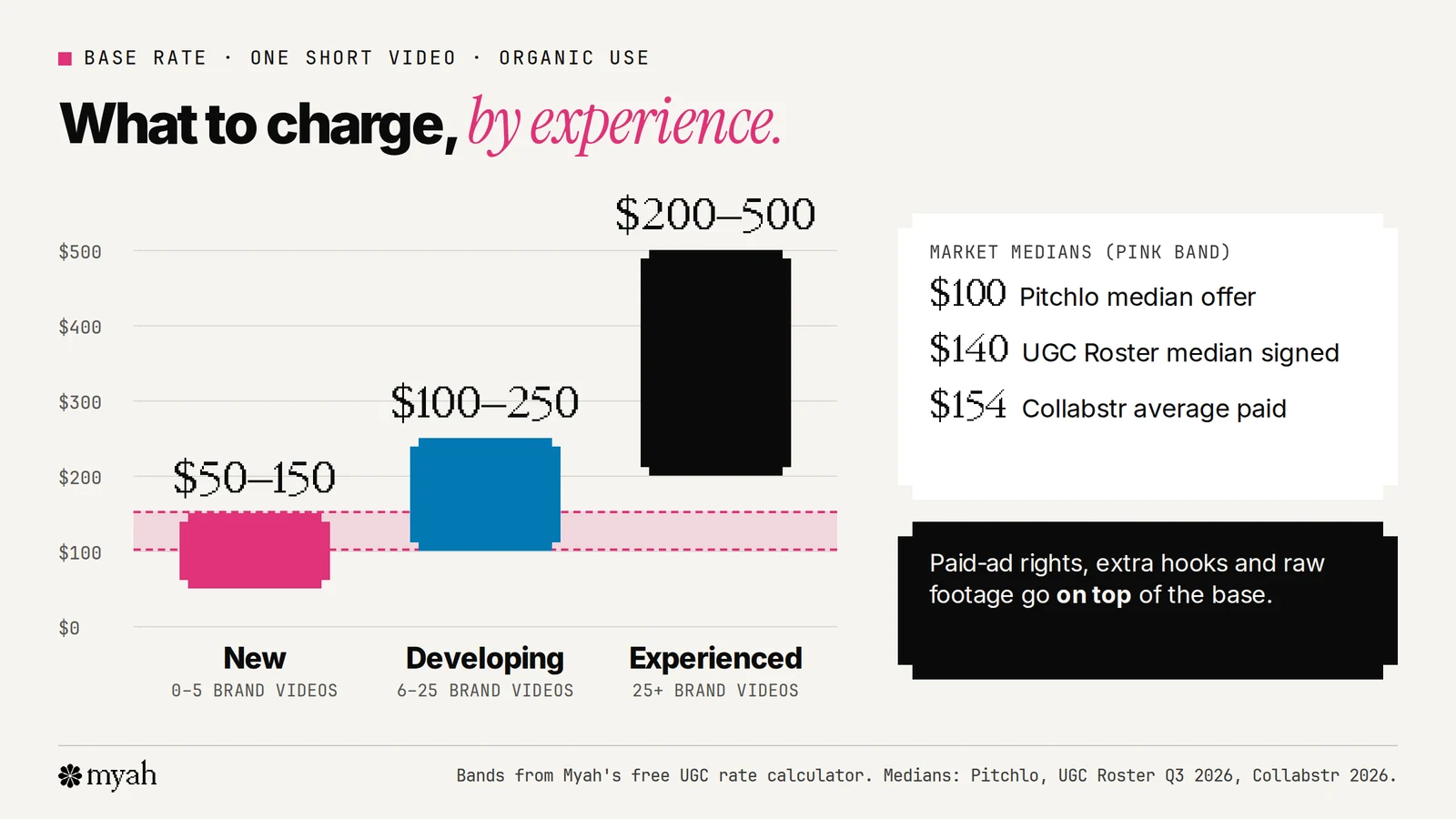
A beginner with fewer than five brand videos can reasonably charge $50 to $150 for one short, edited video that the brand posts on its own channels. That's the starting band in our free UGC rate calculator, which we built from the data above.
| Experience | Brand videos delivered | Base rate per video | What the data shows |
|---|---|---|---|
| New | 0 to 5 | $50 to $150 | Pitchlo's median advertised offer is $100 |
| Developing | 6 to 25 | $100 to $250 | UGC Roster's median signed contract is $140; Collabstr's average UGC payout is $154 |
| Experienced | 25+ | $200 to $500 | Pitchlo's top tenth starts at $306; UGC Roster's top tenth of contracts clears $570 |
Two things matter less than most creators expect:
- Followers. On UGC Roster, creators with under 1,000 followers list a median of $167.50 per package, against $200 for creators with 10,000 to 50,000. Brands buy the video, not your audience. If you're starting from zero, see how to become a UGC creator with no followers.
- Niche. Pitchlo found that median per-video offers in every niche it could measure land within $10 of each other. Niche changes how wide the range is, not the middle.
What moves you up the bands is proof: finished videos a brand can watch. If you don't have any yet, start with how to build a UGC portfolio with no experience.
How much do UGC creators make a month?
Nobody publishes reliable monthly earnings for UGC creators. Pitchlo says its report measures per-brief rates, not annual earnings. UGC Roster says no payout ledger backs its report, so it makes no claims about what creators earn. Anyone quoting a precise monthly figure is guessing.
You can do the arithmetic yourself: videos delivered, times your rate, minus platform fees.
| Illustrative month | Videos | Rate per video | Before fees and tax |
|---|---|---|---|
| Getting started | 2 | $100 | $200 |
| Steady part-time | 4 | $150 | $600 |
| Busy month | 8 | $200 | $1,600 |
These amounts are made up to show the structure. They aren't earnings data.
Two published figures help with the shape of it:
- Retainers pay more per month, for more work. On Pitchlo, monthly retainer briefs had a median of $400 (404 briefs, middle half $200 to $600), against $100 for a single video. A retainer covers several videos, so check how many before you compare.
- Competition is real. On UGC Roster, the median campaign drew 96.5 applications, and there were about 65 applications for every creator a brand added to its roster. Landing work takes volume and a strong portfolio.
Influee, a UGC marketplace, says its creators typically earn €290 to €850 a month. That's the platform's own marketing claim, not audited data.
What about "UGC creator salary" figures?
Salary sites show much bigger numbers. ZipRecruiter lists an average of $123,124 a year ($59.19 an hour) for a "UGC creator" in the US. ZipRecruiter says its estimates come from employer job postings and third-party data and are not verified by employers. Its own table also puts the 25th percentile ($130,000) above that average.
Treat salary sites as a rough guide to salaried in-house roles that use the title, not to freelance UGC income. As Pitchlo puts it, UGC is priced per project, not salaried.
What adds to your rate: usage rights, hooks, raw footage and whitelisting
Your base rate covers making the video and letting the brand post it on its own channels. Anything beyond that is a separate line on your quote:
- Paid-ad usage: the brand runs your video as an ad. Priced by how long it can run. Read UGC usage rights for paid ads before you agree to any length.
- Extra hooks: alternative openings so the brand can test which one stops the scroll.
- Raw footage: the unedited clips, so the brand can recut the video.
- Whitelisting: the brand runs the ad from your account, for example as a Meta partnership ad. Usually priced per month.
- Exclusivity and rush: not working with competitors for a period, or delivering within days.
There's no shared standard for these. The agency inBeat says paid usage fees have no shared market standard, and published guides disagree:
| Add-on | Our rate calculator | Launchpoint guide | inBeat guide |
|---|---|---|---|
| Paid ads, 30 days | +35% of base | +30% to 50% (30 to 90 days) | Not listed |
| Paid ads, 90 days | +60% | +30% to 50% (30 to 90 days) | +20% to 30% (3 months) |
| Paid ads, 6 months | +75% | +50% to 100% (6+ months) | +25% to 40% |
| Paid ads, 12 months | +90% | +50% to 100% (6+ months) | +30% to 50% |
| Perpetual (buyout) | +125% | +100% to 150% | +100% to 150% |
| Raw footage | +25% | +30% to 50% | Not listed |
| Extra hook | $25 to $75 each | $50 to $100 each | Not listed |
| Whitelisting | +30% per 30 days | +30% per month | Not listed |
| Rush delivery | +25% (72 hours), +50% (24 hours) | +25% to 50% | Not listed |
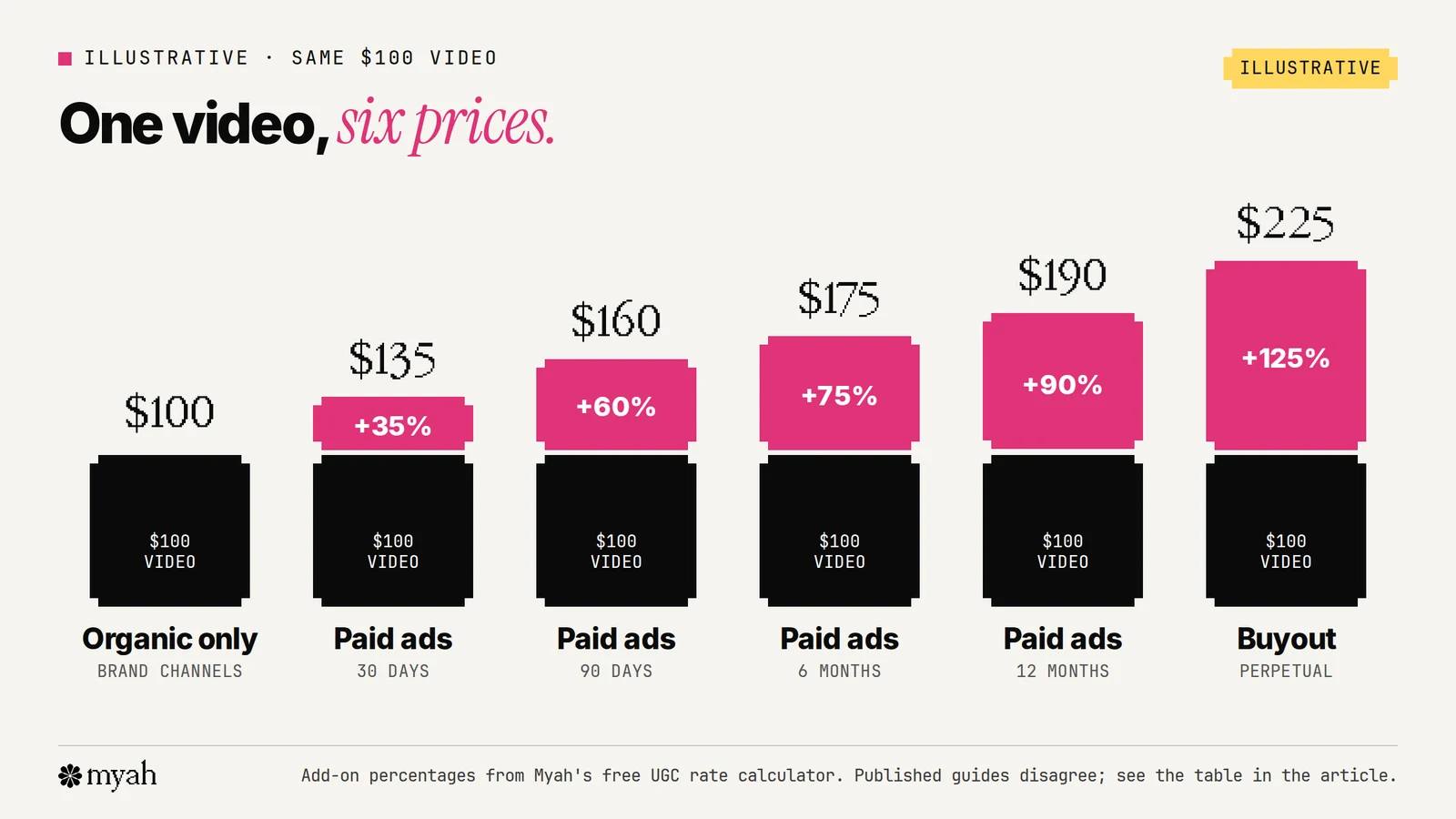
Most deals don't include paid use at all. Of 110 UGC Roster contracts that stated how the video would be used, 68% covered organic posting only, 17% covered paid ads, 13% covered both and 2% included whitelisting. If a brand wants to run your video as an ad, that's the moment to quote for it.
How do UGC creators get paid?
Here are seven ways UGC work is paid. The difference that matters is who carries the risk if the video doesn't sell.
| Pay model | How it works | Who carries the risk | What the data shows |
|---|---|---|---|
| Flat fee per video | A set amount for each approved video | The brand | Pitchlo median $100 per video |
| Project fee | One price for an agreed set of deliverables | The brand | Pitchlo median $150 (1,228 briefs) |
| Monthly retainer | A monthly amount for a set number of videos | Shared | Pitchlo median $400 a month (404 briefs) |
| Usage fee | Extra pay for the brand to run your video as an ad | The brand | 17% of UGC Roster contracts covered paid ads |
| Share of sales | A commission on sales from your link or discount code | You | 24% of UGC Roster campaigns include commission |
| Pay per view | A rate per 1,000 views on posts, often on top of a base | You | viral.app's median is $1 per 1,000 views |
| Gifted product | Free product, no cash | You | 21% of UGC Roster campaigns are gifted only |
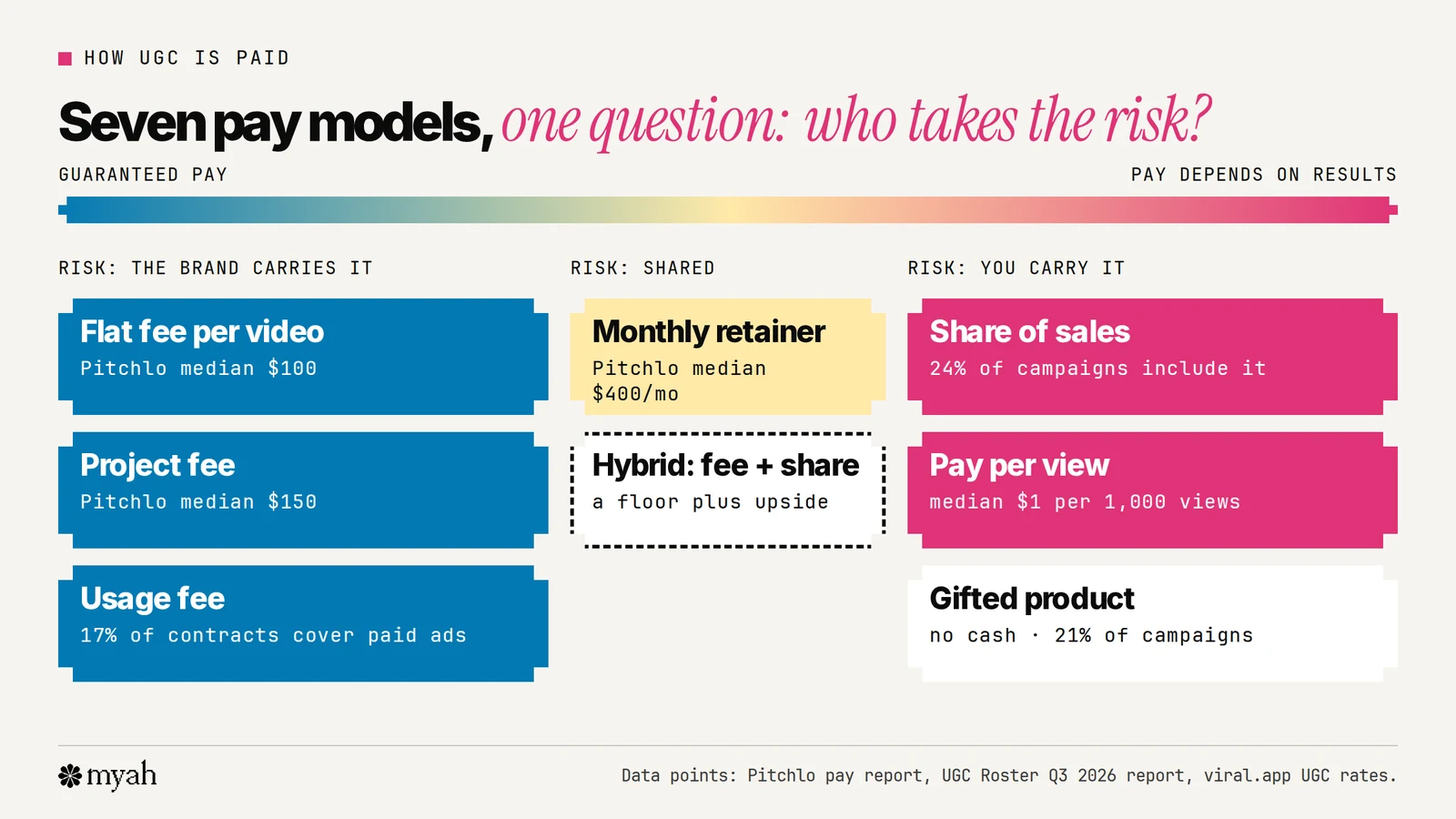
Pay tied to results can pay well: Pitchlo's performance-based briefs had a median of $200 (108 briefs). But a commission-only deal pays nothing if the product doesn't sell, and pay per view rewards videos that travel. A flat fee plus a share of sales gives you a floor and some upside. Our guide to flat fee vs commission works through the maths, and platforms that pay UGC creators on sales compares where commission is on offer.
How long does it take to get paid?
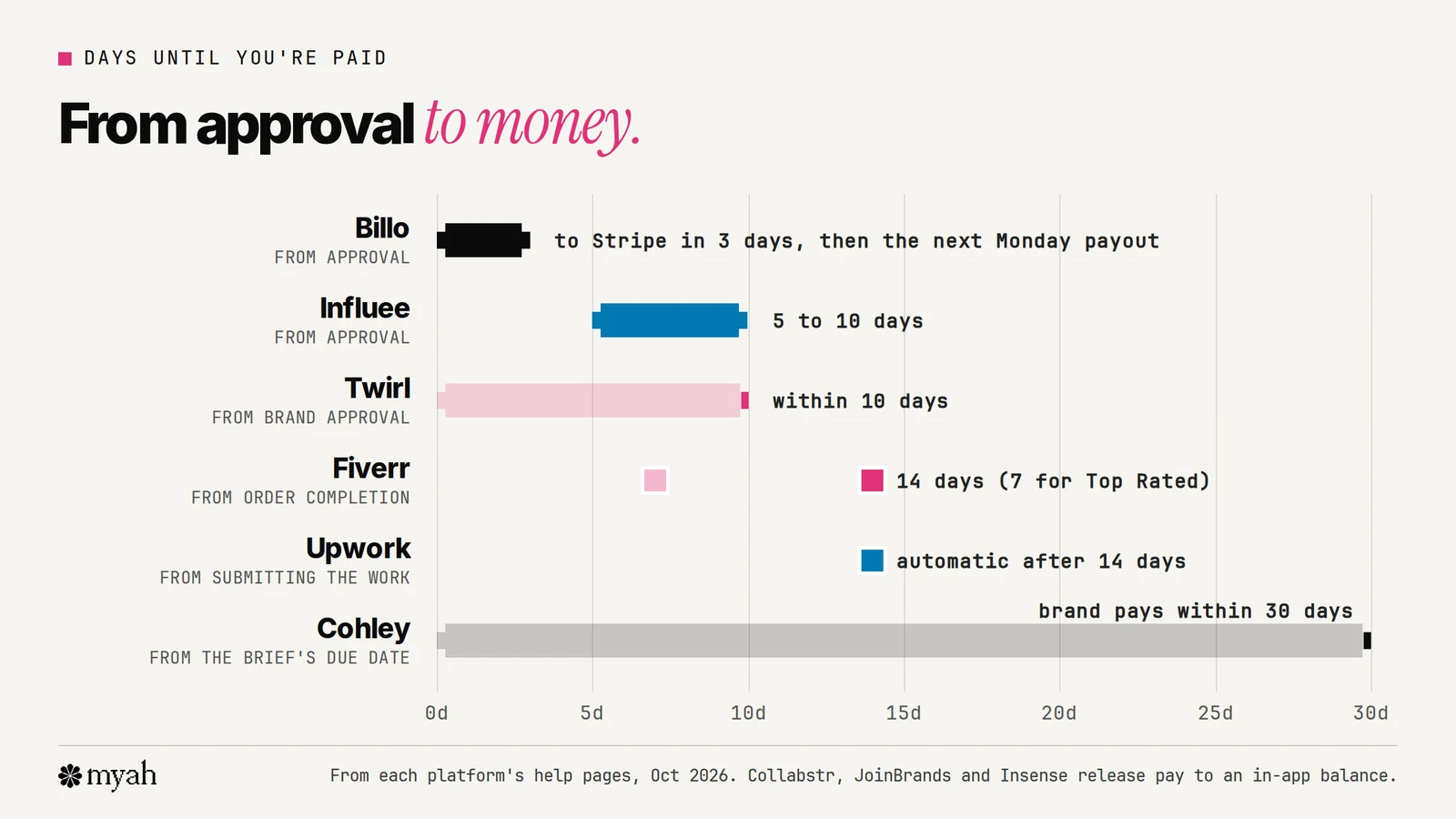
On a platform, you're usually paid within a few days to a month of the brand approving your video. Here's what each platform says on its own help pages.
| Platform | When you're paid | Cut from your pay |
|---|---|---|
| Billo | Moves to your Stripe account within 3 days of approval; Stripe pays out to your bank every Monday | None listed; Billo covers transfer fees |
| Influee | Within 5 to 10 days of approval | None listed for creators |
| Twirl | Within 10 days of brand approval | None ("100% yours"); currency conversion fees can apply |
| Collabstr | Released to your Collabstr balance when the brand approves | 15% commission |
| JoinBrands | Paid to your JoinBrands wallet after the fee is deducted | 20% on job earnings (15% with Creator PRO) |
| Insense | You withdraw from your Insense balance | None; a $3 bank fee on withdrawals under $50 |
| Fiverr | Available to withdraw 14 days after the order is complete (7 days for Top Rated sellers) | 20% (you earn 80% of each order); withdrawal fees vary by method |
| Upwork | On a funded fixed-price milestone, paid automatically 14 days after you submit the work, if the client doesn't release it first | 0% to 15% per contract |
| Cohley | The brand must pay within 30 days of the brief's due date | None; no PayPal fee on a standard payout |
Direct deals with brands, outside a platform, are paid on whatever terms you agree. Put the amount, the due date and what happens if a revision is rejected in writing before you start.
What you actually keep
Three things come off your rate before it's spending money:
- The platform's cut. It ranges from nothing to 20% on the platforms above. If you set your own price, build it in: price = what you want to keep ÷ (1 − the fee). We walk through it in the best UGC platforms for creators.
- Payout and currency fees. Small, but they add up on low-value jobs.
- Tax. In the US, you usually owe self-employment tax once your net self-employment earnings reach $400 in a year, according to the IRS. Set some of every payment aside. This isn't tax advice; check the rules where you live.
Is UGC legit, and is it worth it?
Yes, UGC is real paid work: brands post budgets and sign contracts, as the data above shows. But a lot of what's advertised isn't paid in cash.
- About one in five briefs Pitchlo sees state no pay at all, and it leaves them out of its figures.
- Of 156 labelled campaigns on UGC Roster, 42% paid cash only, 24% included commission, 21% offered gifted product only and 8% offered product plus a fee.
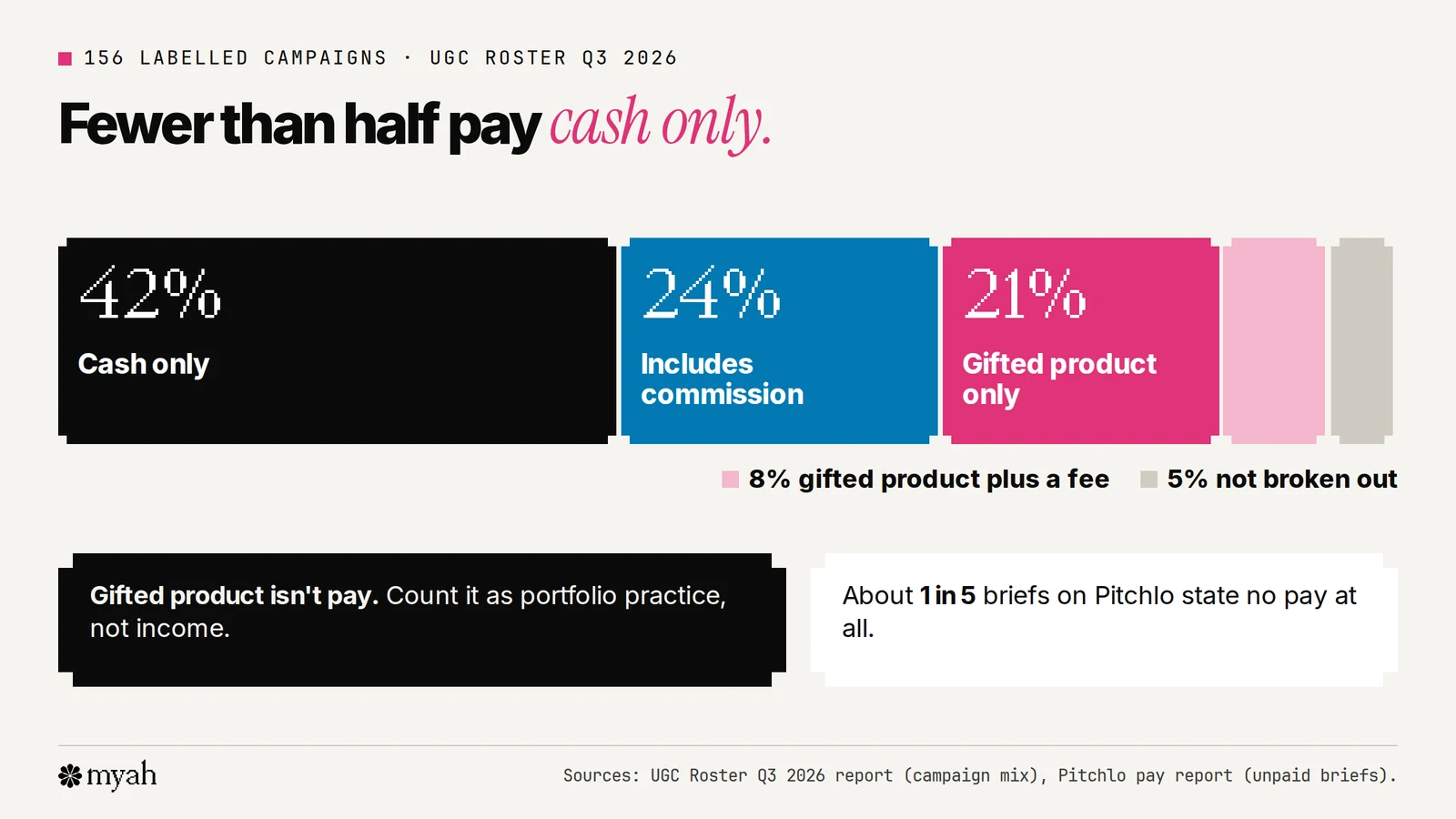
Gifted product isn't pay. It can make sense early on, when you need samples for a portfolio, but count it as practice, not income.
Watch for scams. The FTC warns that scammers pose as brand recruiters, promise free products and big pay, then ask for your bank details or ask you to pay with gift cards, crypto, a payment app or a wire transfer. Don't pay to apply for a brief, and keep payment on the platform: Billo, for example, tells creators not to ask for or accept payments outside it.
If you post a brand's video on your own account, disclose it. The FTC says a material connection includes the brand paying you or giving you free or discounted products.
Is it worth it? It can be, if you treat it as freelance work. Expect to apply to many briefs for each one you win, price every job from the data rather than from hope, and charge separately for paid use. If you want a steady salary from the start, UGC alone isn't that.
Common questions
Do UGC creators get paid?
Yes, on paid briefs. Pitchlo's median advertised offer is $100 per video and UGC Roster's median signed contract is $140. But about one in five briefs on Pitchlo state no pay, and 21% of UGC Roster campaigns are gifted product only, so check the pay before you apply.
How much do UGC creators make per video?
Most offers fall between $50 and $200. Pitchlo's median is $100 across 628 per-video briefs; UGC Roster's median signed contract is $140. Our rate calculator puts experienced creators at $200 to $500, and paid-ad rights add more.
How much should a beginner UGC creator charge?
Start at $50 to $150 for one short, edited video with organic use, then add usage rights, hooks and raw footage as separate lines. Use round numbers. Our UGC rate calculator gives you a starting range.
Do you need followers to make money from UGC?
No. Brands pay for the video, not your reach. On UGC Roster, creators with under 1,000 followers list a median of $167.50, close to the $200 listed by creators with 10,000 to 50,000.
How often do UGC creators get paid?
It depends on the platform. Billo pays creators in the US, UK and Canada weekly, Influee within 5 to 10 days of approval and Twirl within 10 days. On Cohley, brands have up to 30 days after the brief's due date.
Do you have to pay to become a UGC creator?
No. Legitimate platforms don't charge you to apply to briefs. Some sell optional upgrades, such as JoinBrands' Creator PRO, which lowers its fee. If a "brand" asks you to pay to take part, walk away.
Is UGC a full-time job?
For a few creators, but there's no reliable data on how many. Rate reports measure what a video pays, not what creators earn in a year. Salary-site figures above $100,000 are model estimates, not freelance UGC income.
Sources
Platform facts are from each platform's own pages as published in October 2026. Rate data is published by the companies named, which run marketplaces or job boards.
- Pitchlo: UGC pay report (live), How much do UGC creators make?
- UGC Roster: UGC Rates Report Q3 2026
- Collabstr: 2026 Influencer Marketing Report
- viral.app: UGC creator rates
- ZipRecruiter: UGC creator salary
- Launchpoint: UGC and influencer pricing guide
- inBeat: Influencer marketing benchmark report 2026
- Billo: how and when you'll get paid
- Influee: for creators
- Twirl: for creators
- Collabstr: payouts
- JoinBrands: creator fees
- Insense: transaction fees
- Fiverr: payment terms
- Upwork: fixed-price payment protection, freelancer service fee
- Cohley: how creators get paid
- FTC: Influencers: spot a job scam, Disclosures 101 for social media influencers
- IRS: Topic 554, self-employment tax
New to UGC? Start with what UGC is and what UGC creators do, then compare the best UGC platforms for creators.
Myah is a marketplace where brands post paid video campaigns, and each campaign shows its pay before you apply: a flat fee per approved video, a share of sales, or both. Myah is free for creators, and the brand's fee is paid on top, never taken from creator earnings. We're in early access. Join creator early access to set up your profile and portfolio. Early access does not guarantee campaigns, availability or earnings.