

Meta Andromeda retrieves ad candidates before later ranking stages; it is not the whole ad delivery system. Meta's engineering explanation establishes that distinction. The sources reviewed here do not establish a universal UGC production quota. For brands commissioning creator videos, our advice is to brief different buying questions and visible demonstrations, then choose a test that can answer your measurement question. More exports alone are not a creative strategy.
This guide separates Meta's published statements from Myah's planning advice. The fictional lunchbox examples and printable worksheet are briefing tools, not a formula for better ad results.
What is Meta Andromeda, and where does it fit in ad delivery?
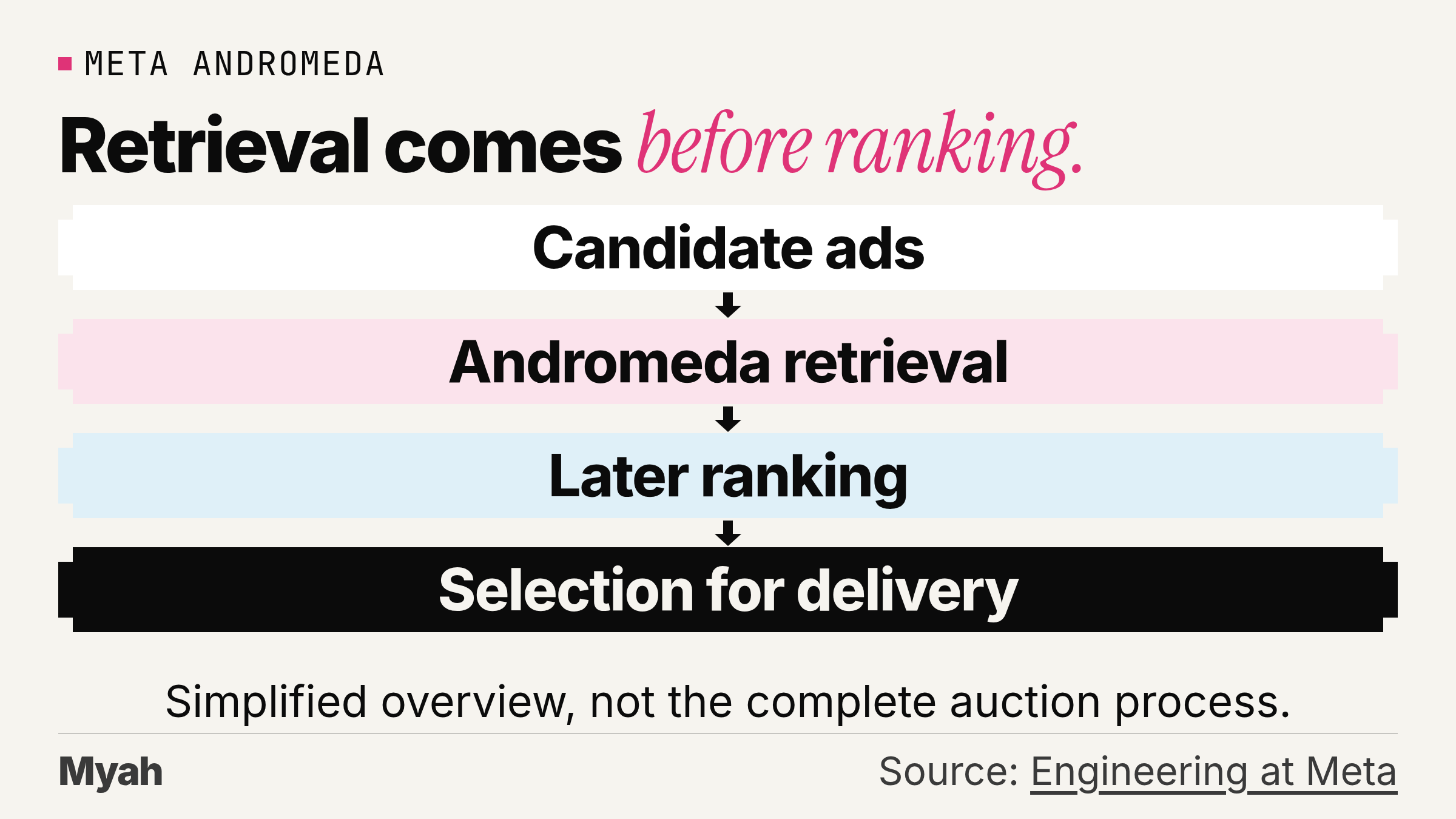
Meta describes Andromeda as an ads retrieval system. Retrieval narrows the candidate pool; larger ranking models then predict value for people and advertisers to determine which ads are shown. That is the useful distinction for a creative team: being considered is not the same as being selected for delivery.
Here is a simplified overview, not the complete auction process:
- Candidate ads: the pool considered for retrieval.
- Andromeda retrieval: narrows that pool to relevant candidates.
- Later ranking: predicts value for people and advertisers.
- Selection for delivery: the final ads to be shown.
Meta connects Andromeda with handling the growing volume and diversity of eligible ads enabled by automation and generative AI. Its Creative Advantage explanation describes that system-level challenge. It does not turn the system's capacity into a production requirement for your brand.
Our practical reading: start the creator brief with what a buyer needs to understand, rather than a guess about what an unpublished algorithm rule demands.
What has Meta said about creative variety, and what does not follow?
Meta defines creative diversification as creating ads with different themes, messages and visuals for different audience segments. Its guidance also distinguishes diversification from iteration. Neither statement establishes that every small edit is worthless or that more content guarantees better results.
Use this evidence table to check the scope of advice before putting it into a creator assignment. The final column is Myah editorial advice, not Meta's instructions.
| Question | What Meta publishes | What that does not establish | Myah editorial advice |
|---|---|---|---|
| Is Andromeda the whole algorithm? | Andromeda handles retrieval before later ranking. Engineering explanation. | A complete account of ad delivery or a guaranteed route to impressions. | Keep architecture separate from the commissioning decision. |
| Does a cosmetic change mean diversification? | Meta describes distinct assets for different personas or use cases, rather than just iterations. Diversification guidance. | A published scoring threshold that tells you whether your edit counts. | Name the different buyer question before requesting another version. |
| Has Meta recommended an ad count? | Meta recommends at least 20 diversified ads specifically in Advantage+ shopping campaigns. Campaign-specific guidance. | A universal Andromeda requirement for every brand or a quota of creator videos. | Preserve the campaign scope when evaluating numerical advice. |
| Does similarity mean iterations are banned? | Meta says similar ads share learning and delivery optimization at the creative level. It also says iteration can inform new concepts. Similarity and iteration guidance. | A duplicate-ad penalty or a rule that only a single version may run. | Keep useful iterations, but distinguish them from new concepts. |
Meta specifically says its ads system groups assets sharing visual and thematic attributes. That is documented behavior, not merely practitioner speculation. The reviewed guidance does not publish a numerical similarity threshold or a duplicate-ad penalty. Do not turn shared learning into a claim that every similar asset gets suppressed.
Does Andromeda mean I need more UGC ads?
Not automatically. The reviewed sources do not establish a mandatory number of UGC concepts or creators for every advertiser. They also do not establish the ideal count for your account.
In Demystifying Creative Diversification, Meta recommends considering a broad portfolio across text, image and video instead of producing and refining a fixed volume of creatives per campaign. That sits alongside the campaign-specific count recommendation above. Neither is a reason to describe all numerical guidance as an agency invention, or to commission an unlimited supply of videos.
Our planning recommendation is to separate concepts, creator assignments, hooks, crops, exports and revisions in the scope. An alternate opening may be useful without answering a new buying question. A new creator may bring relevant experience without changing the underlying concept.
Before commissioning more work, ask: which buyer question remains unanswered, what evidence can the creator show, and can we evaluate the resulting ad? Use your production capacity and measurement resources to scope the assignment. Do not treat those planning choices as an algorithm formula or assume your entire creative portfolio must be UGC.
What counts as a different UGC concept?
For this worksheet, a concept is the buying question, message and demonstration or story that answers it. An execution variation changes how that idea is presented. These are Myah's planning definitions, not Meta's classification system.
The matrix below uses a fictional modular lunchbox. All assignments are illustrative, not completed shoots, customer evidence or tested recommendations. Product details must be verified against the actual sample before filming.
| Buying question and angle | Relevant creator experience | Format | Visible proof and boundary |
|---|---|---|---|
| How would I pack separate foods for work? Angle: work-lunch packing. | Someone who genuinely packs work lunches. | Overhead packing demonstration. | Show the actual sample being packed. Do not invent leakproof or food-safety claims. |
| How does this sample fit into this day bag? Angle: day-bag fit. | Someone who actually carries the bag shown. | Pack-and-unpack routine. | Show that sample and bag together. Do not claim it fits every bag. |
| Which parts come out and fit back together? Angle: removable-parts walkthrough. | Someone demonstrating the supplied sample. | Close-up walkthrough. | Show only what actually detaches and reassembles. Do not invent cleaning or durability claims. |
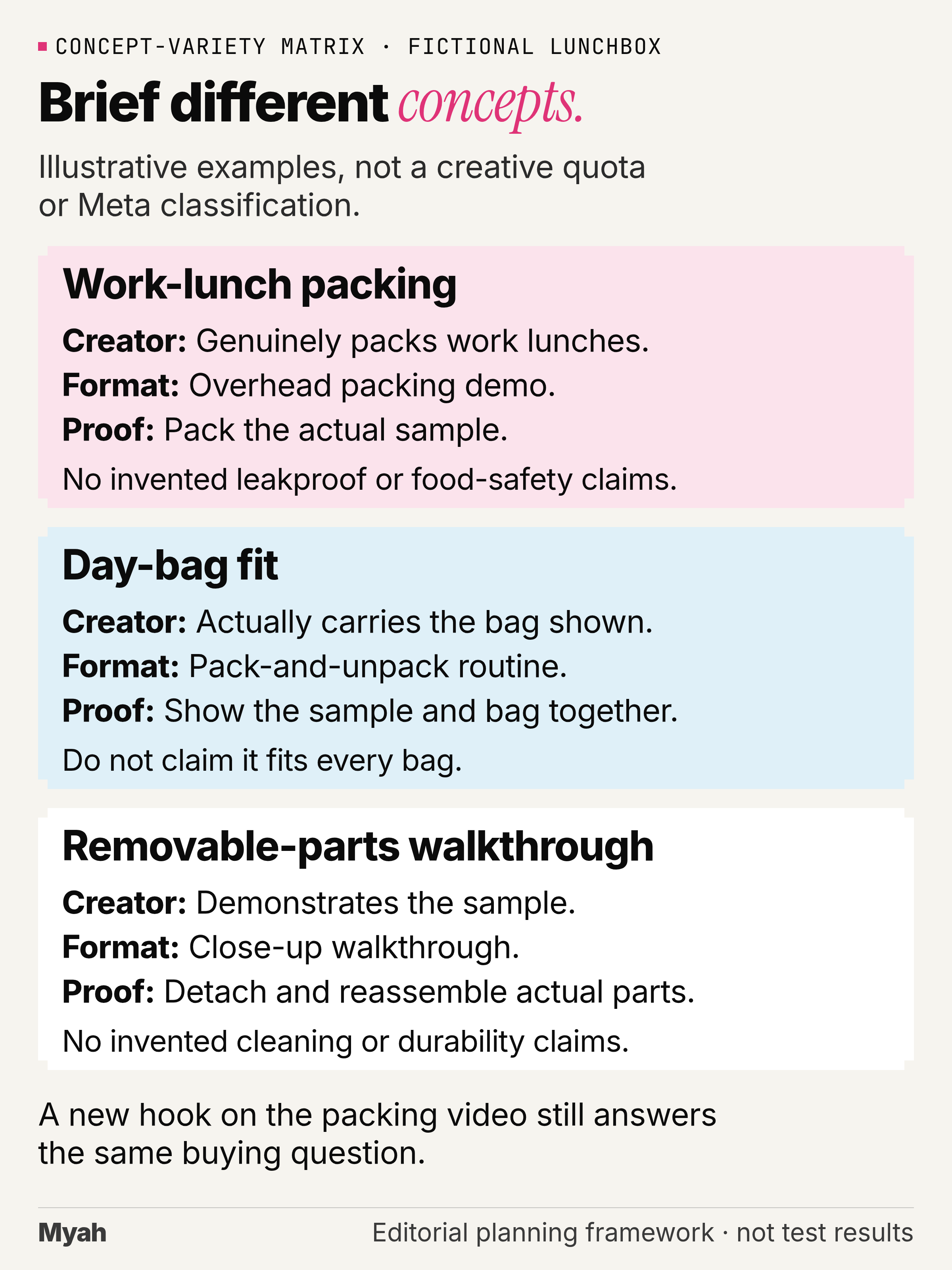
Changing the opening of the work-lunch packing video keeps the same question. Moving from packing food to showing bag fit changes what the viewer learns. Under this rubric, swapping a face, crop or caption alone is not proof of a different concept.
These examples are not a recommended batch size or an instruction to produce every possible combination. Choose assignments that address a real uncertainty about your product. For other presentation options, see our UGC video formats and examples.
How do you turn the matrix into a creator brief?
Turn the chosen row into an observable assignment: what should the viewer understand, and what must the camera show? Keep the approved message narrow enough for the creator to demonstrate truthfully.
For the illustrative bag-fit concept, the core instruction could be:
Show whether the supplied sample fits in the bag you actually use. Film its placement and removal clearly. Describe only what is visible for that bag and sample. Do not claim it fits every bag.
Then agree the deliverables rather than leaving “make some variations” open to interpretation. Copy these fields into your brief or use the printable worksheet:
- Concept ID: Give the idea a stable name for briefs and results.
- Buyer question/use case: State the uncertainty the video should answer.
- Angle and approved message: Write the point the demonstration can support.
- Creator experience needed: Specify relevant experience without inventing a personal history.
- Format and proof shot: Describe the presentation and what must be visible.
- Agreed concepts/hooks/exports/revisions: Record each deliverable separately.
- Intended test question and success measure: Name the comparison and business outcome before production.
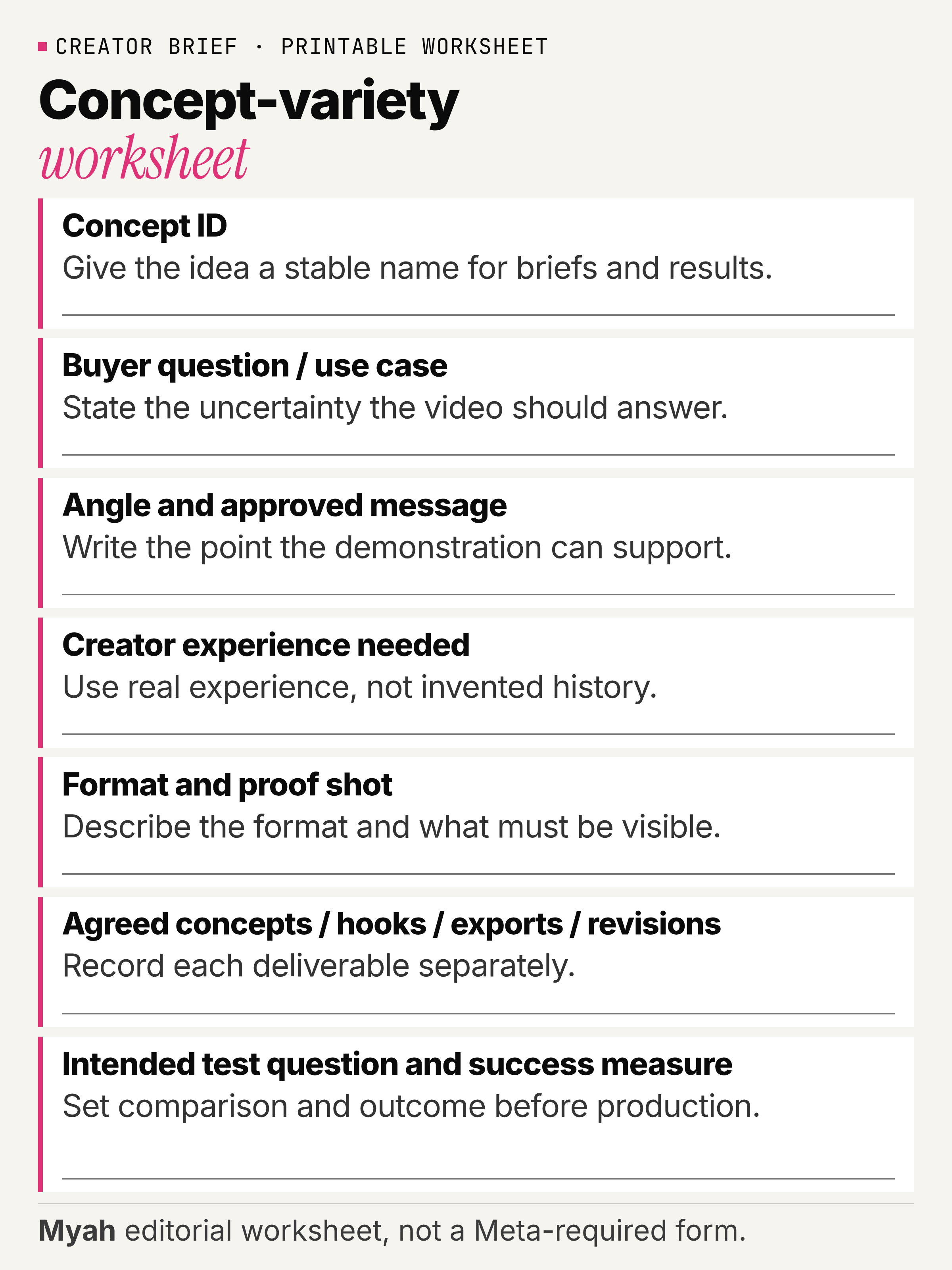
Download the concept-variety worksheet (PDF).
Attach verified product facts, evidence for approved claims and claims to avoid. Agree usage rights, audio, disclosures and acceptance checks before work starts. U.S. FTC guidance says endorsements must reflect the endorser's honest opinions and experience. Advertisers can be liable for misleading or unsubstantiated statements made through endorsements. See the endorsement guidance in the Code of Federal Regulations (PDF). The guidance also says material connections that audiences do not reasonably expect must be disclosed clearly and conspicuously; these can include payment or free products. See the material-connection disclosure guidance (PDF).
Leave room for truthful delivery rather than scripting invented enthusiasm. Accept the commissioned work against the agreed brief, not an unstated promise of advertising performance. Use the copyable UGC brief template for the fuller handoff, and how to hire UGC creators for Meta ads for portfolio selection.
How should you test UGC concepts on Meta?
Choose the question before choosing the method. Exploring which complete creative packages deserve more work is different from isolating whether a particular change caused a difference. The following comparison separates Meta's documented methods from our advice on interpreting them.
| Method | What Meta documents | Useful question: editorial advice | Interpretation limit |
|---|---|---|---|
| Simultaneous campaigns or ad sets without A/B Testing | Meta warns that simultaneous campaigns or ad sets without its A/B testing tool do not receive an even split and can produce inaccurate comparisons. A/B Testing documentation. | Which creative packages warrant further investigation? | Low exposure alone does not establish that a concept is bad. |
| Randomized A/B Testing | Meta divides audiences into random, non-overlapping groups and describes comparisons that differ in a distinct variable. A/B Testing documentation. | Does the specified treatment perform differently under these test conditions? | A package comparison does not isolate its individual components or guarantee a winner. |
Check the current Creative Test requirements in Ads Manager before planning around that feature.
Meta recommends keeping ad sets identical except for the variable being tested in its A/B Testing documentation. Our interpretation for concept planning: a complete creative package can be the treatment you compare, but changing angle, creator and format together cannot identify which component drove a difference.
Write the hypothesis, selected business outcome and comparison conditions before seeing results. For an illustrative lunchbox test, ask whether a bag-fit demonstration or a packing demonstration performs differently on the chosen purchase measure. If the creators and formats also differ, record that you compared packages, not just angles.
Use this editorial record to connect results to the next brief:
- Concept and version: Identify the exact asset.
- Hypothesis and changes: State the question and what differed.
- Comparison conditions: Record the method, audience, offer and relevant setup.
- Delivery received: Record exposure before interpreting outcomes.
- Selected business outcome: Report the measure chosen before the comparison.
- Limitations: Note uncertainty, uneven delivery and bundled changes.
- Next brief decision: Retain, revise, investigate further or mark inconclusive.
Do not force a winner from weak evidence. Our recommendation is to keep “inconclusive” available rather than translating limited delivery into a creative verdict. Use how to interpret hook rate on Meta to investigate attention, not as a substitute for your business outcome.
What should go into your next creator commission?
Choose a buying question you have not covered. Specify the visible demonstration, the relevant creator experience and the agreed deliverables. Decide what comparison would inform the next brief. That gives the creator a concrete assignment without pretending to know an unpublished Andromeda rule.
The worksheet is useful without joining Myah. It is a planning aid, not an automated product feature.
Myah is a UGC marketplace where apps pay creators to post about them. Myah is live and sign-ups are open. Apps post paid campaigns with the pay shown upfront. Creators post approved videos on their own TikTok or Instagram.
See how Myah works for apps, or post a campaign for your app.