

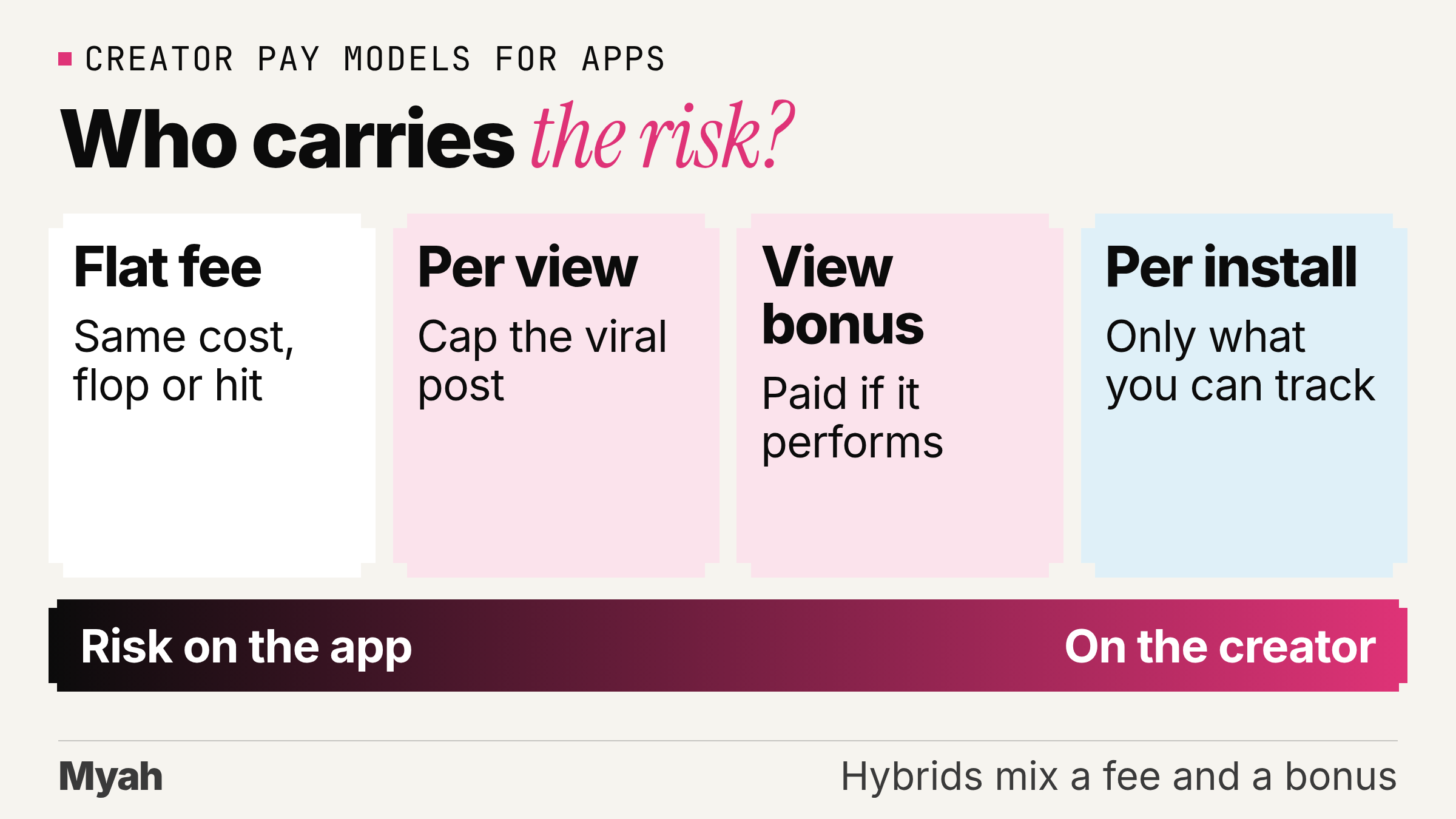
Creator pay models for apps come down to one question: what are you paying for? A flat fee pays for a video and a post. Per view pay, as a rate per thousand views or a bonus at a view target, pays for reach. Per install pay is for an outcome, and only works if you can tell which creator brought each install. For most small app teams, a flat fee per video, often with a view bonus, is the simplest place to start. Per-install deals make sense once your tracking can credit installs to each creator.
Below are the four models side by side, the published rates for each, a worked example that shows who keeps the upside of a viral post, and the terms to put in writing.
The four creator pay models at a glance
| Model | You pay for | Measured by | Who carries the risk | Fits when |
|---|---|---|---|---|
| Flat fee per video | An agreed video, posted by an agreed date | Proof the post is live | You: a post that flops costs the same as one that takes off | You are testing formats and creators, and want a known cost |
| Per view (rate per thousand views) | Views on the creator's post | The platform's view count, under rules you set | Shared: low views cost little, a viral post costs a lot unless capped | You want reach at volume, for example clipping campaigns |
| View target bonus | A post that passes a set number of views | The view count on a cut-off date | Shared: the creator earns the bonus only if the post performs | You want a base fee with an upside the creator can see |
| Per install, trial or subscriber | An install or in-app event credited to the creator | Tracking links, codes and attribution tools | The creator: an install you cannot attribute earns nothing | Your tracking can credit installs to each creator |
Hybrids are common: a base fee plus a view bonus, or a base fee plus a bonus per install. The base covers the creator's time; the bonus rewards the result.
What does each model cost? The published numbers
There is no single market rate, and the published figures measure different things. Read each one with its source and what it counts.
| Model | Published figure | What it measures |
|---|---|---|
| Flat fee | TikTok nano creators (1,000 to 10,000 followers): about $50 to $200 per post or video; micro creators (10,000 to 100,000): about $200 to $800 | Planning ranges in Influencer Marketing Hub's 2026 rate guide, not quotes |
| Per view | A median listed rate of $1.0875 per thousand views across 707 live campaigns on November 10, 2026; TikTok's median was $1.00 and Instagram's $1.20 | Listed rates on Content Rewards clipping campaigns, as Content Rewards published them, not what creators actually received |
| Per sale | Cal AI's public offer: "you get $10 for every signup", paid for every sale rather than every download | One app's affiliate offer, as its co-founder described it on the Sub Club podcast |
The per-view figure is for clipping, where creators repost cuts of existing videos, so it sits far below what a creator charges to film an original app demo. Whop's own guidance for campaign owners says UGC content typically pays higher rates than clipping. Treat the flat-fee ranges as a starting point, and use our UGC rate calculator or UGC creator rates by experience to set a fee.
A worked example: who keeps the upside of a viral post?
The pay model matters most when one video takes off. In this made-up example, an app works with ten creators. Nine posts get 20,000 views each and one gets 1,000,000, so every model below pays for the same 1,180,000 views.
| Pay model | How it adds up | Total cost | Cost per thousand views |
|---|---|---|---|
| Flat fee of $150 per video | 10 × $150 | $1,500 | $1.27 |
| $5 per thousand views, no cap | 9 × $100, plus $5,000 for the viral post | $5,900 | $5.00 |
| $5 per thousand views, capped at $1,000 per video | 9 × $100, plus the $1,000 cap | $1,900 | $1.61 |
| $100 base, plus $150 at 100,000 views | 10 × $100, plus one $150 bonus | $1,150 | $0.97 |
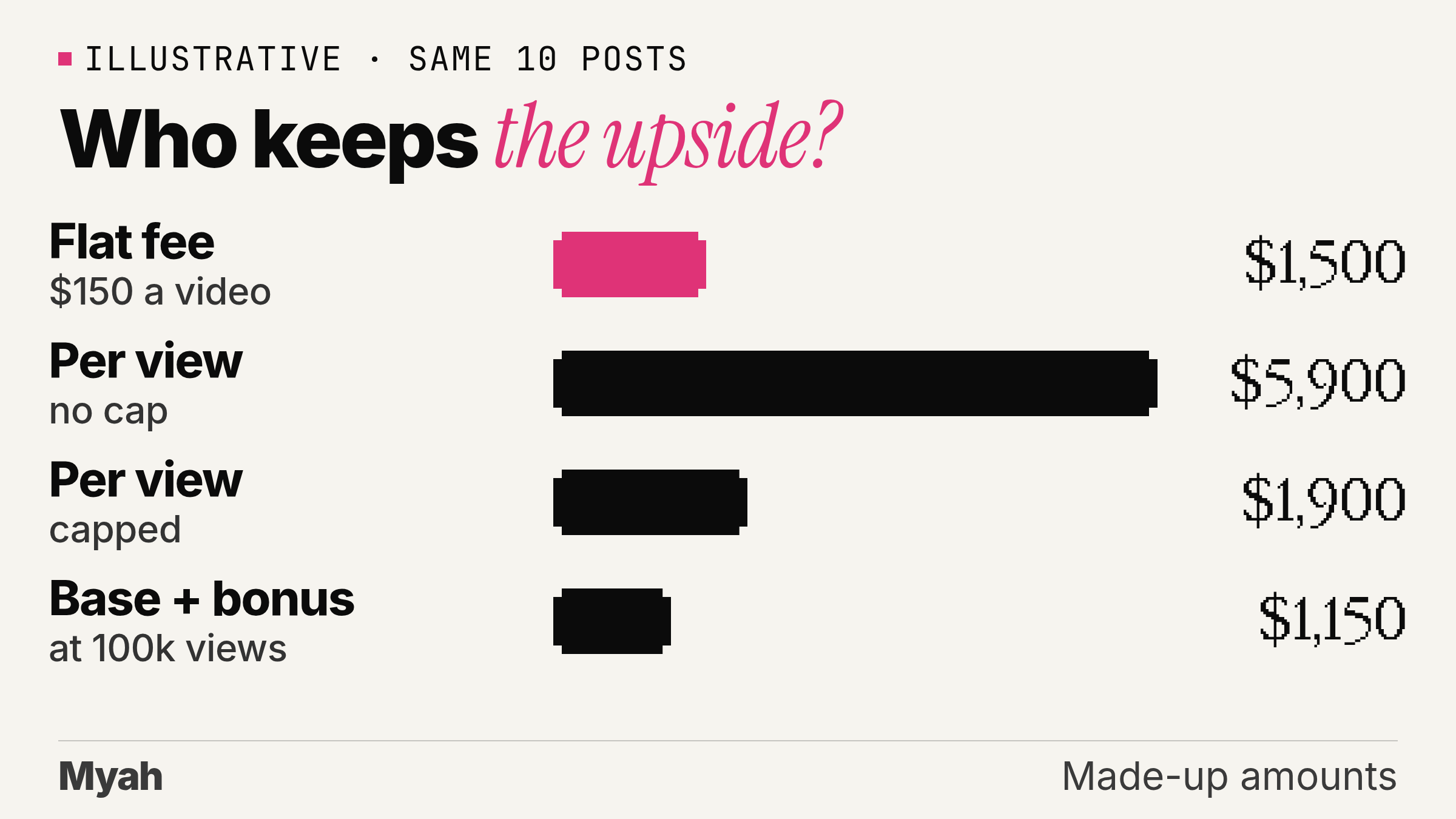
Under a flat fee, the app keeps all the upside of the viral post. Under an uncapped per-view rate, the creator does. Caps and view-target bonuses sit in between. This is the reasoning Cal AI's co-founder Jake Castillo gave for flat fees: "whenever possible, I would try to do flat rate deals because it allows you to capture the asymmetry that is algorithmic content."
The trade-off is that a flat fee costs the same when a post flops. And the cheapest line in the table, a low base plus a bonus, only works if creators accept it: a $100 base is less than many of them charge to film a video at all.
How do you set a fair number? Start from what a view is worth
Cal AI's rule of thumb is to work out how much revenue your app makes per thousand views of creator content, and never pay more than that. In Jake Castillo's words: "you can't pay a CPM that is higher than that RPM, otherwise you are guaranteed to not be profitable."
Early on, while creators are your only marketing, you can estimate it from the days after each post:
- Note the post's views a few days after it goes up.
- Note the new revenue in the same period, above your normal baseline.
- Divide revenue by views, then multiply by a thousand. That is your revenue per thousand views.
- Set the ceiling. A creator whose posts average a given number of views is worth, at most, that number of thousands times your revenue per thousand views.
For example, with made-up numbers: a post with 50,000 views followed by $150 of new revenue gives $3 per thousand views, so a creator who averages 50,000 views is worth up to $150 a video at break-even. Once several creators post on the same day, this gets harder to separate, which is where tracking comes in.
Why is per-install pay harder than it sounds?
Paying only for installs looks safe for the app, but someone has to prove each install came from a creator's post, and the tools for that have limits.
| Method | What it records | What it misses |
|---|---|---|
| App Store campaign link per creator | Apple counts a First-Time Download when a user downloads within 24 hours of using the link | Anyone who installs later, or finds the app by searching. Data shows only once a metric reaches 5. |
| Custom product page per creator | Page views, downloads and conversion rate for that page in App Store Connect | Viewers who never tap through to that page |
| Google Play Install Referrer | The referrer URL and the click and install timestamps | Installs that did not start from the creator's link |
| Promo code | Everyone who enters the creator's code | Everyone who installs without entering it |
| Attribution tool links | Link-level installs and in-app events across iOS and Android | On iOS, tracking across other companies' apps needs the user's permission under App Tracking Transparency |
Apple also says that if a user clicks more than one campaign link, only the most recent one gets credit for later sales. So a viewer who sees two creators and installs through the second credits only the second.
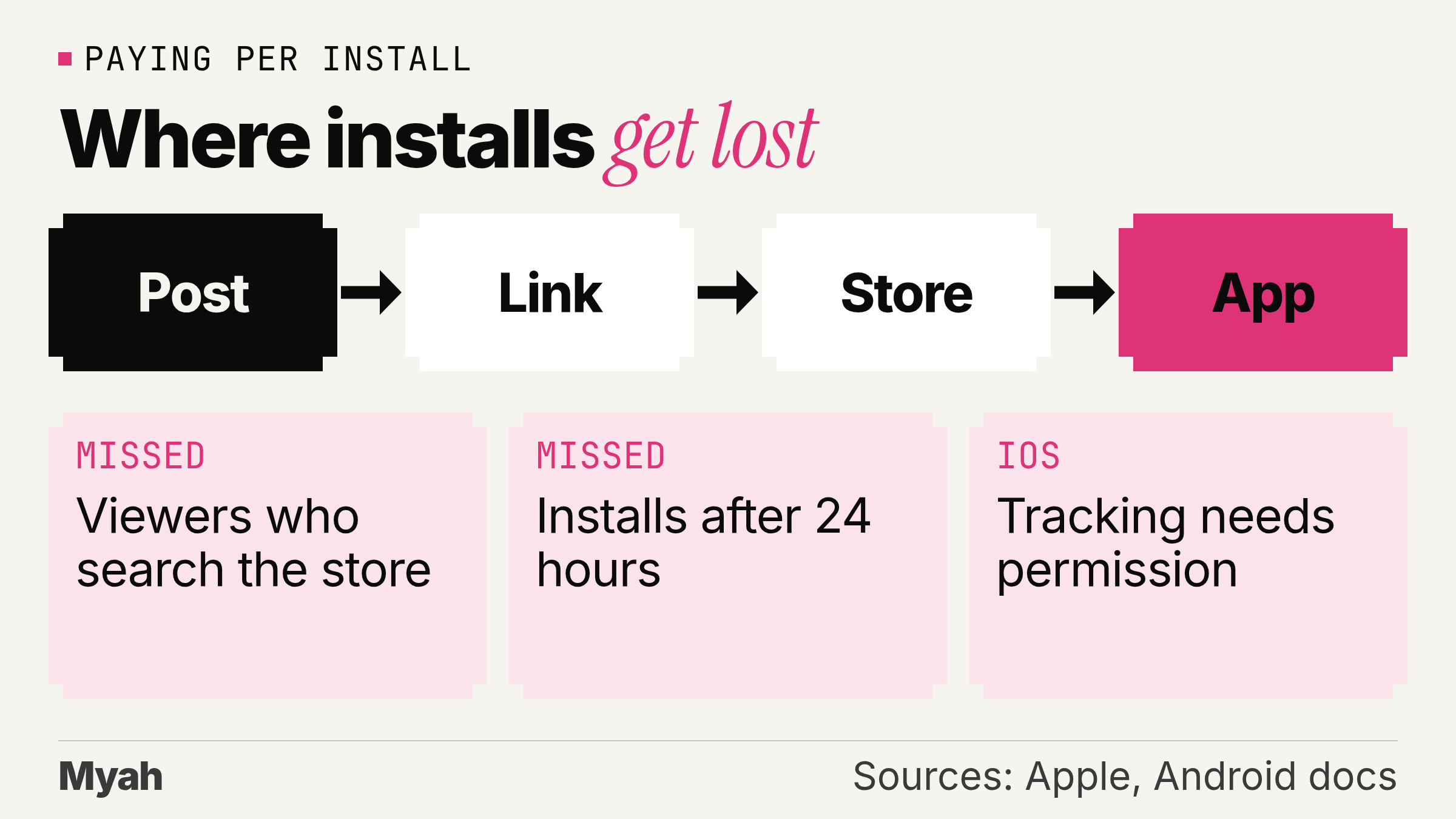
The upshot: under a pure per-install deal, the creator is paid only for installs your tracking can see. Many creators will want a base fee as well. Jake Castillo put it plainly: "attribution is so murky with organic marketing." If you do pay per install, define the tracking method and attribution window in the agreement before the video goes up.
What should a creator pay agreement say?
Whichever model you choose, write these down before filming starts:
- Deliverable: how many videos, length, platform, and the posting date.
- Base fee: what is paid for an approved, posted video, and when.
- What counts as a view: the platform's own count, on which date, and that bought or inflated views do not count.
- Rate and cap: the rate per thousand views or the view target, and the most one video can earn.
- Installs or sales, if paid: the tracking link or code, the attribution window, and how refunds are handled.
- How long the post stays up, and whether you can use the video in your own ads.
- Disclosure: the post is labelled as paid.
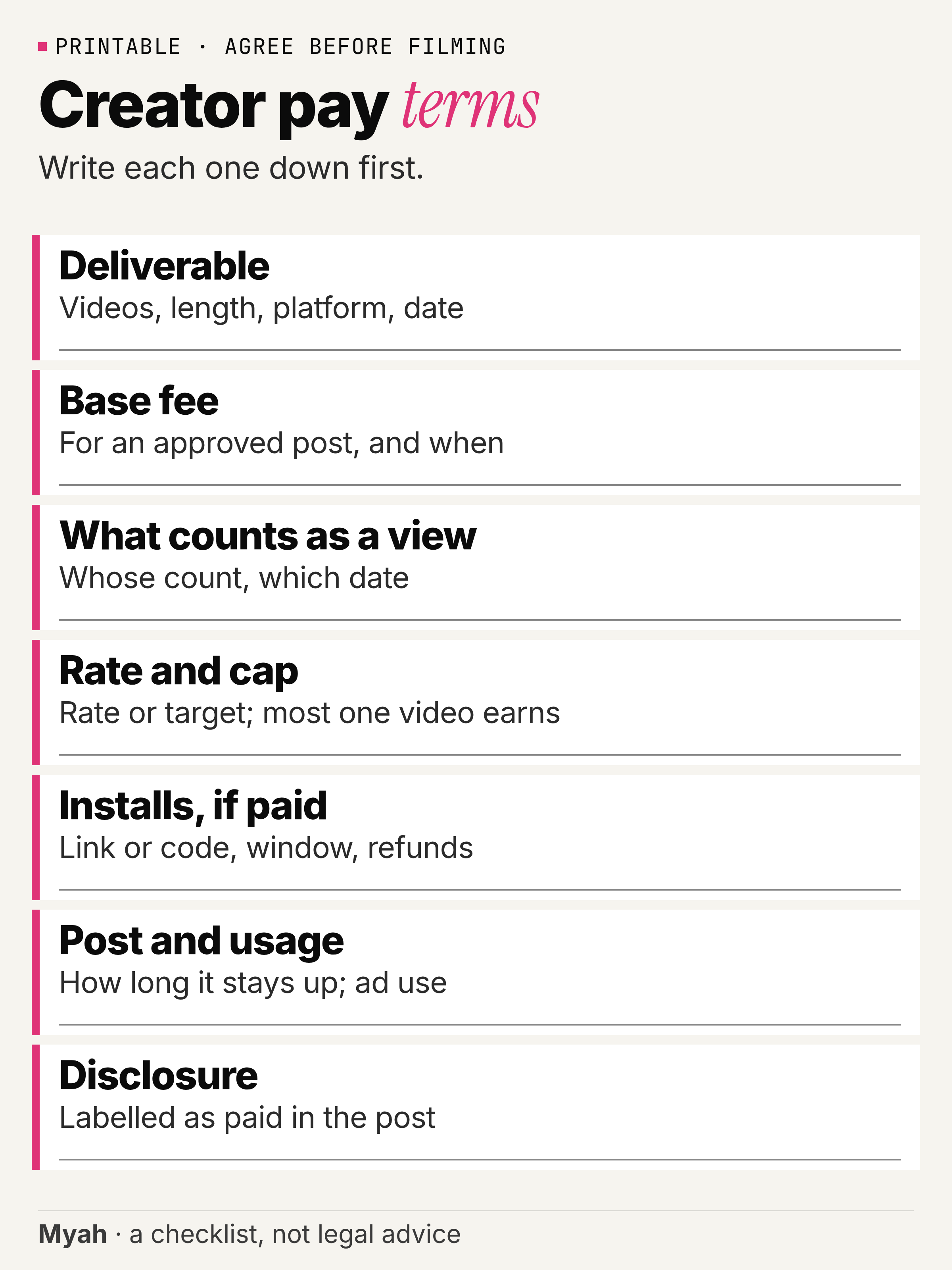
Download the creator pay terms sheet (PDF).
On disclosure, the FTC says creators should disclose any financial relationship with a brand, including free products, and that terms like "ad" or "sponsored" are often enough if they are hard to miss. TikTok requires creators to turn on its content disclosure setting when they promote a brand for payment, and Instagram requires creators to tag the business partner when there is an exchange of value. For the rights side of the deal, see UGC usage rights for paid ads.
Where Myah fits
On Myah, each campaign shows its pay before a creator applies: a set fee per approved video, pay when a post reaches a view target, or both. Myah tracks the views on each creator post from its link, and bought or inflated views don't count. Pay per install is coming, but it does not exist yet. There is no subscription, and Myah's fee is 10% on top of what you pay creators.
Common questions
Should I pay TikTok creators per view or a flat fee for my app?
Start with a flat fee per video if you are still testing which creators and formats work; you know the cost and keep the upside of a hit. Add a view bonus when you want creators to share in the results.
Is pay per install possible with creators?
Yes, if you can credit installs to each creator with campaign links, codes or an attribution tool. Expect gaps, and expect many creators to ask for a base fee as well.
What is a fair rate per thousand views?
It depends on the work. Listed clipping rates on Content Rewards centred on about a dollar per thousand views in November 2026, and original UGC usually pays more. Your own ceiling is the revenue your app makes per thousand views.
What is a hybrid creator deal?
A base fee for the video plus a bonus tied to results, such as a view target or installs. It splits the risk between you and the creator.
Do I need to cap per-view pay?
If you pay per view, yes. Without a cap, one viral post can use up most of a campaign budget, as the worked example shows.
Pick the model that matches what you can measure
Pay for what you can see. If you can only see views, pay per video or at view targets. If you can credit installs to each creator, add an install bonus on top of a base.
Myah is a UGC marketplace where apps get creators posting about them. Post one campaign, approve every video, and pay per video or at view targets.