

To get brand deals with consumer apps, choose an app you can demonstrate honestly and pitch how you would explain a specific feature. Decide whether you are offering video production or a post on your own account, link relevant work and ask about a paid brief. Start with what you can make, not a promise of installs.
Can you get brand deals without a large following?
A small audience need not stop you from applying. On Myah, apps choose creators by their portfolios; a large following is not required to apply. That is a marketplace-specific statement, not a promise that every platform or brief accepts every account. See how applications work.
First, separate what you are offering. These are practical scope descriptions, not rigid industry definitions; production skill and audience value can overlap.
| Offer | What you propose | What to clarify |
|---|---|---|
| Content-only production | An edited file for the app's agreed channels | No posting on your own account included |
| Creator-posted video | Make a video and publish it on your named account after approval | Account, format, approval and posting requirements |
| Audience-led sponsorship | A post with a proposal based partly on your existing viewers | Relevant audience evidence, not guaranteed distribution |
Myah jobs involve posting approved videos on your own TikTok or Instagram, not just delivering a file. The workflow is different from a content-only arrangement made directly with an app.
If you are starting from scratch, focus your portfolio on clear demonstrations and honest explanations. Our guide to getting started as a creator covers the broader preparation.
Which apps should you pitch, and who should you contact?
Start with an app category you understand: perhaps planning, language learning or personal productivity. Look for a feature you can explain through a viewer's question, rather than sending “I'd love to collaborate” to every app you find.
Read the app's official feature pages and try the relevant workflow before claiming personal experience. If you have not used it, say what you want to explore, not that it changed your life. Do not infer a marketing budget from an active social account.
Use the app's published creator application route or an appropriate business contact on its official site. Follow any instructions about submissions. Avoid scraped private addresses, mass mailouts and pitching through customer support when a dedicated route exists.
Keep a shortlist with these copyable fields:
- App and official URL:
- Observed feature and supporting page:
- Viewer question and proposed video concept:
- Relevant work link:
- Published contact or application route:
- Production-only or creator-posted scope:
- Status and any stated reply date:
In the US, a publicly listed business email address does not by itself establish affirmative consent to commercial email. The CAN-SPAM Act defines that consent as the recipient expressly agreeing to receive the message. Check the US email safeguards below before sending.
What should a brand pitch email say?
Use a descriptive subject, a truthful reason for fit, a concrete video idea, a relevant work link, clear posting scope and an easy next-step question. Give the app team enough information to discuss the work without asking them to invent your offer.
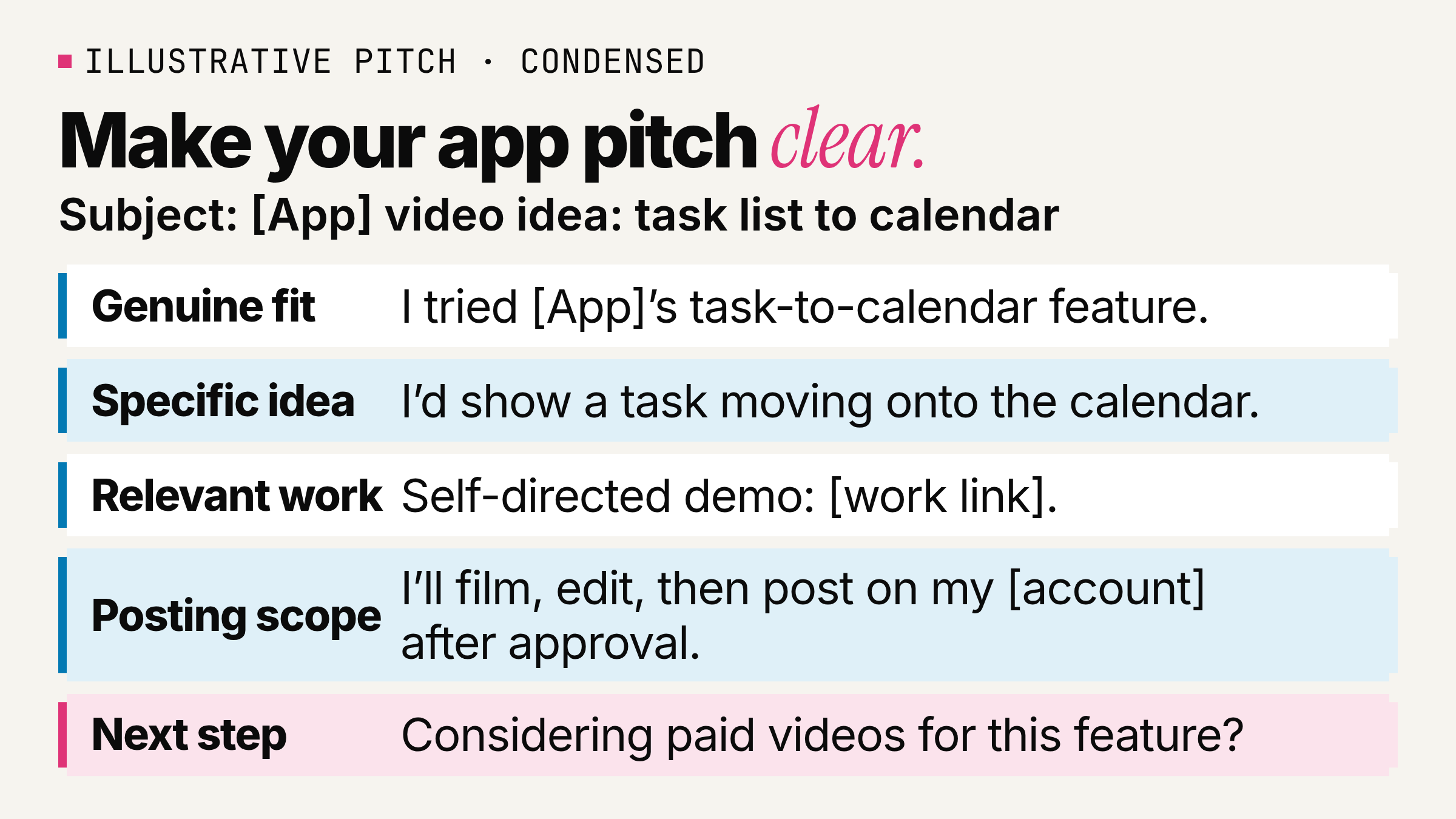
This planning-app email is illustrative, not real outreach. Use its calendar idea only if the target app supports it and you have tried it.
Subject: [App] video idea: from task list to calendar
Hi [Name],
I tried [App]'s task-to-calendar feature and would like to pitch a paid video showing that workflow.
I'd open with an unscheduled task list, then show how I place a task on the calendar. Here's a related self-directed demo: [work link].
The proposed scope includes filming, editing and posting the approved video on my [TikTok or Instagram account].
Are you considering paid creator videos around this feature?
[Name]
- Genuine fit: name a feature you actually tried.
- Specific idea: describe what the viewer will see.
- Relevant work: link a demo and label self-directed work honestly.
- Posting scope: say who publishes and where.
- Next step: ask about a paid brief, not a guaranteed deal.
Other subject patterns: “[App] paid video proposal: [viewer question]” or “Creator application for [brief name].” Avoid false reply prefixes and invented familiarity.
Need work to link? Build a portfolio before your first client, label self-directed projects and test playback while signed out. The initial pitch starts a conversation; it does not settle payment or permissions.
Which pitch template fits your situation?
These five templates are illustrative starting points, not tested outreach or real replies. Replace every bracketed field, remove anything you cannot substantiate and add the applicable sender footer below.
1. Your first paid app job with a small audience
Use this when your demonstration work is more relevant than your audience size. Do not pretend self-directed work was a client assignment.
Subject: Paid [App] video idea for [viewer problem]
Hi [Name],
I'm a creator focused on [topic], building a small audience on [account]. I'm looking for my first paid app project.
I'd like to make a video showing [verified feature] through [specific viewer problem], then post it on my [TikTok or Instagram account] after approval.
Here's a self-directed demo showing my filming and explanation style: [link]. It was not client work.
Is this concept relevant to a paid creator brief you're considering?
[Name]
2. Content-only production
Use this for a separate direct arrangement to deliver a file. It does not include publishing to your audience.
Subject: Paid video production for [App]'s [feature]
Hi [Name],
I make app demonstration videos about [topic]. I'd like to propose an edited video showing [verified workflow] for [viewer question]. Relevant work: [link].
This proposal is for production and file delivery for your agreed channels, not posting on my own account. We'd agree formats, revisions and content-use permissions before work begins.
Are you accepting paid production proposals for this feature?
[Name]
3. An existing relevant audience
Use this only when you have evidence of audience fit. Replace the analytics field with documented information or remove it; do not invent a metric to complete the template.
Subject: [App] video proposal for my [topic] audience
Hi [Name],
I publish [content topic] on [account]. My audience's connection to [app use case] is [documented evidence, with analytics source and reporting period].
I'd like to propose a paid post demonstrating [verified feature] through [video concept]. Here's relevant work: [link].
The offer includes production and approved posting on [account], with no guaranteed reach or installs.
Would you consider this audience and concept for a paid brief?
[Name]
4. A genuine existing app user
Use this when you can describe your own use accurately. Enjoying an app does not require you to offer unpaid promotion.
Subject: Paid video idea from a [App] user
Hi [Name],
I use [App] for [truthful personal use case]. In particular, I've used [feature] to [accurate description, without unsupported results].
I'd like to pitch a paid video walking through that process, including [specific demonstration detail]. Relevant work: [link].
I propose filming, editing and posting the approved video on [account]. I'd agree the scope before production.
Are you considering paid creator work around this use case?
[Name]
5. A response to a published paid brief
Use the requested application channel. Match the stated requirements instead of sending a generic cold pitch or replacing the listed pay with an unrelated offer.
Subject: Creator application: [paid brief name]
Hi [Name or team],
I'm applying for [brief] through [requested route]. My work matches [stated requirement]: [relevant link and explanation].
I've read the listed pay and scope. I can meet [requirements you can genuinely satisfy], including approved posting on [requested account/platform] within [stated timeline].
My proposed approach is [concept that follows the brief]. Could you clarify [unresolved point] before I commit?
[Name]
For commercial email, adapt this illustrative footer where applicable, including on follow-ups. Supply valid details and monitor the opt-out route. This is not a globally compliant legal form; a footer alone does not establish permission to send.
[Sender name / business]. This is a solicitation for paid video services. To stop future marketing emails from me, reply “no thanks”. [Valid business postal address].
When should you follow up on a pitch?
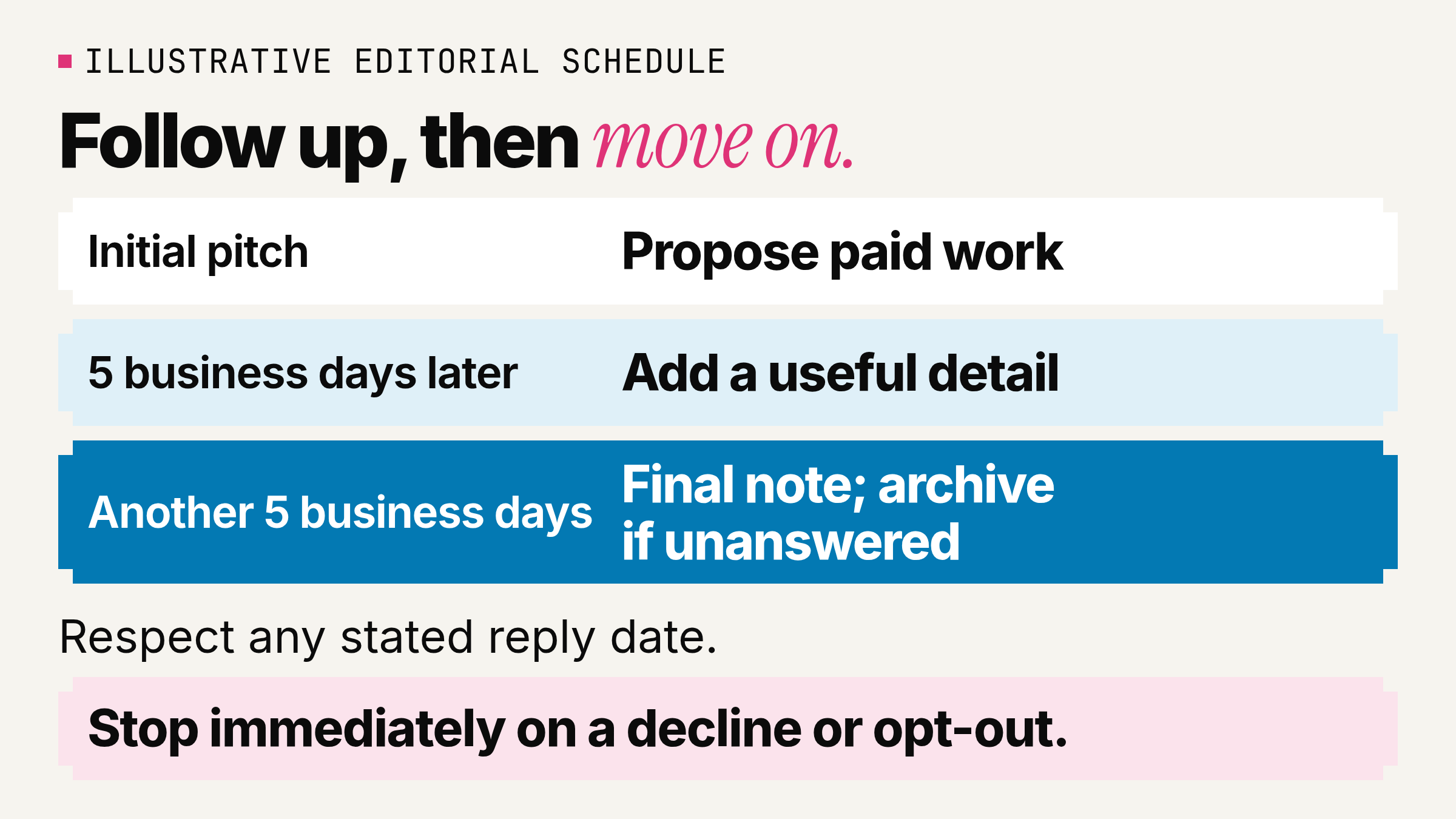
Use a limited plan, then move on. The schedule below is an illustrative editorial choice, not a measured best time to get replies. A recipient's stated review date takes precedence.
| Timing | Purpose | Action | Stop or override |
|---|---|---|---|
| Initial pitch | Propose paid work | Send the adapted email | Complete contact and compliance checks first |
| Five business days later | Add something useful | Send a relevant concept detail | Respect any stated reply date |
| Another five business days later | Close the loop | Send a final short message | Archive if unanswered |
| At any decline or opt-out | Respect the recipient's choice | Stop immediately | Never switch channels to evade it |
Illustrative first follow-up:
Hi [Name], following up on my paid [App] video proposal. A detail I'd add: [relevant demonstration detail], so viewers can see [specific action]. Is this relevant to a brief you're considering? [Name]
Illustrative final follow-up:
Hi [Name], I'll close out my [App] proposal for now. If you want to revisit it, the concept and work link are below. Thanks for considering it. [Name]
Do not add guilt, a false deadline or another channel to force a response. Keep declines and opt-outs recorded so you do not accidentally restart outreach.
What should you agree before accepting a brand deal?
Turn an interested reply into a written scope before filming. Use these negotiation prompts, not assumed contract terms:
- Deliverables, formats and the account that will publish.
- Approval process, revision limits and deadlines.
- Fee, payment trigger and payment date.
- Permitted uses of the video and any exclusivity.
- For view-dependent pay, the target, measurement source and conditions.
Do not promise a view target will be reached. The UGC rate calculator is an optional estimating aid, not evidence of what an app will pay. Review these questions to ask about content usage rights before granting permissions.
Plan truthful disclosure before posting. US endorsement guidance says endorsements must reflect the endorser's honest opinions, findings, beliefs or experience. Unexpected connections that could materially affect an endorsement's credibility must be disclosed clearly and conspicuously. Payment can be a material connection. See the official Endorsement Guides.
TikTok requires its content disclosure setting to be turned on when you post content promoting a brand, product or service. Follow its promotional-content guidance. A platform label does not automatically satisfy the US clear-and-conspicuous disclosure standard. The official guidance includes an example of an inadequate built-in disclosure.
What should you check before sending?
Use this pre-send checklist:
- The app and contact are correct.
- The feature observation is genuine.
- The offer explicitly concerns paid work.
- Posting scope and account are clear, or file-only delivery is explicit.
- The relevant work link plays while signed out.
- Experience and audience details are truthful.
- There are no unsupported results or promises.
- The next-step question is easy to answer.
- The contact route and applicable marketing rules have been checked.
A cold email promoting your paid video services can count as commercial email under US law. See the statutory definition. For unsolicited US commercial email, use truthful sender information and nondeceptive subjects, identify the solicitation, provide a clear working opt-out and include a valid physical postal address. These are key safeguards in the US commercial-email requirements, not a complete compliance checklist.
Prior affirmative consent is an exception to the US solicitation-identification requirement, not to the opt-out or postal-address requirements. See the statutory exception. This guide covers US rules and is general information, not legal advice.
Use the printable planner or copy these fields:
- App / official URL / observed feature:
- Viewer question / video concept:
- Relevant work link:
- Who posts / paid scope:
- Contact route / next-step question:
- Follow-up status / reply date / stop instruction:
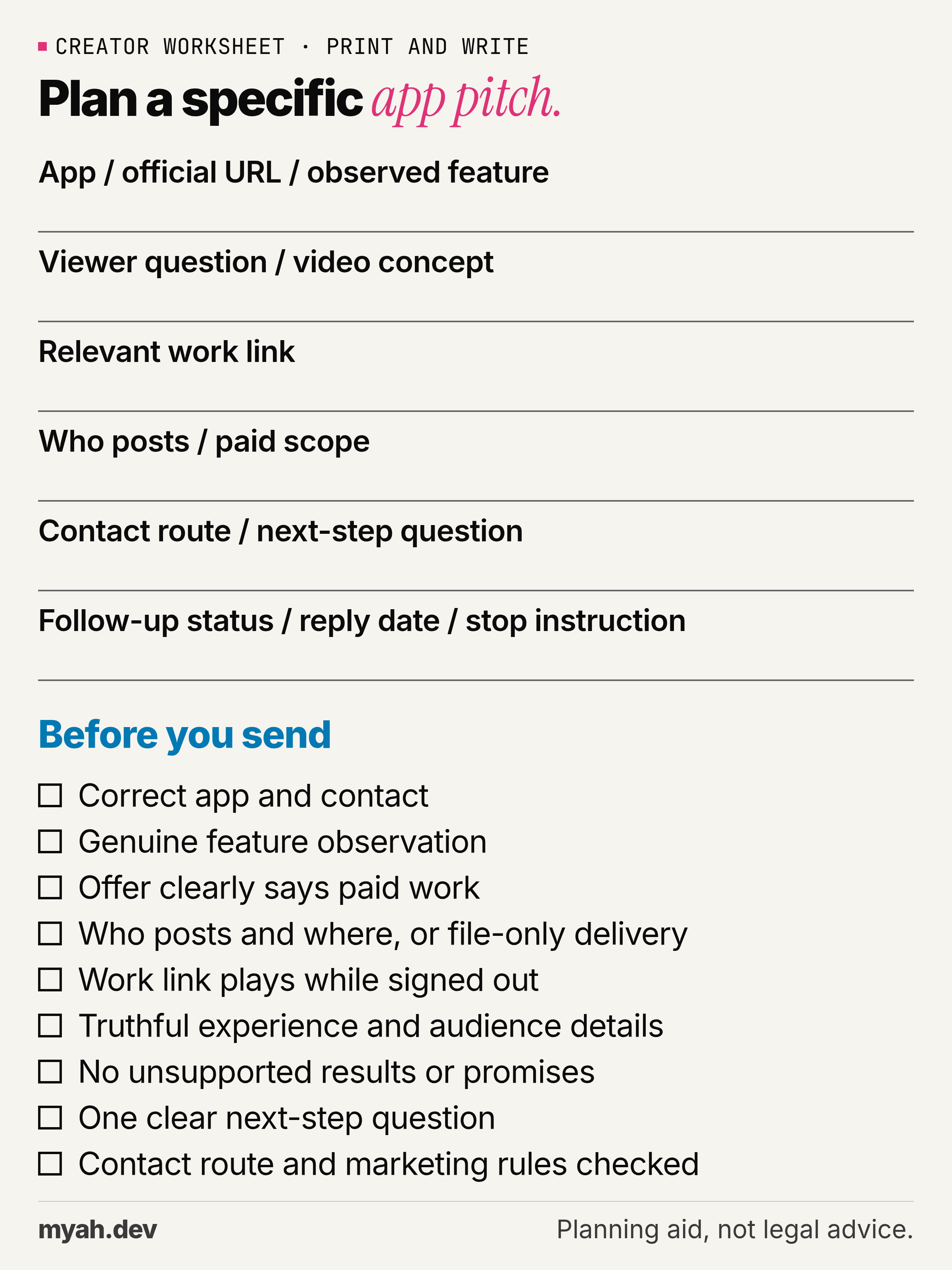
Download the printable pitch planner and checklist. It is a static PDF, not a fillable form; the complete email templates are on this page.
How can you find paid app jobs alongside direct pitching?
Choose a relevant app, adapt a template and test your work link before sending. You can also apply to posted jobs rather than relying only on cold outreach. Neither route guarantees selection.
Myah is a UGC marketplace where apps pay creators to post about them. Apps post paid jobs with the pay shown upfront, and you post approved videos on your own TikTok or Instagram. See the creator workflow.